Congress leader and Leader of Opposition in the Lok Sabha Rahul Gandhi has questioned the National Testing Agency (NTA) over its decision to re-conduct the UGC-NET examination for English, Commerce and Sociology, asking why it took nearly two months for authorities to identify problems in the question papers. His criticism came after the NTA announced that candidates appearing for the three affected subjects would have to take the examination again in September following complaints about multiple errors.
The controversy has put renewed focus on examination quality, question-paper verification and the wider issue of confidence in national-level competitive examinations. The NTA has said that an expert committee examined complaints concerning the three papers and found issues serious enough to warrant fresh examinations rather than simply resolving individual questions through the usual answer-key challenge process.
Rahul Gandhi’s intervention has added a political dimension to the issue. His criticism centres not only on the errors themselves but also on the delay between the original examinations and the decision to conduct a re-test.
Table of Contents
Rahul Gandhi Questions NTA Over UGC-NET Re-Conduct
Rahul Gandhi criticised the NTA following its announcement that the UGC-NET papers for English, Commerce and Sociology would be conducted again. In his remarks, he directly questioned Prime Minister Narendra Modi over the functioning of the examination agency and argued that students were being made to bear the consequences of faulty question papers.

The Congress leader’s central question was straightforward: if the papers contained serious errors, why did it take so long for the authorities to act?
The question is significant because the affected students had already invested considerable time preparing for the examination, travelled to examination centres and completed the original test. A re-examination means repeating that entire process, including preparation and the logistical arrangements associated with appearing for a national-level examination.
For candidates, the issue is therefore not limited to incorrect spellings or repeated questions. It concerns the reliability of the examination system and whether problems can be identified and corrected quickly enough to prevent unnecessary disruption.
What Happened in the UGC-NET June 2026 Examination?
The UGC-NET June 2026 examination became controversial after candidates began reporting problems in some question papers.
UGC-NET is a national-level examination conducted by the NTA on behalf of the University Grants Commission. It is used to determine eligibility for categories including Junior Research Fellowship, Assistant Professor positions and admission to PhD programmes, depending on the candidate’s performance and applicable criteria. The examination has been conducted by the NTA in computer-based mode since December 2018.
The June 2026 examination covered a large number of subjects. However, complaints regarding the quality of the question papers were particularly prominent in English, Commerce and Sociology.
Candidates reported problems including repeated questions, spelling and language errors, translation issues and concerns about question quality. Earlier reports from July documented allegations concerning the English and Sociology papers, including claims that a substantial number of English questions had appeared in an earlier examination.
The complaints eventually led the NTA to examine the matter through a committee.
Why Were English, Commerce and Sociology Papers Cancelled?
The NTA’s decision was based on complaints about multiple errors in the three papers.
According to reports, the agency’s committee concluded that the problems were sufficiently widespread that they could not simply be addressed by dropping a few defective questions during the answer-key challenge process. As a result, a fresh examination was considered necessary to protect fairness among candidates.
The decision means that candidates who appeared for the affected papers must sit for another examination.
Reports indicate that the re-examinations for English, Commerce and Sociology are scheduled for September 9 and 10, 2026. Candidates affected by the decision will not have to pay another examination fee for the re-test. The remaining 84 subjects are not covered by the re-examination decision.
The distinction is important because the NTA has not cancelled the entire UGC-NET June 2026 examination.
Rahul Gandhi Questions the Two-Month Delay in UGC-NET Re-Exam
The most prominent criticism from Rahul Gandhi concerns the timing of the NTA’s decision.
The original examination for the affected subjects was held earlier in the summer, while the decision to conduct a fresh examination came later. During this period, candidates had already completed the test and were waiting for the next stages of the evaluation process.
The delay raises several questions about the examination system.
First, how quickly are question-paper complaints reviewed?
Second, what quality-control procedures are applied before and immediately after an examination?
Third, when candidates report serious errors, how long should authorities take to determine whether the complaints are genuine?
And finally, could an earlier review have prevented candidates from spending additional time and money preparing for an examination that would eventually be repeated?
These questions are now part of the wider debate over the NTA’s examination management.
Candidates Had Already Flagged Problems
The concerns did not emerge only after the NTA’s latest announcement.
Reports from July show that candidates had already raised concerns about the English and Sociology papers. In the Sociology examination, candidates alleged several spelling, language and translation mistakes. Examples reported at the time included misspellings of names of prominent scholars and problems with translated questions.
The English paper also attracted attention because candidates alleged that many questions had been repeated from an earlier examination. One report cited a candidate’s claim that 67 of the 150 questions were identical to questions from an earlier paper. These claims were part of the complaints that contributed to the controversy and should be distinguished from findings formally established by the authorities.
The sequence is important. Candidates raised concerns, discussions spread publicly, and the issue continued until the NTA eventually announced a re-examination.
That timeline explains why the question of delay has become central to the political debate.
Rahul Gandhi has cited this sequence while questioning the NTA’s response.

What Does the Re-Examination Mean for Students?
Rahul Gandhi has argued that students should not have to bear the consequences of such errors.
For affected candidates, the re-test creates a mixed situation.
On one hand, a fresh examination can provide a more equal opportunity if the original papers were genuinely compromised by widespread errors. A properly prepared new paper could ensure that all candidates compete under the same conditions.
On the other hand, students must prepare again for an examination they believed they had already completed.
Many candidates may have moved on to other academic commitments, employment-related plans or preparation for other competitive examinations. Repeating a major examination requires additional time, concentration and planning.
There can also be practical costs. Students may need to travel to examination centres again and rearrange their schedules.
The NTA’s decision not to charge an additional examination fee addresses one part of the burden, but it does not eliminate the time and logistical costs associated with appearing for another examination. The September re-test therefore remains a major concern for affected candidates.
Why Question-Paper Accuracy Matters
The concerns raised by Rahul Gandhi also bring attention to the importance of accuracy in national examinations.
The controversy highlights why question-paper preparation is one of the most important stages of any competitive examination.
A question paper is expected to meet several basic standards. Questions should be factually accurate, clearly worded and consistent with the prescribed syllabus. Translations should convey the intended meaning, while answer options should be checked carefully.
Even a small mistake can create confusion. When errors occur across a significant number of questions, however, they can potentially affect the fairness of the entire examination.
This becomes especially important in UGC-NET because candidates are competing for academic eligibility and research opportunities.
The examination can influence a candidate’s path towards academic careers, including eligibility for Assistant Professor positions and, under applicable categories, Junior Research Fellowship and PhD-related opportunities.
Rahul Gandhi’s Criticism Puts NTA Under Renewed Scrutiny
Rahul Gandhi’s criticism has added to the scrutiny already facing the agency.
The UGC-NET controversy comes at a time when the NTA is already under considerable public scrutiny over the management of major examinations.
The agency has faced criticism in connection with examination-related controversies, including the cancellation of other major tests. The latest UGC-NET decision has therefore revived questions about whether stronger quality-control mechanisms are needed before question papers are administered to candidates.
The NTA is an autonomous organisation under the Department of Higher Education, Ministry of Education, and conducts several major national examinations.
Because of the scale of its responsibilities, errors in one examination can quickly become a national issue.
The UGC-NET case also demonstrates the importance of responding to candidate complaints through a transparent and time-bound process.
Rahul Gandhi and Opposition Demand Greater Accountability
Rahul Gandhi’s criticism reflects the broader opposition argument that students should not be made to pay the price for administrative mistakes.
The Congress has questioned the functioning of the NTA and the government’s oversight of national examinations. Rahul Gandhi’s intervention has brought the issue into the political spotlight at a time when students and academic communities are already debating the reliability of competitive examination systems.
However, the political criticism and the administrative investigation are separate matters.
The NTA’s committee has made the decision to conduct a fresh examination based on the complaints and its assessment of the affected papers. Whether the agency’s processes were sufficiently fast or effective is a broader question that can be evaluated through the timeline and the systems used to review complaints.
What the NTA Must Address Next
The re-examination itself is only one part of the solution.
The questions raised by Rahul Gandhi also make the NTA’s future quality-control measures important.
The NTA will also need to ensure that the new papers undergo stronger verification before being presented to candidates.
That could include multiple rounds of subject-expert review, careful checking of translations, verification of factual information and systematic comparison with earlier question papers.
The objective should be to ensure that the September examination does not face similar complaints.
For candidates, clarity will also be important. Authorities need to communicate the re-examination schedule, examination centres, admit-card arrangements and other relevant instructions well in advance.
The affected candidates have already experienced uncertainty once. A clear and predictable process for the re-test would help reduce further disruption.
A Larger Test of Examination Credibility
The UGC-NET controversy is ultimately about more than three subjects.
National examinations depend heavily on trust. Candidates prepare for months because they believe that the examination will be conducted under clear and equal conditions.
When a paper is later declared unsuitable for evaluation, that trust can be affected.
The decision to conduct a re-examination may therefore be viewed as an attempt to restore fairness. At the same time, the controversy shows that preventing errors in the first place is preferable to correcting them after thousands of candidates have already appeared.
This is why Rahul Gandhi’s question about the delay has gained significance. The issue is not merely whether the NTA eventually identified the problems, but whether the system could have detected them earlier.
What Happens Next?
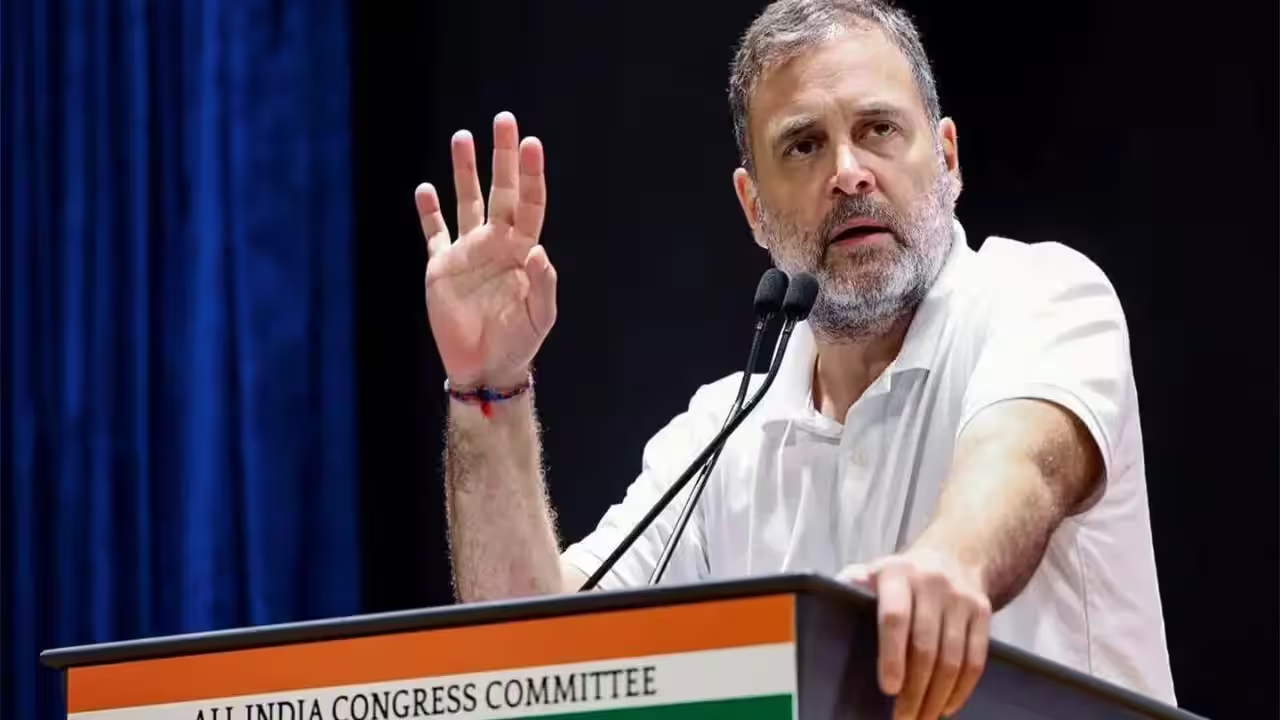
The developments will also determine how Rahul Gandhi and the opposition respond to the NTA’s next steps.
The immediate next step is the re-conduct of the UGC-NET examinations for English, Commerce and Sociology.
The reported September 9 and 10 schedule gives affected candidates a limited period to prepare again. No additional examination fee is expected to be charged for the re-test, while the other subjects remain unaffected by the decision.
Candidates should follow official NTA and UGC-NET communications for the final schedule, admit-card information and examination instructions.
The NTA’s official UGC-NET platform provides examination-related updates, while the agency’s broader website carries notices concerning its examinations.
The issue has also become politically significant after Rahul Gandhi questioned the examination process. The decision to re-conduct UGC-NET papers for English, Commerce and Sociology has opened a fresh debate over examination quality and accountability. The NTA says complaints about multiple errors prompted a committee review and led to the conclusion that a fresh test was necessary rather than simply correcting individual questions.
For Rahul Gandhi and the Congress, however, the central issue is why the problems took so long to be addressed. His criticism has placed the delay at the heart of the political debate, while affected candidates face the practical task of preparing for the examination once again.
The re-examination could help restore fairness to the affected candidates, but the larger challenge for the NTA is preventing similar errors from reaching examination halls in the first place. Stronger question-paper verification, quicker complaint assessment and clearer communication could be crucial to rebuilding confidence.
For thousands of UGC-NET aspirants, the September re-test is now another important stage in an examination journey that they expected to have already completed. The outcome will not only determine their academic eligibility but could also influence the wider debate over how India’s major competitive examinations are prepared, monitored and corrected when things go wrong.