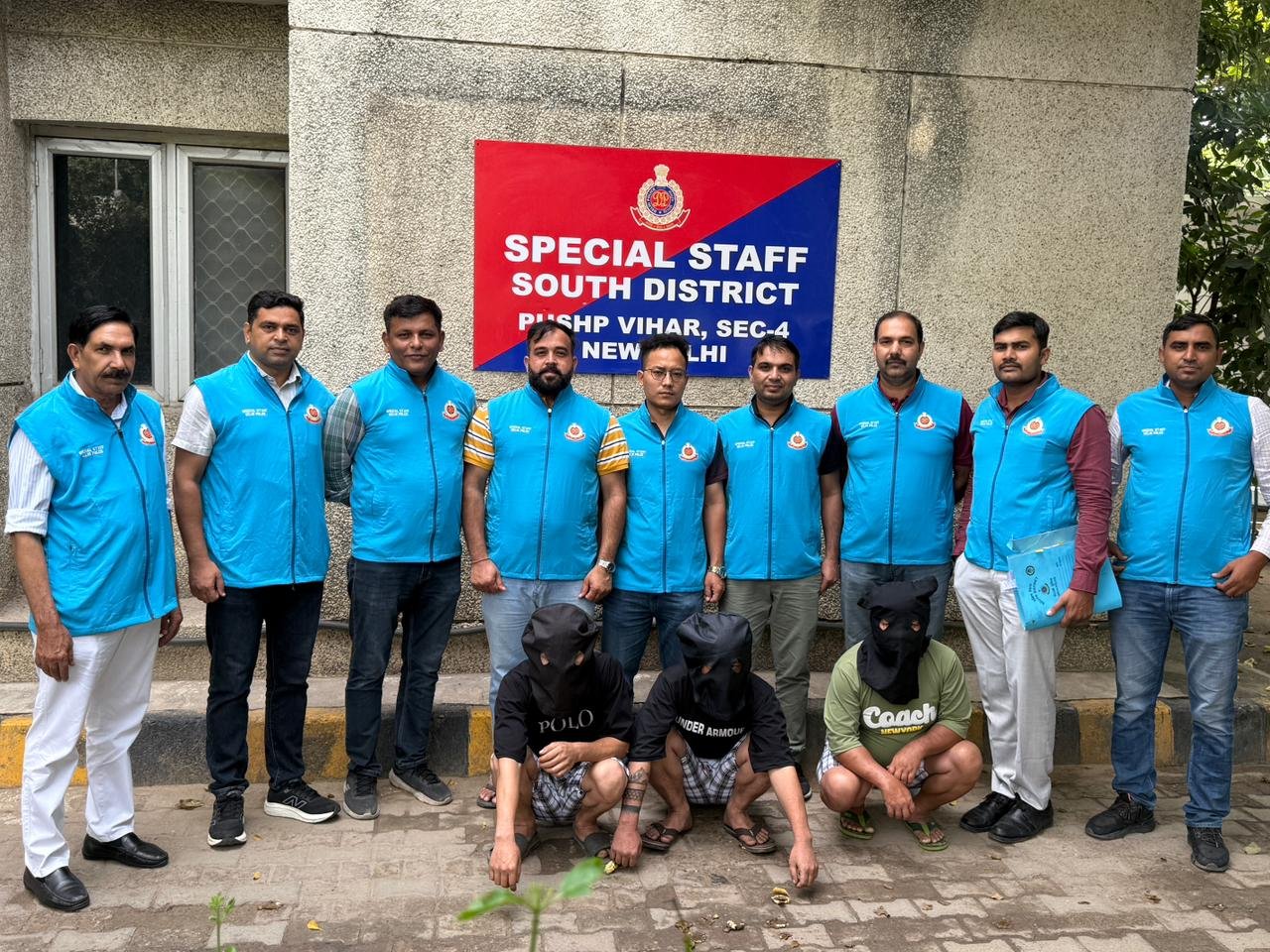
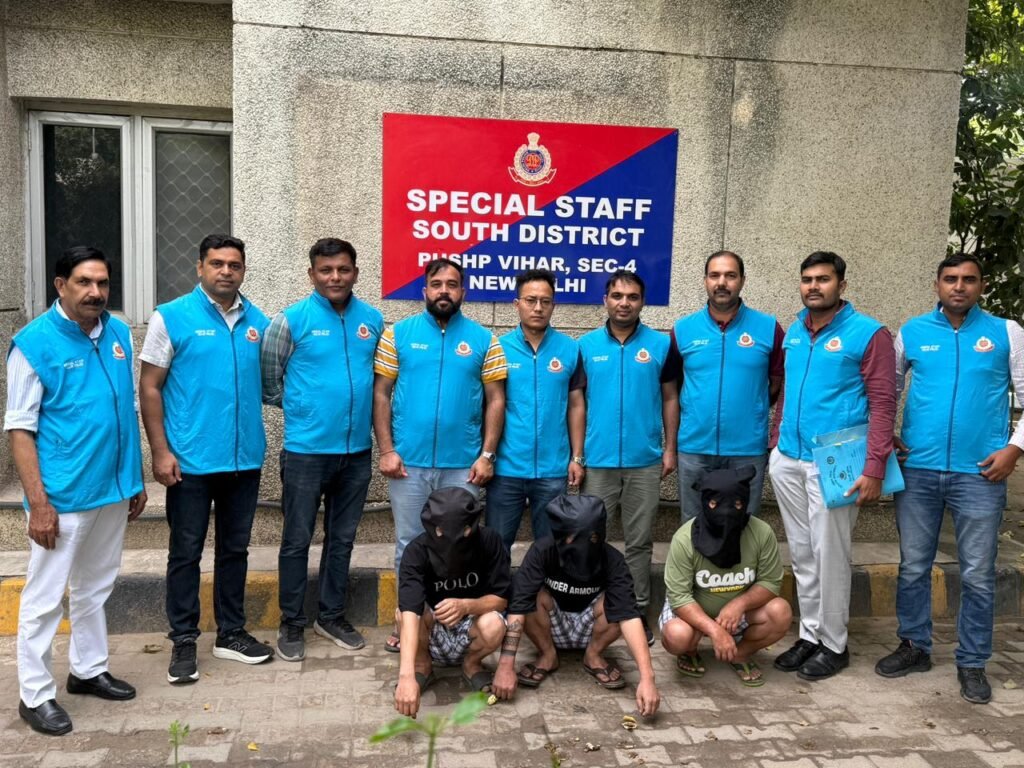
International Drug Trafficking Network has suffered a major setback after Delhi Police’s Special Staff, South District, dismantled an alleged cross-border narcotics syndicate and seized 8.598 kg of high-quality Charas worth nearly ₹9 crore in the international illicit market. Acting on specific intelligence, police arrested three Nepalese nationals who were allegedly operating a sophisticated drug distribution network linking the Indo-Nepal border to Delhi NCR. The operation not only led to one of the biggest Charas recoveries by the South District in recent times but also exposed the alleged use of WhatsApp, digital banking platforms, and covert delivery methods to run the illegal trade, marking a significant achievement in Delhi Police’s ongoing fight against organized narcotics trafficking.
The seized narcotics have an estimated value of nearly ₹9 crore in the international illegal market, making this one of the most significant drug seizures by the South District in recent times. Beyond the quantity recovered, investigators believe the operation has exposed a larger International Drug Trafficking Network that relied on cross-border supply routes, encrypted communication through WhatsApp, and digital banking channels to distribute narcotics across Delhi NCR.
The successful operation highlights the growing capability of Delhi Police in tackling organized crime through intelligence gathering, surveillance, and coordinated field action. It also demonstrates the increasing importance of technology-driven investigations in combating modern drug syndicates.
Table of Contents
Major Blow to an International Drug Trafficking Network
According to Delhi Police, the operation was initiated after the Special Staff received credible secret information suggesting that three Nepalese nationals residing in Kotla Mubarakpur were actively supplying Charas in different parts of Delhi NCR.
Rather than conducting immediate arrests, officers first verified the intelligence and developed the information through surveillance and technical monitoring. This patient approach enabled investigators to identify the suspects’ activities before launching a carefully planned raid.
On June 29, 2026, the Special Staff conducted the operation at the suspects’ residence in Kotla Mubarakpur. During the search, police recovered a total of 8.598 kilograms of Charas, a quantity that falls under the commercial category as defined by the NDPS Act.
All three accused were arrested at the spot, while the recovered narcotics were seized following legal procedures.
Following the recovery, Delhi Police registered FIR No. 129/2026 under Sections 20, 25 and 29 of the NDPS Act at Police Station Kotla Mubarakpur, and further investigation was initiated.
The case is now being investigated as part of a much larger International Drug Trafficking Network that extends beyond Delhi and reportedly has links to Nepal.
Who Are the Accused?
Police have identified the three arrested accused as:
- Bharat Thapa (32), originally from Arghakhanchi District in Nepal.
- Govind Budha (32), also a resident of Arghakhanchi District, Nepal.
- Jyoti Pun Magar (50), a resident of East Rukum District, Nepal.
All three had been living in Shyam Gali, Nanak Chand Basti, Kotla Mubarakpur, Delhi.
According to investigators, none of the accused had any previous criminal involvement on record. However, preliminary investigation suggests they were actively participating in an organized International Drug Trafficking Network that sourced narcotics from the Indo-Nepal border before distributing them across Delhi.
Recovery Worth Nearly ₹9 Crore
The most striking aspect of the operation was the large quantity of high-quality Charas recovered.
Police seized:
- 5.566 kilograms from Jyoti Pun Magar
- 1.552 kilograms from Bharat Thapa
- 1.480 kilograms from Govind Budha
The total recovery amounted to 8.598 kilograms of commercial-grade Charas.
Officials estimate that the seized narcotics carry an international black market value of approximately ₹9 crore. Such quantities are generally associated with organized trafficking operations rather than individual drug peddlers.
The recovery has prevented a substantial amount of narcotics from entering Delhi’s illegal drug market, where such substances often reach consumers through multiple layers of distributors.
How the International Drug Trafficking Network Operated
Investigators believe the accused were part of a well-organized International Drug Trafficking Network that used multiple methods to avoid detection.
According to police findings, Jyoti Pun Magar functioned as the primary supplier. He allegedly procured Charas from a Nepal-based source operating near the Sonauli border along the Indo-Nepal frontier.
Once transported into India, the narcotics were allegedly distributed through Bharat Thapa and Govind Budha, who supplied retail consumers across Delhi.
Unlike traditional drug syndicates that rely heavily on physical meetings, this International Drug Trafficking Network reportedly adopted modern communication methods.
Customers allegedly placed orders through WhatsApp, while payments were made using digital banking platforms.
This reduced face-to-face interactions and helped the accused operate discreetly within the city.
Digital Technology Becoming a New Challenge for Investigators
One of the most notable aspects of this case is the increasing use of digital communication in narcotics trafficking.
According to investigators, the accused accepted customer orders through WhatsApp and received payments through online banking channels.
To avoid leaving evidence behind, they allegedly deleted chats and call records immediately after completing every transaction.
Such practices have become increasingly common among organized criminal groups because digital communication allows traffickers to coordinate operations without maintaining permanent records.
However, modern forensic technology has also improved considerably.
Delhi Police are currently examining seized electronic devices, financial records, mobile phones and digital payment histories to reconstruct communication patterns and identify additional members of the International Drug Trafficking Network.
Experts say digital evidence often proves invaluable because deleted chats, payment histories and metadata can sometimes be recovered during forensic examination.
The financial investigation is expected to reveal whether larger money laundering channels were also involved.
Cross-Border Supply Route Under Scanner
Police investigation indicates that the Charas originated from the Indo-Nepal border region, specifically around the Sonauli crossing.
The open nature of the India-Nepal border allows legitimate movement of people and goods under bilateral agreements. However, criminal organizations occasionally attempt to misuse this accessibility for smuggling narcotics and other illegal commodities.
Investigators are now working to identify the Nepal-based supplier who allegedly coordinated procurement before the narcotics entered India.
Tracing the upstream suppliers is often considered the most important aspect of narcotics investigations because dismantling only local distributors rarely ends the trafficking chain.
By targeting suppliers, transporters, financiers and distributors together, law enforcement agencies can significantly weaken an International Drug Trafficking Network.
Delivery Methods Designed to Avoid Suspicion
Police have also revealed details about the methods allegedly used by the accused to remain unnoticed.
Instead of using private vehicles that could attract attention, deliveries were reportedly made using auto-rickshaws and bike taxis.
Such transportation blends easily into Delhi’s heavy traffic, making surveillance more difficult.
The accused also reportedly ensured that communication records were erased after each transaction, reducing the chances of investigators finding direct evidence during routine checks.
These operational techniques indicate that the International Drug Trafficking Network had developed practical methods to reduce exposure while maintaining continuous supply across the city.
Importance of Intelligence-Led Policing
The success of this operation underlines the growing role of intelligence-led policing in combating organized crime.
Rather than relying on chance recoveries or routine checking, the Special Staff first gathered actionable intelligence, verified it through surveillance and then executed a targeted raid.
Such operations require coordination between field officers, surveillance teams, technical analysts and supervisory officers.
The police team involved in this operation included SI Naveen, SI Amit, ASI Padam, HC Rakesh, HC Praveen, HC Manish, Ct. Surender and Ct. Khoichung Bill.
The operation was conducted under the leadership of Inspector Anuj Kumar, In-Charge of Special Staff, South District, with overall supervision by ACP Operations Ritu Raj.
Their coordinated planning ensured that the suspects were apprehended together, reducing the possibility of evidence being destroyed or accomplices escaping.
The professionalism displayed during the operation deserves appreciation, as such intelligence-based investigations require patience, careful verification of information and precise execution. By successfully intercepting a major International Drug Trafficking Network before the narcotics reached consumers, the Special Staff has demonstrated the effectiveness of proactive policing in safeguarding the city from organized drug crime.
Investigation Now Focused on the Bigger Syndicate
Although three accused have been arrested, investigators believe the case is far from over.
Police are currently analysing:
- Digital payment records.
- Mobile phones and electronic devices.
- WhatsApp communication patterns.
- Financial transactions.
- Cross-border supply links.
- Potential local distributors.
Investigators are attempting to identify every individual associated with the International Drug Trafficking Network, including suppliers, transporters, financiers and retail-level distributors.
Such investigations often extend beyond one state and may require coordination with multiple law enforcement agencies.
Financial analysis may also uncover additional bank accounts, digital wallets and payment channels used to move proceeds generated through illegal narcotics trade.
Why Cases Like This Matter
Drug trafficking is not merely about the illegal sale of narcotics. Organized trafficking networks often finance wider criminal activities, exploit vulnerable communities and create public safety concerns.
Commercial quantities of narcotics indicate operations designed for large-scale distribution rather than personal consumption.
By intercepting such consignments before they reach retail markets, police can significantly reduce the availability of illegal drugs while disrupting criminal profits.
The dismantling of this International Drug Trafficking Network also demonstrates how law enforcement agencies are adapting to evolving criminal methods involving encrypted communication, digital payments and sophisticated logistics.
As investigations continue, authorities are expected to pursue every available lead to identify the remaining members of the syndicate, trace the Nepal-based supplier and map the complete trafficking chain operating between the Indo-Nepal border and Delhi. The seizure of 8.598 kilograms of Charas and the arrest of three alleged traffickers mark an important step in that broader effort, reflecting the sustained commitment of Delhi Police to combating organized narcotics crime through intelligence-driven operations and thorough investigation.