India’s Homegrown Automatic Train Protection Technology Aims to Make Railway Operations Safer, Smarter and More Efficient
Indian Railways: Can technology help a train automatically respond before a dangerous situation turns into an accident? Indian Railways is attempting to answer that question with Kavach, its indigenous Automatic Train Protection (ATP) system designed to add an automated safety layer to train operations without removing the loco pilot from the driving process.
Developed by the Research Designs & Standards Organisation (RDSO) of Indian Railways, Kavach has emerged as one of the country’s most important railway technology initiatives. The system is designed to continuously monitor train movement, signalling information and speed, while automatically intervening when critical safety limits are breached.
Passenger train trials for Kavach began in 2016. In July 2020, Indian Railways adopted the technology as the country’s National Automatic Train Protection System. Since then, the system has evolved significantly, with Kavach 4.0 now being commissioned on major high-density railway corridors.
According to the information provided by Indian Railways, Kavach 4.0 has been successfully commissioned across 2,633 route kilometres, including sections of the Delhi-Mumbai and Delhi-Howrah corridors.
The technology is now being developed further, with Kavach 5.0 being planned for suburban railway operations where significantly higher train frequencies create additional safety and operational challenges.
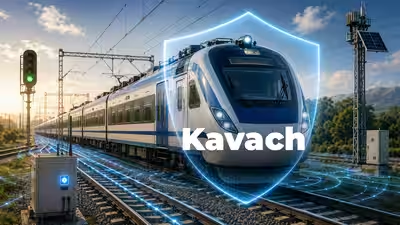
Table of Contents
What Is Kavach and Why Does Indian Railways Need It?
For decades, train operations on Indian Railways have relied heavily on signalling systems and the judgement of loco pilots. Although modern interlocking systems have significantly strengthened railway safety, the responsibility for observing signals, maintaining speed and responding appropriately to changing operational conditions still rests largely with the driver.
This creates an inherent human factor in railway operations.
Kavach is designed to provide an additional automated layer of protection. It does not replace the loco pilot. Instead, it continuously monitors the movement of the train and provides the driver with critical information while being capable of automatically applying brakes when necessary.
The system is primarily intended to prevent three major safety risks:
- Signal Passing at Danger (SPAD)
- Overspeeding
- Potential train collisions
By combining real-time information with automated intervention, Kavach is intended to strengthen safety across India’s increasingly busy railway network.
How Does Kavach Work?
Kavach works through continuous communication between equipment installed on locomotives and systems positioned along railway tracks.
The technology uses secure Ultra High Frequency (UHF) radio communication along with track-mounted RFID tags.
The RFID tags help determine the train’s precise location. At the same time, wayside equipment installed along the railway network gathers important operational information.
This information can include:
- Signal aspects
- Track occupancy
- Point positions
- Route status
- Train location
- Movement authority
- Permitted speed
The information is then communicated to the locomotive’s Kavach equipment in real time.
Inside the Indian Railway locomotive, the loco pilot receives information regarding important parameters such as the train’s target speed, distance and signalling conditions.
The system uses this information to determine the safe movement conditions of the train.
If the train approaches a dangerous situation and the required action is not taken, Kavach can automatically intervene.
For example, if a train passes a red signal, exceeds the permitted speed or enters a conflicting route, the system can apply the brakes.
In a situation where two trains are detected as moving toward a possible collision, Kavach can issue an automatic stop command to the trains involved.
This ability to continuously monitor and intervene is one of the central features that distinguishes an automatic protection system from conventional signalling alone.
Kavach Adds an Automated Safety Shield
One of the biggest advantages of Kavach is that it addresses situations in which human reaction may not be sufficient.
At higher speeds, particularly above 120 kmph, the time available to recognise a danger and apply emergency braking can be extremely limited.
Kavach provides the loco pilot with real-time information while also maintaining the ability to automatically enforce critical safety parameters.
The objective is therefore not to remove human decision-making but to provide an additional technological safeguard.
The system effectively acts as a second layer of protection between operational risks and a potentially serious incident.
According to experts cited in the source material, this could be particularly important for India’s dense railway network, where human-factor incidents remain one of the most difficult safety challenges to completely eliminate.
Kavach 4.0: India’s Next Step in Railway Safety
The development of Kavach has progressed through multiple stages since passenger trials began in 2016.
The system was officially adopted as India’s National Automatic Train Protection System in 2020. Its latest major version, Kavach 4.0, represents a significant step toward wider deployment.
The system has already been commissioned across 2,633 route kilometres, including parts of the Delhi-Mumbai and Delhi-Howrah corridors.
Indian Railways has prioritised high-density and heavily used routes because these sections carry nearly 96% of railway traffic, according to the information provided.
The strategy is to focus initially on sections where the technology could have the greatest impact on railway safety.
The next-generation Kavach 5.0 is being developed with suburban rail operations in mind. Suburban systems operate at extremely high frequencies, making reliable train separation and automatic protection particularly important.

How Kavach Compares With Global Railway Safety Systems
Kavach has also attracted attention because it has been designed as an indigenous alternative to internationally used automatic train protection technologies.
The system has been certified to Safety Integrity Level 4 (SIL-4), described by Indian Railways as one of the highest internationally recognised safety standards for railway signalling.
One of Kavach’s major advantages is its reported cost.
According to the source material, Indian Railways estimates the rollout cost of Kavach at approximately Rs 50 lakh per kilometre, compared with around Rs 1.5 crore to Rs 2 crore per kilometre for the European Train Control System (ETCS).
That cost difference could become significant when technology has to be deployed across thousands of route kilometres.
Crisil Intelligence Director Anshuman Chauhan said Kavach addresses human-factor incidents that have historically been difficult to eliminate on a railway network as large and dense as India’s.
PwC India’s Santosh Misra described Kavach as a strategic safety platform that could reduce accident risks arising from human error while supporting more efficient train operations.
Why Kavach Is Important for India’s Railway Network
Indian Railways operates one of the world’s largest railway networks and carries an enormous volume of passenger and freight traffic.
As train speeds increase and railway corridors become more congested, maintaining safe distances between trains becomes increasingly important.
Kavach is intended to provide continuous situational awareness and automated intervention.
This could allow Indian Railways to strengthen safety while also creating conditions for more efficient train operations.
The technology is particularly relevant as India continues to introduce modern trains and upgrade railway infrastructure. Projects involving Vande Bharat trains, high-speed railway development and upgraded signalling systems are all part of a broader effort to modernise the railway network.
The Biggest Challenge: Large-Scale Deployment
Despite its potential, Kavach faces a major challenge: scale.
Deploying an automatic protection system across thousands of kilometres requires multiple components to work together.
Trackside equipment must be installed. Locomotives must be fitted with compatible Kavach systems. Communication infrastructure, including optical fibre connectivity and telecom towers, must be established. RFID tags and other equipment must also be installed along the railway.
The technology cannot deliver its complete benefits if only a portion of a particular route is covered.
Experts therefore emphasise the importance of ensuring both trackside and rolling-stock deployment across entire operational sections.
Retired ICF General Manager and Vande Bharat architect Sudhanshu Mani described Kavach as a potentially transformative signalling system, while also arguing that Indian Railways should accelerate its implementation.
Manufacturing and Vendor Capacity Remain Critical
Another challenge is developing enough manufacturing and technical capacity to meet the enormous requirements of Indian Railways.
Anshuman Chauhan noted that every kilometre of deployment requires infrastructure such as optical fibre, telecom towers and RFID equipment, while stations and locomotives also require their own systems.
Building a vendor ecosystem capable of meeting these requirements at national scale takes time.
According to Chauhan, increasing manufacturing capacity through a clearly defined long-term order pipeline will be important for maintaining deployment momentum.
PwC India’s Santosh Misra similarly highlighted the importance of broadening supply chains, accelerating approvals, strengthening skilled manpower and mobilising investment.
Lessons From Europe and the United States
India’s experience with Kavach is not unique in terms of implementation complexity.
Automatic train protection systems have historically taken years, and sometimes decades, to deploy across major railway networks.
According to the source material, Europe’s ETCS remains deployed across only a portion of the trans-European network decades after its initial specifications.
The United States also faced a lengthy process while implementing Positive Train Control, which was mandated in 2008 and completed in December 2020 at an estimated cost of $14 billion.
These examples highlight an important lesson for India: technology development is only one part of railway modernisation. Standardisation, interoperability, manufacturing capacity and long-term implementation planning are equally important.
The Road Ahead for Kavach
The future of Kavach will depend not only on technological development but also on the speed and consistency of its deployment.
Indian Railways has already moved from trials to large-scale implementation, with Kavach 4.0 operating on important sections of the Delhi-Mumbai and Delhi-Howrah corridors.
The development of Kavach 5.0 also indicates that the technology is being adapted for different operational environments.
However, the full safety benefits will become visible only when the system achieves deeper network penetration and both trains and infrastructure are equipped consistently.
India’s railway modernisation programme is increasingly combining indigenous technology with large-scale infrastructure development. Kavach represents an important part of that transformation.
Its significance extends beyond preventing individual incidents. By providing an automated safety layer, real-time information and the ability to intervene when critical conditions are breached, the system has the potential to reshape how railway safety is managed across the country.
The challenge now is implementation.
If Indian Railways can overcome infrastructure, vendor capacity, workforce and deployment challenges, Kavach could become one of the most important examples of indigenous technology being deployed at national scale.
For a railway network as vast and heavily used as India’s, that combination of domestic innovation, global safety standards and large-scale implementation could prove crucial to building a safer and more technologically advanced railway system.