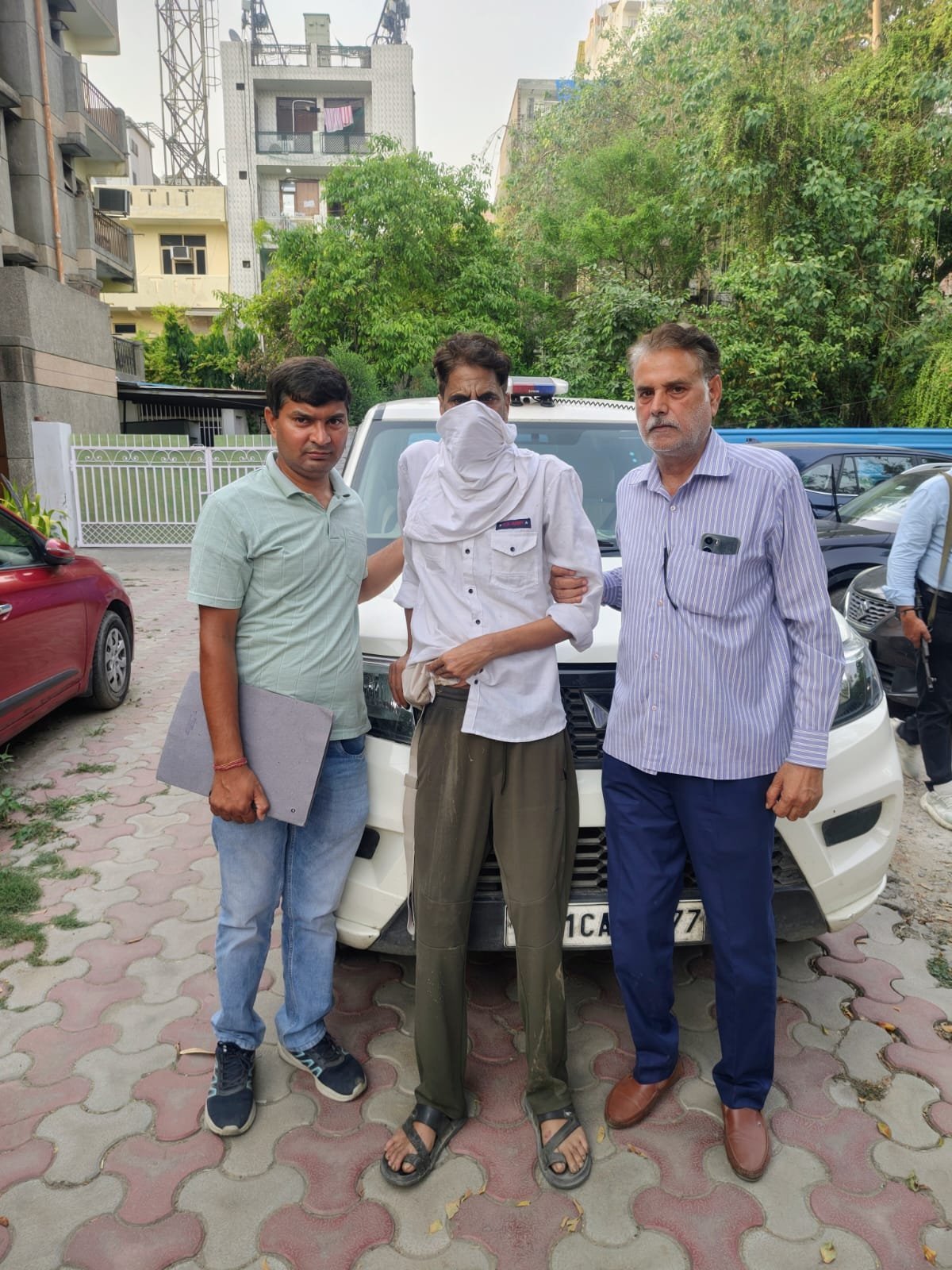
In a major breakthrough, the Delhi Police Crime Branch has arrested well-known social activist and YouTuber Salim Khan in connection with a 31-year-old kidnapping for ransom and murder case dating back to 1995. The arrest has shocked many people, especially those who knew him only as a social activist and online personality who frequently appeared on social media platforms discussing social issues and local concerns.
According to Delhi Police, the accused had been evading arrest for more than two decades after jumping interim bail granted by the Delhi High Court in 2000. During this period, he allegedly changed his identity, shifted locations multiple times, and built a new image in society as a social activist and YouTuber under the name Salim Wastik.
The case relates to the kidnapping and murder of 13-year-old Sandeep Bansal, son of a businessman from North East Delhi. Police officials said the accused, along with his associate Anil, kidnapped the child for ransom and later murdered him. The accused had already been convicted and sentenced to life imprisonment in 1997, but after receiving interim bail, he disappeared and remained absconding for years.
The arrest was carried out by the Anti Robbery and Snatching Cell (ARSC) of the Crime Branch under the supervision of senior officials. Police described the operation as the result of continuous surveillance, technical investigation, and verification of old records and identities.
 A Social Activist With A Hidden Past
For years, Salim Khan was known publicly as a social activist involved in local issues and social awareness campaigns. He reportedly gained popularity through his YouTube activities and social media presence. Many people in Uttar Pradesh and nearby areas recognized him more as a social activist than as a wanted criminal.
Police officials revealed that the accused carefully built a new identity over the years. He allegedly declared himself “dead” in the eyes of law enforcement agencies to avoid arrest and mislead authorities. Investigators said he adopted the name Salim Ahmed and later became known as Salim Wastik while living in Loni, Ghaziabad.
The transformation from a convicted criminal to a recognized social activist has raised serious questions about how long-term fugitives manage to escape the legal system and rebuild their public image. Investigators believe the accused used constant movement between Haryana and Uttar Pradesh to avoid police tracking.
Officials stated that despite living openly as a social activist, the accused managed to hide his criminal history from many people around him. Over time, he became active online and developed influence through videos and local activism.
The 1995 Kidnapping That Shocked Delhi
The incident dates back to January 20, 1995, when 13-year-old Sandeep Bansal left his home to attend classes at Ramjas School. His father, Sita Ram, was a cement businessman in North East Delhi.
According to police records, the child left home around 11:30 AM for the second shift at school but never returned home in the evening. The family became worried and started searching for him. The next day, the father received a phone call informing him that his son had been kidnapped.
Police said the caller demanded ₹30,000 as ransom for the safe release of the boy. Instructions were reportedly given to deliver the money near the Loni Flyover and place it inside a bus heading towards Baghpat. The kidnappers also warned the family not to inform the police.
However, the matter had already been reported to authorities. A case was registered at Delhi Police and investigation began immediately.
During the investigation, suspicion fell on Salim Khan, who was working as a martial arts instructor at the same school where the victim studied. A neighbor reportedly informed police that the child was seen leaving with a tall man known as “Masterji” around the time he was supposed to go to school.
Police teams then reached the residence of Salim Khan. During questioning, he allegedly confessed involvement and led officers to a drain near Mustafabad where the child’s body was recovered. The body was later identified by the victim’s father.
The case became one of the most disturbing kidnapping-for-ransom crimes in Delhi during that period because it involved a school-going child and someone connected to his educational environment.
Role Of Co-Accused Anil
Police investigation also uncovered the involvement of co-accused Anil. Initially absconding, he later surrendered before the court in February 1995.
Investigators stated that Anil played a key role in planning the kidnapping. Police records mention that he allegedly suggested targeting a child from a wealthy family for ransom. Evidence recovered during the investigation included the victim’s watch, school bag, and tiffin box from his jhuggi settlement.
Authorities also alleged that Anil was the person who made ransom calls to the victim’s father. Based on evidence and investigation, police added murder and kidnapping-for-ransom charges under the Indian Penal Code.
The court later convicted both accused and sentenced them to life imprisonment in 1997.
Bail, Escape And Disappearance
After conviction, both accused approached the Delhi High Court in appeal. During the appeal proceedings, Salim Khan received interim bail in November 2000.
According to investigators, he never returned to custody after being released. Police said he jumped bail and disappeared from Delhi. Authorities claim he spent years moving through different cities in Haryana including Karnal and Ambala while working as an almirah maker and laborer to survive.
Over time, he allegedly changed his identity and settled permanently in Loni, Ghaziabad around 2010. There, he reportedly started a shop selling ladies’ clothing and other items.
Police officials believe his strategy of frequently changing locations and identities helped him stay away from arrest for more than 26 years. During this period, he gradually became known publicly as a social activist and online content creator.
The High Court later upheld his conviction in 2011, but by then the accused had already disappeared.
Social Activist Image And Public Presence
One of the most surprising aspects of the case is how the accused managed to create a strong public identity as a social activist despite being a convicted fugitive.
Police officials stated that he remained active on YouTube and social media platforms where he reportedly discussed public matters and local issues. Residents in some areas reportedly viewed him as a helpful social activist involved in community matters.
This dual identity has become one of the most talked-about elements of the case. Experts say social media today allows individuals to quickly build influence and public trust, making it easier for people to reshape their image.
Criminal psychologists often explain that long-term fugitives try to integrate themselves into society by building trust, social relationships, and public credibility. In this case, investigators believe the accused carefully developed the image of a social activist to avoid suspicion.
The case also highlights the challenges faced by law enforcement agencies in tracking fugitives who change identities and maintain low profiles for long periods.
The Investigation That Led To Arrest
The breakthrough reportedly came when the ARSC unit of the Crime Branch started monitoring parole jumpers involved in serious crimes.
Police officials said Head Constable Mintu Yadav received secret information regarding the identity of Salim Wastik. Investigators then began collecting old records, photographs, fingerprints, and court documents to confirm whether the social activist was actually the convicted criminal Salim Khan.
After verification, police confirmed the match through fingerprints and old photographs. A special raiding team was then formed under Inspector Robin Tyagi.
With assistance from Uttar Pradesh Police, the Crime Branch conducted a raid in Loni, Ghaziabad and arrested the accused successfully.
Officials described the arrest as a result of sustained surveillance and detailed background investigation. The operation has once again highlighted the importance of inter-state coordination between police agencies.
Attack On The Accused Earlier This Year
Interestingly, the accused himself was recently involved in another criminal case earlier this year.
Police records show that in February 2026, an attack was reported on the social activist in Loni, Uttar Pradesh. Two men allegedly stabbed him multiple times in the neck and abdomen near his office premises.
He was initially treated at Guru Teg Bahadur Hospital and later shifted to Max Super Speciality Hospital for further treatment.
Following the attack, a criminal case was registered in Uttar Pradesh and security personnel were reportedly provided to him by local police authorities.
At that time, many people viewed him only as a social activist and social media personality who had survived a violent attack. Few were aware of his alleged past and pending conviction.
Questions Raised By The Case
The arrest of a social activist in a decades-old murder case has sparked debate around identity, justice, and law enforcement tracking systems.
Legal experts say the case demonstrates how delayed justice can still eventually reach offenders, even after years of disappearance. At the same time, the case also exposes gaps in monitoring convicted criminals released on interim bail.
The story has generated widespread public reaction because of the contrast between the accused’s public image as a social activist and the serious allegations connected to his past.
Crime experts also point out that the role of digital media and YouTube has transformed how individuals create influence in society. A person can now build credibility quickly through online platforms, making background verification increasingly important.
For many people, the case serves as a reminder that public image alone cannot define someone’s entire history. The investigation revealed that behind the image of a social activist and online personality was a man convicted in one of Delhi’s shocking kidnapping and murder cases from the 1990s.
Police have now lodged the accused in Tihar Jail after completing legal formalities.