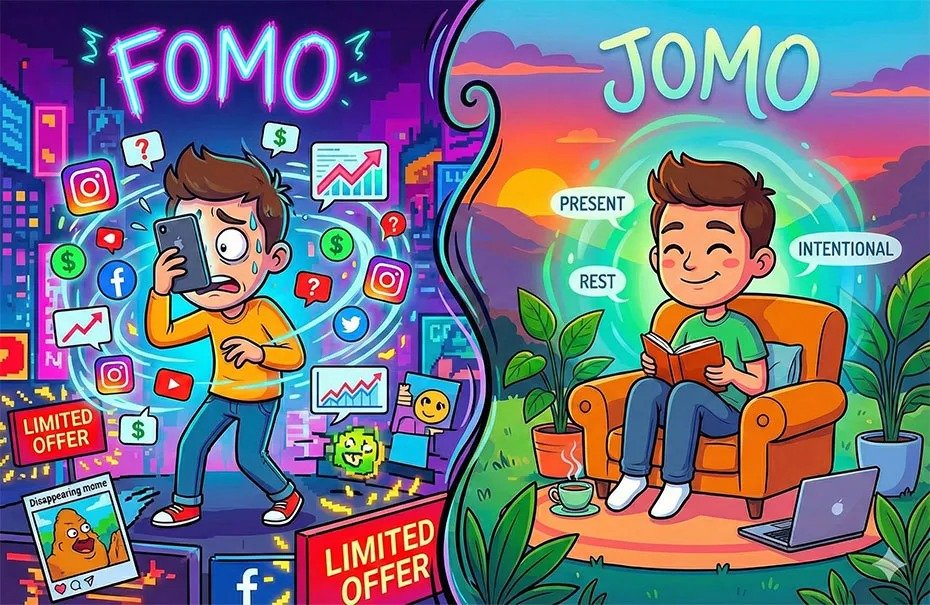
For years, FOMO — the Fear of Missing Out — has been one of the defining emotions of the social media era. The pressure to attend every gathering, follow every trend, respond to every message and keep up with carefully curated versions of other people’s lives has shaped how young people consume content, socialize and even make lifestyle decisions.
But in 2026, a noticeable shift is taking place. Instead of worrying about what they might be missing, many members of Generation Z are embracing JOMO — the Joy of Missing Out. The idea is simple: choosing not to participate in everything can be a source of freedom rather than regret.
The shift from FOMO to JOMO reflects a broader change in how young people think about well-being, social media, productivity, travel, friendships and personal time. Recent coverage has highlighted Gen Z’s growing preference for slower lifestyles, digital detoxes and intentional choices over constantly staying busy. (Moneycontrol)
Rather than disappearing from social media completely, the movement is more about becoming selective about where time and attention are spent.
Table of Contents
What Is FOMO and Why Has It Become So Powerful?
FOMO stands for Fear of Missing Out. It describes the anxiety or uneasiness people can experience when they believe others are enjoying experiences, opportunities or social connections without them.
Although the feeling existed long before smartphones, social media has significantly amplified it.
Platforms allow users to see a continuous stream of other people’s activities — from holidays and parties to restaurant visits, shopping hauls, career achievements and personal milestones. The result can be a distorted impression that everyone else is constantly doing something exciting.
For Gen Z, who have grown up alongside smartphones and social platforms, this environment can make comparison almost unavoidable.
Research has associated FOMO with social media use and has examined its relationship with factors including loneliness, self-esteem and social connectedness.
The problem is not necessarily one particular post. Instead, it is the constant accumulation of updates.
One person’s vacation may trigger the thought that you need to travel. Someone else’s career announcement may make you question your own progress. A friend’s night out can create the feeling that you should have been there.
Over time, ordinary life can begin to feel inadequate when compared with the highlights appearing on a screen.
From FOMO to JOMO: A Different Way of Looking at Life
JOMO stands for Joy of Missing Out.
Instead of asking, “What am I missing?”, the JOMO mindset asks, “What do I actually want to be doing?”
It is not necessarily about rejecting social interaction or becoming completely disconnected. Rather, it is about making deliberate choices instead of participating because of pressure, comparison or fear.
That distinction is important.
Someone practising JOMO may decide to stay home on a Friday night rather than attend another event. They may spend a weekend without posting anything online. They may take a holiday without creating a detailed social media itinerary or decline an invitation simply because they need time to themselves.
In other words, missing out becomes a choice rather than a failure.
Current 2026 lifestyle coverage has linked the FOMO-to-JOMO shift among Gen Z with burnout, social media pressure, overbooked schedules and a growing desire for calm.
Why Gen Z Is Getting Tired of Constant Connectivity
One of the biggest reasons behind the JOMO movement is the exhaustion associated with being permanently connected.
Smartphones have made communication easier, but they have also blurred the boundaries between being available and being constantly available.
Messages, notifications, social media updates and algorithmically recommended content can make it difficult to experience genuine downtime.
For younger users, this can create a strange contradiction: they may have more ways than ever to stay connected, yet feel increasingly overwhelmed by the amount of information and social activity competing for their attention.
A recent systematic review of research examining social media and FOMO among Gen Z identified recurring associations between FOMO, increased social media engagement, anxiety and social comparison, while also noting that more longitudinal research is needed to establish causality.
That nuance matters. Social media does not automatically cause poor mental well-being, and not everyone experiences FOMO in the same way. However, the relationship between digital behaviour, comparison and feelings of social pressure is increasingly being studied.
Social Media Is Changing the Meaning of “Missing Out”
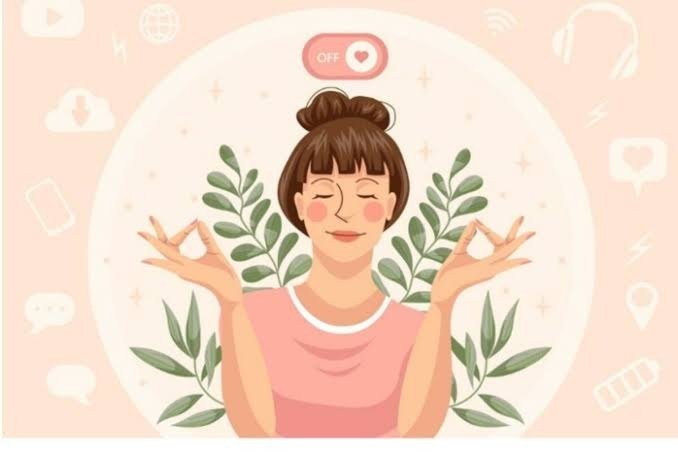
Interestingly, JOMO itself has become a social media trend.
Young people can now post about deleting apps, taking breaks, spending weekends offline or choosing quiet evenings. This creates an irony at the heart of the movement: people are sometimes using social media to announce that they are stepping away from social media.
But the underlying behaviour is still significant.
The emphasis is moving from public participation to personal control.
Instead of feeling obligated to document every experience, some young users are becoming more comfortable keeping moments private. The goal is not necessarily to abandon digital platforms but to stop allowing them to determine what counts as an enjoyable or successful life.
This also connects with the wider idea of digital minimalism, where people consciously reduce unnecessary digital activity rather than attempting to eliminate technology altogether.
JOMO and the Rise of Intentional Living
The JOMO movement also fits into a broader lifestyle shift toward intentional living.
For years, modern culture celebrated being busy. Packed calendars, constant travel, multiple social commitments and ambitious productivity routines were often presented as signs of success.
JOMO challenges that idea.
A quieter schedule can be viewed as valuable rather than boring. Rest can become productive in its own way. Spending time alone does not automatically mean being lonely. And declining an invitation does not necessarily mean missing an important part of life.
The broader appeal is control.
Instead of saying yes because everyone else is saying yes, people are increasingly asking whether an activity genuinely adds value to their lives.
That could mean choosing a quiet evening with a book over a crowded event, cooking at home instead of eating out because it is trending, or taking a slow holiday instead of attempting to visit every possible attraction.

The Connection Between JOMO and Travel
Travel is another area where the FOMO mindset has traditionally been powerful.
Social media has transformed travel into something that is often documented as much as it is experienced. Popular destinations can become associated with specific photographs, restaurants or activities that travellers feel they must experience.
JOMO offers an alternative.
Instead of trying to reproduce someone else’s itinerary, travellers can focus on what they personally enjoy. This may mean staying longer in one location, spending an afternoon doing nothing, avoiding overcrowded attractions or choosing a less popular destination.
The emerging preference for slow and restorative travel has been identified as part of the wider shift toward calmer lifestyles in 2026.
The message is straightforward: a holiday does not have to look impressive online to be meaningful.
Why Saying “No” Is Becoming More Acceptable
Another important part of JOMO is the changing attitude toward boundaries.
In a culture where instant responses and constant availability have become normal, saying “no” can feel uncomfortable.
FOMO can encourage people to accept invitations they do not want, participate in conversations they are tired of or stay online because they are worried something important might happen without them.
JOMO reverses that equation.
It makes selectivity acceptable.
People can choose fewer commitments while giving more attention to the ones they genuinely value.
This can also influence friendships. Instead of measuring closeness by how frequently people meet or interact online, relationships can increasingly be based on quality, trust and mutual understanding.
JOMO Does Not Mean Isolation
There is an important distinction between healthy disconnection and complete social withdrawal.
JOMO is not a recommendation to avoid people, ignore responsibilities or disconnect from the world indefinitely.
Taking a break from social media can be refreshing, but excessive withdrawal may have a different impact. Research into digital detox practices has also found that stepping away from social media can sometimes increase social pressure or feelings of missing out, showing that the relationship between connectivity and well-being is complicated.
The healthier interpretation of JOMO is therefore not “I don’t need anyone.”
It is:
“I don’t need to participate in everything.”
That distinction makes the trend less about isolation and more about intentionality.
The Psychology Behind the Shift
At its core, FOMO is connected to comparison and belonging.
Humans naturally want to feel included. Seeing other people participate in experiences can make exclusion feel more significant, even when there is no actual rejection taking place.
Social media intensifies this process by providing an almost continuous stream of social information.
JOMO attempts to interrupt that cycle.
Instead of evaluating personal happiness against what others are doing, individuals focus on their own preferences and priorities.
Psychological research has explored JOMO as a potentially positive counterpart to FOMO, including its relationship with social media use and well-being.
This does not mean JOMO should be treated as a cure-all. Rather, it represents a change in mindset: contentment does not have to depend on constant participation.
From Hustle Culture to Rest Culture
The popularity of JOMO also reflects a larger rejection of the idea that productivity should dominate every aspect of life.
Gen Z has increasingly become associated with conversations around burnout, work-life boundaries and mental well-being.
The desire for rest is therefore becoming less likely to be viewed simply as laziness.
Whether it is spending an afternoon at home, taking a break from notifications or refusing to fill every weekend with plans, the underlying message remains the same: rest is part of a sustainable lifestyle.
This helps explain why concepts such as digital detox, slow living and intentional downtime continue to appear alongside discussions about JOMO.
How FOMO Influences Everyday Decisions
FOMO is not limited to parties and social events.
It can influence:
- Shopping: Buying products because they are trending.
- Travel: Visiting destinations because they are popular online.
- Food: Trying viral restaurants or dishes simply because everyone is discussing them.
- Fashion: Purchasing micro-trends to remain relevant.
- Career: Comparing professional progress with peers.
- Social media: Checking apps repeatedly to avoid missing updates.
- Entertainment: Watching shows or following conversations because everyone else is doing so.
- Relationships: Maintaining connections because of fear of being left out.
JOMO challenges these automatic reactions by introducing a simple question: Do I actually want this, or am I afraid of missing it?
That question can turn an impulsive decision into a conscious one.
Why JOMO Could Become a Major Lifestyle Trend in 2026
The appeal of JOMO lies in its simplicity.
People do not necessarily need to abandon technology, delete every social media account or reject modern lifestyles. They can simply become more selective.
That makes JOMO particularly relevant at a time when people are dealing with information overload, constant notifications and increasingly personalized digital feeds.
The trend also aligns with other lifestyle movements — from slow travel and digital detoxes to minimalist consumption and intentional wellness.
For Gen Z, the idea may be less about completely disconnecting and more about regaining control over attention.
And that may be the most important difference between FOMO and JOMO.
FOMO asks people to look outward and compare.
JOMO encourages them to look inward and choose.
The rise of JOMO
The rise of JOMO does not mean FOMO is disappearing. Social media, trends and the desire to belong will continue to influence people’s choices.
What is changing is the willingness to question that pressure.
For a generation that has grown up documenting, sharing and consuming life through screens, deliberately choosing to miss something can feel surprisingly empowering.
In 2026, the idea of a good life may increasingly be defined not by how much someone manages to experience, but by whether those experiences actually matter to them.
FOMO says you need to keep up. JOMO says you are allowed to slow down.
And for an increasingly connected generation, that freedom to miss out may be exactly what makes the moment worth experiencing.