Asus has expanded its Android tablet portfolio in India with the launch of the Asus Pad, a premium tablet designed for entertainment, productivity, learning and creative work. The new device combines a large 12.2-inch OLED display with a high refresh rate, a MediaTek D8300 processor, a 9,000mAh battery and Android 16.
The Asus Pad has been introduced in two storage configurations, with prices starting at ₹45,990. The company is positioning the tablet as a versatile device for users who want a larger screen for multimedia consumption while also requiring enough performance for productivity, creative applications and everyday computing.
The tablet will go on sale in India from August 6, 2026, through multiple online and offline retail channels. Asus is also offering no-cost EMI options for customers looking to spread the purchase cost over several months.
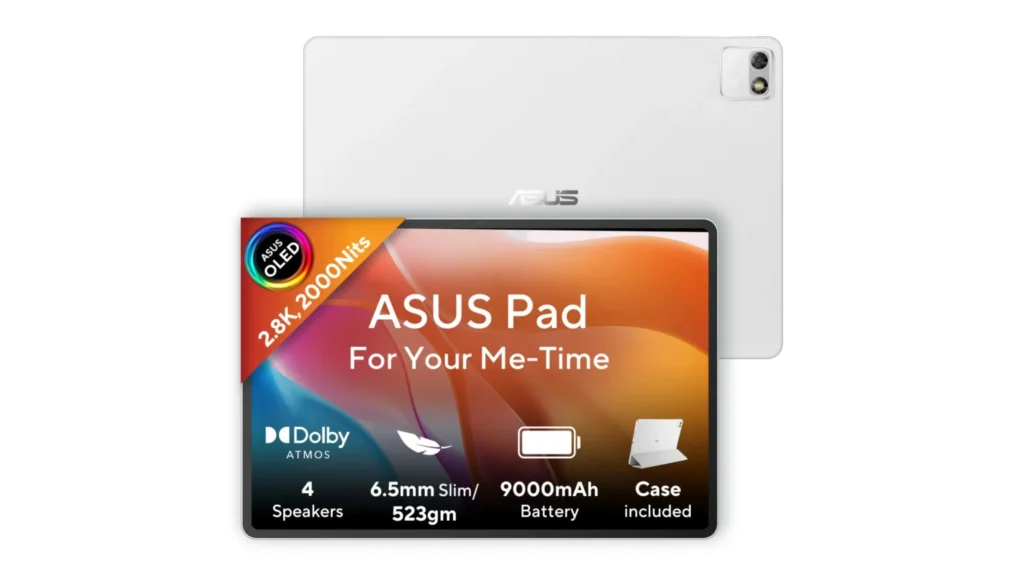
Table of Contents
Price in India and Availability
The tablet is available in two configurations in the Indian market.
The 8GB RAM + 128GB storage model has been priced at ₹45,990, while the higher-storage 8GB RAM + 256GB variant costs ₹49,990.
Sales will begin on August 6, with consumers able to purchase the tablet through Flipkart, the company’s eShop, Asus & ROG Stores, Reliance Digital and authorised retail stores.
For customers opting for financing, the company is offering up to 12 months of no-cost EMI. According to the company, monthly instalments start at approximately ₹3,833, potentially making the tablet more accessible to buyers who prefer monthly payments over an upfront purchase.
The pricing puts the device in India’s competitive premium-tablet segment, where manufacturers are increasingly attempting to blur the distinction between traditional tablets and lightweight productivity machines.
12.2-Inch 2.8K OLED Display Is a Major Highlight
One of the strongest features of the tablet is its display.
The device comes with a 12.2-inch 2.8K dual-layer OLED panel, giving users a large viewing area combined with the contrast and colour characteristics associated with OLED technology.
The display supports an impressive 144Hz refresh rate, which is considerably higher than the 60Hz panels still found on many conventional tablets. A higher refresh rate can make scrolling, animations and supported games appear smoother.
The manufacturer has also equipped the display with a claimed 2,000 nits peak brightness, which should help improve visibility in bright environments when the content and display mode support peak brightness.
The panel covers 100% of the DCI-P3 colour gamut, making the display particularly relevant for users who work with visual content. Wider colour coverage can be useful for photography, video consumption, illustration and other creative tasks where colour reproduction matters.
The combination of a 12.2-inch size, 2.8K resolution, OLED technology and 144Hz refresh rate gives the tablet a specification sheet aimed at consumers who place a high priority on screen quality.
MediaTek D8300 Processor Powers the Tablet
Under the hood, the device is powered by the MediaTek D8300 processor.
The chipset is paired with 8GB of LPDDR5X RAM and up to 256GB of UFS 3.1 internal storage.
This combination is designed to provide enough performance for everyday applications, multitasking and multimedia workloads. The use of LPDDR5X memory and UFS 3.1 storage also gives the tablet a more performance-focused hardware configuration compared with basic entry-level Android tablets.
For users who need additional storage, the device supports microSD expansion of up to 1TB.
That expandable-storage option could be particularly useful for people who keep large collections of videos, photographs, documents, games or creative files locally rather than relying entirely on cloud storage.
9,000mAh Battery With 45W Fast Charging
Battery capacity is another major selling point of the tablet.
The device packs a 9,000mAh battery, designed to support extended usage across entertainment, work, study and other activities.
The company has paired the battery with 45W fast charging. It claims that the tablet can charge from 0% to 50% in around 30 minutes.
For a large-screen device, battery endurance can be particularly important because tablets are frequently used for long periods of video playback, online classes, browsing, document work and gaming.
The combination of a large-capacity battery and fast charging is therefore aimed at reducing the inconvenience associated with frequently connecting a tablet to a charger.
Actual battery life will naturally vary depending on factors such as display brightness, refresh-rate settings, applications, connectivity and workload. Nevertheless, the 9,000mAh capacity gives the device a substantial power reserve on paper.
Android 16 Comes Pre-Installed
The tablet runs Android 16, bringing the device onto Google’s latest Android platform.
The operating system provides the software foundation for applications, entertainment services, productivity tools and other tablet functions.
The company is also attempting to make the device useful beyond conventional media consumption. Its combination of a large display, substantial RAM and support for a stylus is designed to make it suitable for note-taking, creative work and productivity.
The move to Android 16 also gives the tablet a more current software platform at launch, which could be an important consideration for consumers planning to keep the device for several years.
Pen 2.0 Support Adds Creative Potential
The tablet supports the Asus Pen 2.0 stylus, extending its functionality beyond touch-based navigation.
Stylus support can be useful for students taking handwritten notes, professionals annotating documents and creators working on sketches or digital artwork.
The large 12.2-inch OLED display also provides a relatively spacious canvas for such activities.
Combined with the display’s 2.8K resolution and 100% DCI-P3 colour coverage, stylus compatibility strengthens the tablet’s positioning as a device suitable for creative work rather than simply video streaming and web browsing.
Quad Speakers With Dolby Atmos
For entertainment, the tablet comes equipped with quad speakers and Dolby Atmos support.
The four-speaker setup is designed to provide a more immersive audio experience when watching movies, listening to music or playing games.
Large-screen tablets are often used as portable entertainment devices, and audio quality can therefore be nearly as important as display quality.
The inclusion of Dolby Atmos adds another multimedia-focused feature to the device’s specification list, complementing its OLED display and 144Hz refresh rate.
Together, these features make the tablet particularly suited to users who want a portable entertainment screen that is larger than a smartphone while remaining more compact than a laptop.

Connectivity Features
The Asus Pad supports several modern connectivity standards.
The tablet comes with Wi-Fi 6E, providing access to newer Wi-Fi spectrum where supported by compatible networks and infrastructure.
It also features Bluetooth 5.3, allowing it to connect with compatible wireless accessories such as headphones, speakers, keyboards and other peripherals.
For wired connectivity, the device includes a USB Type-C port.
These connectivity options make the Asus Pad suitable for a range of use cases, including wireless entertainment, peripheral connectivity and transferring data through wired connections.
GlideX Connects the Tablet With Other Devices
Asus has also included its GlideX software on the tablet.
The feature is designed to allow users to share files and work across multiple operating systems, including Windows, macOS, Android and iOS.
Cross-device functionality is becoming increasingly important as consumers use multiple devices throughout the day.
For example, someone using a Windows laptop and an Android tablet may want to transfer files or continue certain workflows between the two devices. GlideX is intended to make such interactions more convenient within the Asus ecosystem.
This feature also reinforces the company’s effort to position the Asus Pad as a productivity-oriented tablet rather than purely an entertainment device.
Designed for Entertainment, Productivity and Learning
Asus says the new tablet has been designed around several different use cases, including entertainment, productivity, learning and creative work.
That broad positioning reflects the changing tablet market.
Modern tablets are increasingly expected to handle tasks that once required a laptop, while still maintaining the convenience of a touchscreen and relatively portable form factor.
For students, the large OLED display can be useful for online classes, reading digital textbooks and taking notes with a stylus.
For professionals, the combination of 8GB RAM, fast storage, a large display and cross-device software can support document-based workflows and multitasking.
For creators, the 2.8K OLED display, DCI-P3 colour coverage and Asus Pen 2.0 support provide features aimed at visual work.
For entertainment-focused buyers, the OLED panel, 144Hz refresh rate, quad speakers and Dolby Atmos provide a strong multimedia-oriented package.
Asus Pad Enters a Competitive Tablet Market
The launch comes at a time when the Indian tablet market is evolving beyond basic consumption devices.
Consumers increasingly expect tablets to perform multiple roles, from watching content and attending online classes to creating documents, editing media and interacting with other devices.
The Asus Pad’s specifications reflect this broader expectation.
Its 144Hz OLED display targets users who care about visual quality and smoothness, while the MediaTek D8300 processor and 8GB LPDDR5X RAM focus on performance. Expandable storage provides additional flexibility, while the 9,000mAh battery addresses one of the most important requirements for portable devices.
The addition of stylus support and GlideX further expands its potential productivity applications.
Is the Asus Pad Worth Considering?
At a starting price of ₹45,990, the Asus Pad is not positioned as an entry-level Android tablet. Instead, Asus is targeting buyers who are willing to spend more for a higher-end display, stronger hardware and a broader set of features.
The 12.2-inch 2.8K OLED display is one of its strongest attractions, particularly for users who consume large amounts of visual content or work with colour-sensitive material.
The 144Hz refresh rate, 2,000-nit peak brightness and 100% DCI-P3 coverage add to the premium display proposition.
The 9,000mAh battery and 45W charging system address portability and endurance, while Android 16 provides a modern software foundation.
However, buyers will also need to consider their individual requirements. Users looking primarily for basic browsing and video streaming may not need to spend nearly ₹46,000 on a tablet. On the other hand, students, creators and professionals who can make use of the display, stylus compatibility, performance and cross-platform features may find the package more compelling.

The Asus Pad marks a significant addition to Asus’ Android tablet lineup in India, combining premium display technology with performance-focused hardware and a large battery.
Starting at ₹45,990, the tablet offers a 12.2-inch 2.8K dual-layer OLED display, 144Hz refresh rate, MediaTek D8300 processor, 8GB LPDDR5X RAM, up to 256GB UFS 3.1 storage, microSD expansion up to 1TB, and a 9,000mAh battery with 45W fast charging.
Its quad-speaker system with Dolby Atmos, Wi-Fi 6E, Bluetooth 5.3, Android 16, Asus Pen 2.0 support and GlideX connectivity features add further versatility.
With sales beginning August 6 through Flipkart, Asus’ own stores and eShop, Reliance Digital and authorised retailers, the Asus Pad will soon be available to Indian consumers looking for a premium Android tablet.
The device’s biggest proposition is its attempt to combine entertainment and productivity in a single large-screen package. Whether it can establish itself against competing premium tablets will ultimately depend on real-world performance, software optimisation, battery endurance and the overall experience it delivers at its ₹45,990 starting price.