

Metro stations across central Delhi witnessed heightened security measures on Sunday as authorities tightened restrictions ahead of a proposed protest march by the Cockroach Janata Party (CJP) towards Parliament. With the Monsoon Session of Parliament commencing today, security agencies implemented extensive precautionary measures across central Delhi, leading to the temporary closure of several major Delhi Metro stations and the deployment of a large number of police personnel and Rapid Action Force (RAF) teams.
The developments come amid continuing protests linked to activist Sonam Wangchuk’s campaign demanding accountability over alleged examination paper leaks and broader concerns regarding transparency in the education system. Although Wangchuk was shifted to Safdarjung Hospital following concerns over his health after his prolonged hunger strike, his supporters have continued demonstrations at Jantar Mantar, keeping the issue in the national spotlight.
Table of Contents
Authorities have clarified that no permission was granted for any protest march towards Parliament, and prohibitory orders remain in force across the New Delhi district to maintain law and order during the parliamentary session.
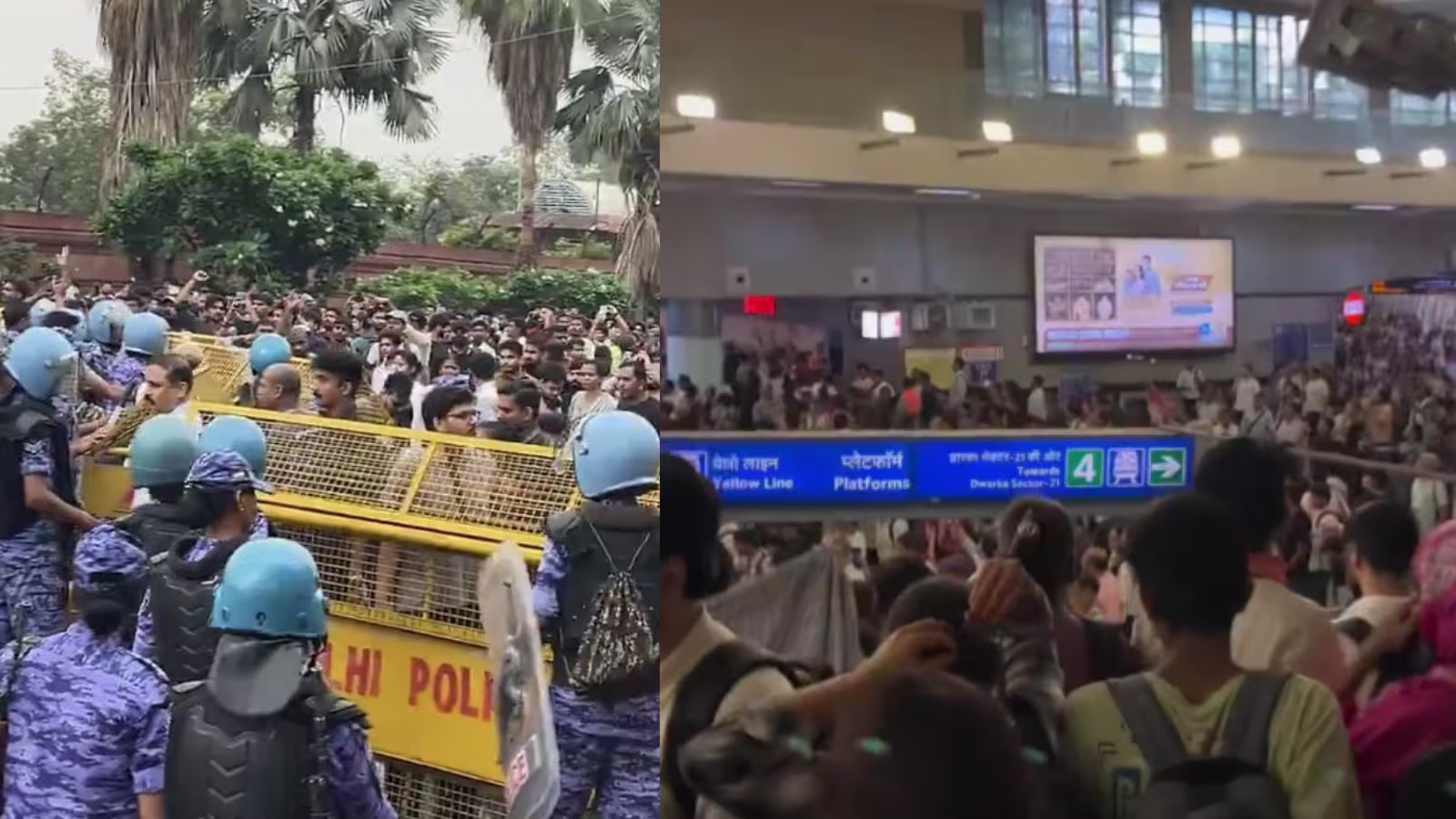
Five Major Delhi Metro Stations Closed Due to Security Concerns
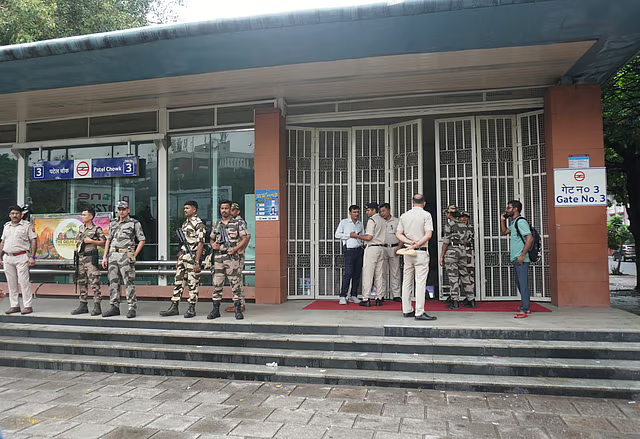
As part of the security arrangements, Metro Stations across central Delhi were temporarily closed after the Delhi Metro Rail Corporation (DMRC) issued an advisory.
According to the official advisory, the following Metro stations have been closed until further notice:
- Janpath
- Rajiv Chowk
- Patel Chowk
- Central Secretariat
- Seva Teerth
The DMRC informed commuters through its official social media platforms that the closures were implemented purely due to security reasons and advised passengers to make alternate travel arrangements.
The suspension of services at these busy Metro stations affected thousands of commuters, as Rajiv Chowk and Central Secretariat are among the busiest interchange Metro stations in the Delhi Metro network.
Officials stated that metro services on other sections continued to operate normally, although passengers were advised to expect additional security checks and possible delays near sensitive government zones.
Heavy Security Blanket Across Central Delhi
Security across the New Delhi district was significantly strengthened from the early hours of the morning.
Delhi Police personnel, supported by the Rapid Action Force (RAF), were deployed in large numbers around Parliament House, Jantar Mantar, Vijay Chowk, North Block, South Block, and several adjoining government buildings.
Barricades were installed at strategic points to regulate movement, while police teams monitored entry routes leading towards Parliament.
Authorities maintained strict surveillance to prevent any unauthorized gathering or attempt to breach security arrangements around the high-security zone.
Additional personnel were also stationed near important intersections, metro exits, and government offices to ensure that public order remained under control throughout the day.
Parliament’s Monsoon Session Brings Additional Security
The beginning of the Monsoon Session of Parliament has naturally increased the security sensitivity in the national capital.
The session, scheduled to continue until August 13, is expected to witness discussions on several important legislative matters, making Parliament one of the country’s most heavily secured locations during this period.
Security agencies routinely strengthen arrangements whenever Parliament is in session.
However, the ongoing protest movement and the proposed march towards Parliament prompted authorities to adopt additional precautionary measures this time.
Officials said ensuring uninterrupted parliamentary functioning while maintaining public safety remains their primary objective.
Delhi Police Clarifies Position on Proposed March
Delhi Police issued a detailed advisory clarifying that no permission had been sought or granted for any protest march towards Parliament.
According to police officials, any attempt to organize processions or unauthorized gatherings in restricted areas would amount to a violation of existing prohibitory orders.
The advisory reiterated that Metro Stations demonstrations are permitted only at designated protest sites after obtaining prior approval from competent authorities.
Police urged citizens to cooperate with security arrangements and avoid entering restricted zones during the ongoing parliamentary session.
Section 163 BNSS in Force Across New Delhi District
Authorities confirmed that prohibitory orders under Section 163 of the Bharatiya Nagarik Suraksha Sanhita (BNSS) remain in force throughout the New Delhi district.
The provision prohibits:
- Unauthorised protest marches
- Public processions
- Demonstrations
- Assemblies involving five or more persons
- Gatherings in notified restricted areas
Officials explained that these restrictions are intended to prevent disruptions, maintain law and order, and ensure the security of important government institutions.
Police also warned that any violations could invite legal action under the relevant provisions of the Bharatiya Nyaya Sanhita (BNS).
Rapid Action Force Deployed at Sensitive Locations
The Rapid Action Force, known for handling public order situations and crowd management, has been deployed extensively around Parliament and Jantar Mantar.
RAF personnel have been positioned alongside Delhi Police teams to respond quickly to any untoward incident.
Security officials stated that deployment has been planned to ensure peaceful management of demonstrations while safeguarding public property and government installations.
The Metro Stations visible presence of RAF personnel reflects the administration’s preparedness to handle any situation that may arise during the protest period.
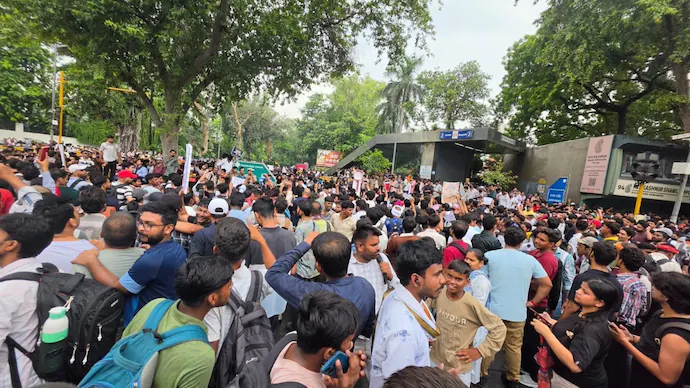
Protest Continues at Jantar Mantar
While restrictions remain in place around Parliament, demonstrations have continued at Jantar Mantar, the designated protest venue in the capital.
Supporters associated with the CJP have continued raising slogans and demanding action on education-related issues.
Police have allowed demonstrations only within the permitted framework while maintaining strict monitoring of activities in the area.
Officials said continuous dialogue is being maintained with protest representatives to ensure that demonstrations remain peaceful.
Sonam Wangchuk’s Hunger Strike Remains Central to the Protest
The current movement traces its origins to activist, innovator and education reform advocate Sonam Wangchuk, who had been observing an indefinite hunger strike.
The protest was launched primarily to demand accountability regarding alleged irregularities in competitive examinations and repeated incidents of examination paper leaks.
After completing 21 days of fasting, Wangchuk was shifted to Safdarjung Hospital following medical advice and concerns regarding his deteriorating health.
Authorities stated that the decision was taken considering his medical condition and in compliance with legal requirements.
However, his supporters alleged that he was removed without consent and described the Metro Stations action as a crackdown on a peaceful democratic protest.
Wangchuk Outlines Conditions to End Hunger Strike
From Safdarjung Hospital, Wangchuk reiterated the demands that form the basis of his protest movement.
According to statements shared on social media, he has sought:
- Government accountability regarding examination paper leaks.
- Greater transparency in the education system.
- Assurance from Members of Parliament that education reforms will receive priority during the Monsoon Session.
- Direct communication from political representatives if his medical condition prevents him from personally meeting lawmakers.
Supporters argue that these assurances are necessary to restore public confidence in India’s competitive examination system.
Focus on Education Accountability
The protest has drawn national attention toward concerns regarding examination integrity.
Repeated allegations of paper leaks in various competitive examinations have triggered widespread debate over the need for stronger security mechanisms, greater transparency, and institutional reforms.
Education experts believe that restoring trust in public examinations requires improvements in question paper security, digital monitoring, accountability mechanisms, and faster investigation of alleged irregularities.
Although different stakeholders have expressed varying opinions regarding the protest, there is broad agreement that examination integrity remains an important public issue.
Security Agencies Monitor Situation Closely
Senior officials continue reviewing the security situation throughout the day.
Drone surveillance, CCTV monitoring, and additional communication systems have reportedly been activated across several sensitive locations to facilitate rapid response if required.
Traffic police have also issued advisories regarding possible diversions around central Delhi due to security arrangements.
Motorists have been advised to use alternate routes and allow additional travel time.
Metro Stations Closure Impacts Daily Commuters
The closure of key Metro Stations has affected office-goers, tourists, students, and daily commuters.
Many passengers arriving at these Metro Stations, including Rajiv Chowk and Central Secretariat had to alter their travel plans after learning about the temporary suspension of station operations.
Transport experts note that metro stations closures in central Delhi often have a cascading effect on overall passenger movement due to the area’s importance as an interchange hub.
Authorities have appealed for public cooperation until normal services are restored.
Political Attention During Parliament Session
With Parliament now in session, observers believe education reforms and examination-related concerns may continue receiving political attention.
The ongoing demonstrations have intensified public debate surrounding examination transparency, institutional accountability, and governance.
Whether the issue becomes part of formal parliamentary discussions remains to be seen over the coming weeks.
Meanwhile, security agencies are expected to maintain heightened vigilance until the situation normalises.
Delhi remained under an extensive security blanket as authorities prepared for the proposed CJP protest march coinciding with the opening day of Parliament’s Monsoon Session. The temporary closure of five major Delhi Metro stations, deployment of Rapid Action Force personnel, enforcement of prohibitory orders under Section 163 of the BNSS, and increased surveillance across central Delhi reflected the administration’s efforts to maintain law and order while ensuring the smooth functioning of Parliament.
At the heart of the demonstrations remains activist Sonam Wangchuk’s demand for greater accountability over alleged examination paper leaks and reforms in India’s education system. Even after his transfer to Safdarjung Hospital following a prolonged hunger strike, the movement has continued through supporters gathered at Jantar Mantar. As the Monsoon Session progresses until August 13, attention is likely to remain focused on both the evolving security situation in the national capital and the broader policy questions surrounding education governance, examination integrity, and democratic protest.