

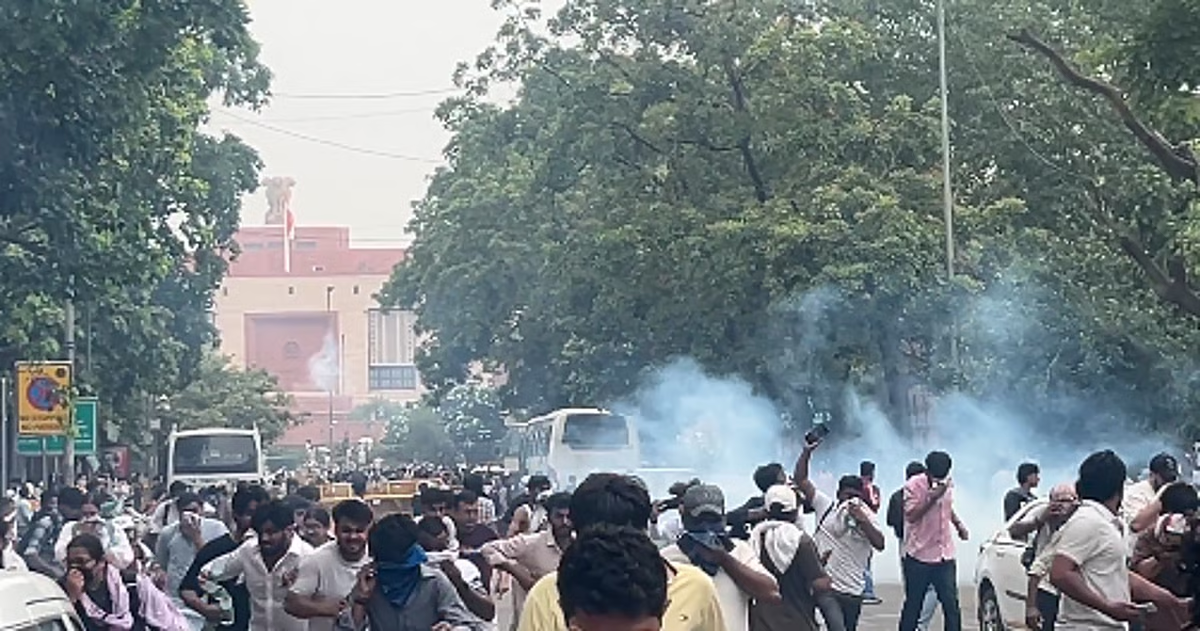
Tension escalated in the national capital on Monday after thousands of supporters of the Cockroach Janata Party (CJP) marched towards Parliament as part of the party’s much-publicised “Sansad Chalo” campaign. What began as a large demonstration from Jantar Mantar soon turned into a major confrontation when protesters approached the high-security Parliament zone despite restrictions imposed by the Delhi Police.
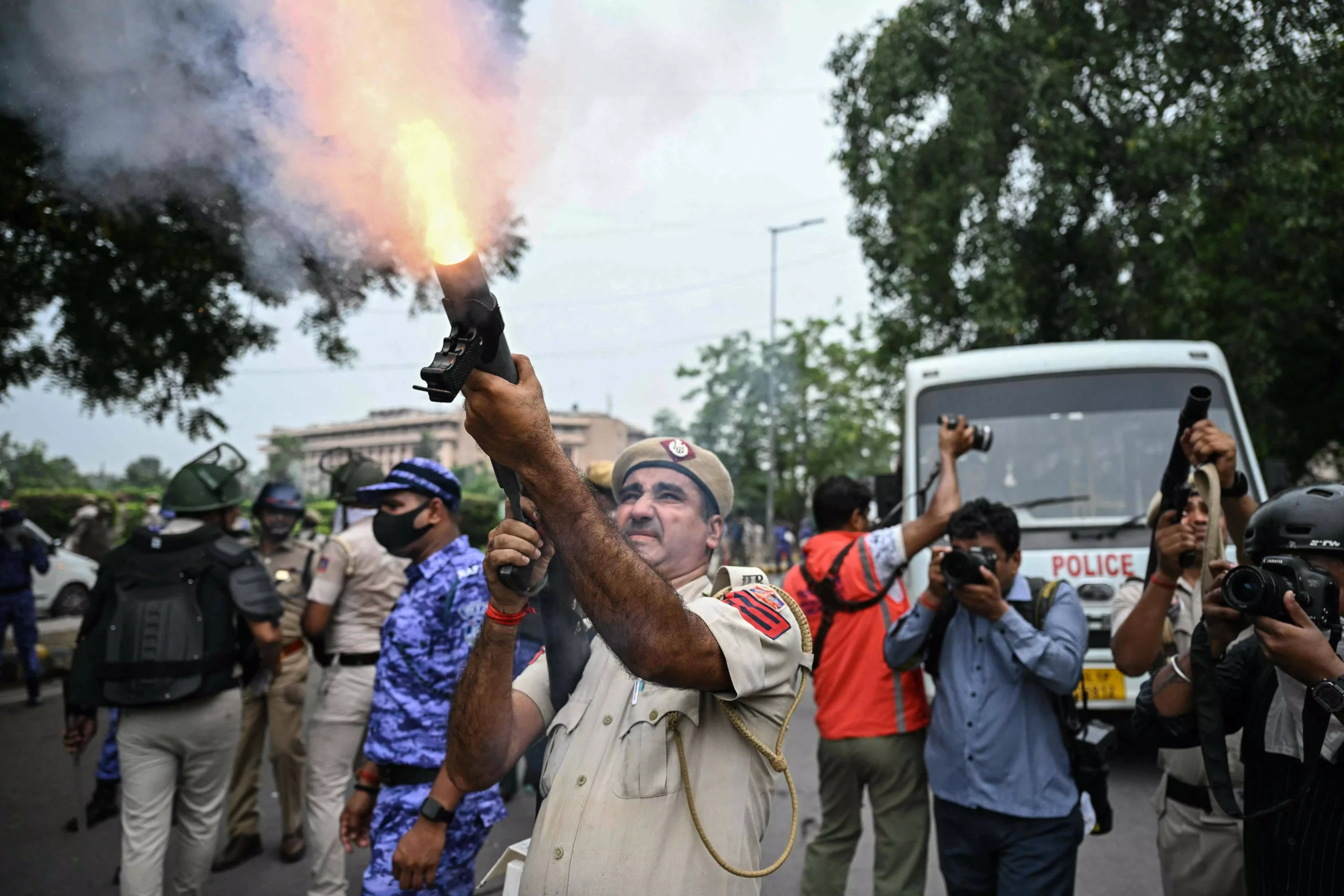
In response to the growing crowd, security agencies significantly strengthened deployment around Parliament House. Police erected multiple barricades, closed the main entrance to the Parliament complex as a precautionary measure, and deployed additional personnel to prevent demonstrators from entering restricted areas. As sections of the crowd attempted to move beyond the barricades, Delhi Police fired tear gas shells to disperse protesters, while several demonstrators were taken into preventive custody.
Table of Contents
The protest coincided with the commencement of the Monsoon Session of Parliament, making security arrangements even more stringent across central Delhi.
Protesters Reach Parliament Vicinity Despite Restrictions
Large numbers of students, youth groups, activists, and CJP supporters assembled at Jantar Mantar before beginning their march towards Parliament.
The protesters raised slogans demanding accountability over alleged examination paper leaks, transparency in the recruitment process, reforms in the education system, and action against those responsible for examination irregularities.
As the march progressed through central Delhi, demonstrators reached several prominent locations including Connaught Place, Janpath, Rail Bhavan, and areas close to Parliament House.
Despite repeated warnings from the Delhi Police regarding prohibitory orders, protesters continued advancing towards the high-security zone, resulting in a tense face-off with security personnel.
Tear Gas Used to Disperse the Crowd
As some protesters attempted to cross multiple layers of barricades near Parliament House, Delhi Police intervened to stop the crowd.
Officials initially appealed to demonstrators to maintain peace and avoid entering restricted areas. However, after sections of the gathering allegedly tried to push through police barricades, security personnel fired tear gas shells to disperse the crowd.
The use of tear gas created panic in parts of the protest site, forcing many demonstrators to move away temporarily.
Several protesters were also detained during the operation. Reports indicated that a number of demonstrators were taken into custody near the Reserve Bank of India (RBI) building while others staged sit-in protests near Rail Bhavan and the Press Club.
Authorities maintained that the security measures were necessary to prevent any breach of the Parliament security perimeter.
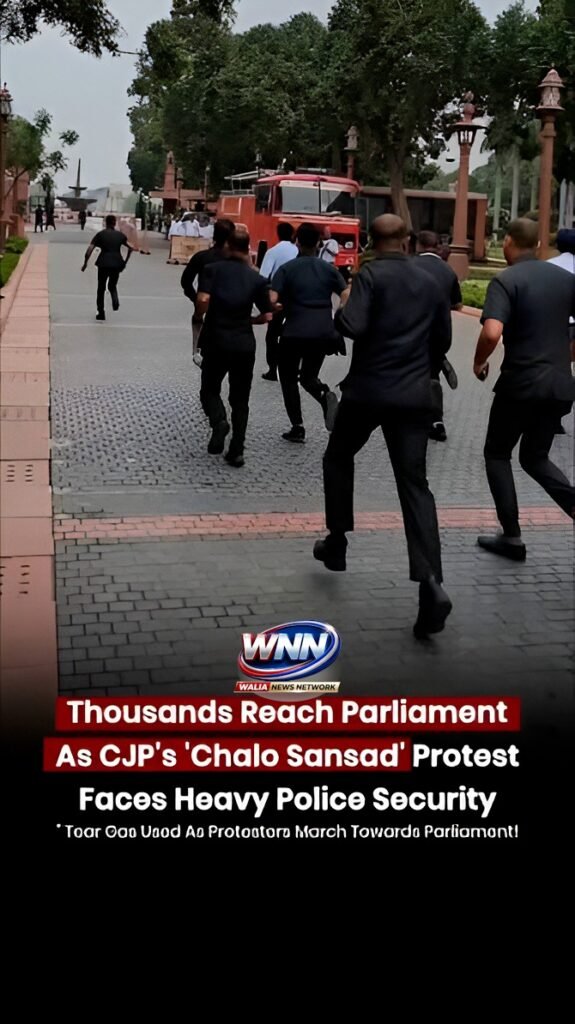
Main Gate of Parliament Closed as Precaution
In view of the rapidly evolving situation, authorities temporarily shut the main gate of Parliament House.
Additional police personnel, anti-riot units, and security vehicles were deployed across the surrounding area to ensure the safety of Members of Parliament, government officials, and public property.
Security officials continued monitoring the situation closely while restricting movement around sensitive government installations.
Officials stated that these arrangements were purely precautionary and intended to maintain law and order during the opening day of Parliament’s Monsoon Session.
High-Level Meetings Amid the Protest
Even as demonstrations continued outside Parliament, important political meetings were reported inside the Parliament complex.
According to reports, Union Education Minister Dharmendra Pradhan met Union Home Minister Amit Shah during the ongoing protest.
Although no official statement was immediately issued regarding the agenda of the meeting, its timing attracted significant attention because of the continuing nationwide protests over examination reforms and alleged paper leaks.
Political observers believe the meeting assumes importance given the growing pressure on the government over education-related issues.
Government Opens Door for Dialogue
While protests continued on the streets, indications also emerged that the government had initiated communication with CJP leaders.
According to party sources, Ashutosh Ranka and Saurav Das left the protest venue to meet Union Minister JP Nadda.
CJP representatives claimed that the government had approached the organisation earlier in the day to initiate discussions regarding its demands.
Party leaders reiterated that they remain open to constructive dialogue but stressed that meaningful reforms in the education system remain their primary objective.
They also maintained that the organisation’s demands had not changed despite the government’s outreach.
Delhi Police Commissioner Visits Parliament Street Police Station
Amid the unfolding developments, Delhi Police Commissioner Anurag Kumar reached Parliament Street Police Station to review the security situation.
Senior police officials continued monitoring crowd movement, deployment strategies, and law-and-order arrangements throughout the day.
The visit highlighted the seriousness with which the administration viewed the evolving protest.
Security agencies coordinated with multiple departments to ensure that the demonstrations did not affect Parliament proceedings or public safety.
Parliament Functioning Continues
Despite the heavy security deployment, parliamentary proceedings continued.
Bharatiya Janata Party MP Jagdambika Pal stated that Members of Parliament were not being prevented from entering Parliament despite reports regarding gate closures.
He clarified that legislators continued to access Parliament through designated routes.
Meanwhile, Union Minister Kiren Rijiju expressed concern over disruptions caused by protests outside Parliament.
He questioned how Parliament could function smoothly if such situations continued during the session.
Arvind Kejriwal Criticises Police Action
Reacting to the developments, former Delhi Chief Minister and Aam Aadmi Party national convener Arvind Kejriwal criticised the police action against protesters.
He alleged that instead of addressing concerns regarding the education system and examination irregularities, the government had responded by using force against young protesters.
Kejriwal stated that the country’s youth would not accept what he described as an attack on their democratic rights.
His remarks added a fresh political dimension to the ongoing protests.
Opposition Leaders Extend Support
Several opposition leaders joined the protest movement or expressed solidarity with the demonstrators.
Among those present were:
- Manish Sisodia
- Sanjay Singh
- Chandrashekhar Azad
- Actor Prakash Raj
- Geetanjali, wife of activist Sonam Wangchuk
Their participation reflected growing political support for the movement demanding examination reforms.
The presence of prominent public figures also drew considerable media attention to the demonstrations.
Chandrashekhar Azad Backs Student Movement
Azad Samaj Party chief and Member of Parliament Chandrashekhar Azad also addressed the gathering.
He said he had joined the movement because he believed young people were facing injustice.
Azad remarked that as an Indian citizen, he considered it his responsibility to stand alongside students demanding fairness and accountability.
He argued that concerns raised by young people deserved serious attention from the government.
Earlier Lathi Charge During March
Before protesters reached Parliament, police had already intervened when demonstrators attempted to move from Jantar Mantar towards Parliament.
Security personnel carried out a mild lathi charge after sections of the crowd allegedly tried to cross barricades.
Police maintained that minimum force was used only after repeated appeals requesting protesters to comply with restrictions failed.
Officials reiterated that prohibitory orders under Section 163 of the Bharatiya Nagarik Suraksha Sanhita (BNSS) remained in force throughout the New Delhi district.
Metro Services Temporarily Affected
The protest also disrupted normal public transport services.
The Delhi Metro Rail Corporation (DMRC) temporarily closed entry and exit at five metro stations located near the protest route.
These included:
- Rajiv Chowk
- Janpath
- Patel Chowk
- Central Secretariat
- Seva Teerth
Authorities stated that the decision was taken purely as a precautionary security measure.
Thousands of commuters were advised to use alternative stations while traffic diversions remained in place across central Delhi.
Large Gathering Despite No Official Permission
Delhi Police had earlier clarified that permission had not been granted for the CJP’s proposed march to Parliament.
Despite this, thousands of supporters gathered at Jantar Mantar before beginning the march.
The campaign was announced by CJP founder Abhijeet Dipke, who called upon supporters from across the country to participate.
The large turnout demonstrated the growing national attention surrounding issues of examination integrity and youth employment.
Key Demands of the Protest
The movement continues to focus on several major demands relating to India’s education system.
Among the principal demands are:
- Accountability for alleged examination paper leaks.
- Greater transparency in competitive examinations.
- Stronger reforms in the education system.
- Action against those responsible for examination irregularities.
- Resignation of Union Education Minister Dharmendra Pradhan.
Supporters argue that repeated paper leak controversies have damaged the credibility of public examinations and affected the future of millions of students.
They also expressed concern over youth unemployment and called for institutional reforms aimed at restoring confidence in recruitment and entrance examinations.
The CJP’s “Sansad Chalo” march turned central Delhi into the centre of a major political and public demonstration as thousands of protesters gathered near Parliament demanding accountability over alleged examination paper leaks and comprehensive reforms in India’s education system. The protest resulted in heightened security, closure of Parliament’s main gate, temporary suspension of access to key metro stations, and the use of tear gas and preventive detentions by Delhi Police after demonstrators attempted to move into restricted areas.
At the same time, parallel political developments—including meetings between senior Union ministers and outreach to CJP representatives—suggested that channels of dialogue may be opening even as protests continued on the streets. With the Monsoon Session of Parliament now underway and education reforms remaining at the centre of national debate, the developments in Delhi are expected to keep the issue firmly in public and political focus in the days ahead.