

Heated Lok Sabha Debate Shifts Focus From Anti-Paper Leak Law to Student Protest Crackdown
The debate over the Public Examinations (Prevention of Unfair Means) Amendment Bill, 2026 witnessed dramatic exchanges in the Lok Sabha as Congress MP Priyanka Gandhi Vadra launched a sharp attack,with Priyanka Gandhi questioning the government’s response on the Central Government, questioning the alleged use of force against students protesting over examination paper leaks,
While the government defended the proposed amendments as a major step toward protecting the integrity of India’s examination system, the opposition argued that legislation alone cannot restore students’ confidence unless accountability is ensured for both examination irregularities and the treatment of peaceful protesters.
Speaking during the parliamentary debate, Priyanka Gandhi questioned who authorised the reported use of lathi charges, tear gas, water cannons, and pellet guns against students participating in demonstrations demanding justice over repeated paper leak controversies.
Table of Contents
Priyanka Gandhi’s speech shifted the discussion, beyond the proposed law itself, raising broader concerns regarding student rights, democratic protest, accountability, and the government’s handling of public dissent.
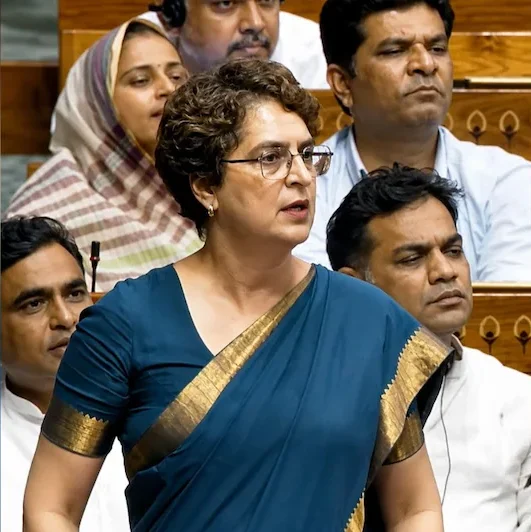
Priyanka Gandhi Demands Answers Over Police Action
Addressing the Lok Sabha, Priyanka Gandhi asked pointed questions regarding the police response to students who had participated in recent demonstrations against examination paper leaks.
Priyanka Gandhi questioned why students demanding fair examinations were allegedly subjected to force and asked who had authorised such action.
According to her remarks, thousands of young people had gathered peacefully to demand accountability after repeated examination irregularities.
Priyanka Gandhi questioned whether the protesters were being treated as criminals despite exercising their democratic right to protest.
Her remarks included questions directed at the country’s top leadership regarding responsibility for the police action during the July student demonstrations.
“Were They Terrorists?” — Strong Questions in Parliament
One of the most discussed moments of the debate came when Priyanka Gandhi questioned the necessity of using force against student demonstrators.
She asked why there was a need for tear gas, water cannons, baton charges, and the reported deployment of pellet guns during protests.
According to Priyanka Gandhi, the government’s response appeared disproportionate considering that the protesters were students demanding transparency in examinations rather than engaging in violence.
Her remarks quickly drew attention both inside Parliament and across social media, becoming one of the defining moments of the day’s debate.
Debate Intended to Focus on Strengthening Anti-Paper Leak Law
The parliamentary discussion was centred on the Public Examinations (Prevention of Unfair Means) Amendment Bill, 2026, introduced by the government to strengthen existing laws against examination fraud.
The proposed amendments seek to make India’s anti-paper leak legislation more stringent through tougher punishments, stronger investigative powers, and enhanced mechanisms to prevent organised examination fraud.
The government has argued that the amendments are necessary to restore public trust following controversies surrounding competitive examinations, particularly the NEET paper leak.
Among the proposed measures are:
- Increased prison terms for offenders.
- Higher financial penalties.
- Stronger action against organised paper leak syndicates.
- Faster investigation and prosecution mechanisms.
- Improved safeguards for examination integrity.
Government representatives described the legislation as a major reform intended to protect millions of students preparing for competitive examinations.
Opposition Says Accountability Must Extend Beyond New Laws
While several opposition leaders acknowledged the importance of stronger legal provisions against examination fraud, they argued that legislative reforms alone cannot address the deeper crisis affecting India’s education system.
Priyanka Gandhi maintained that repeated examination controversies have weakened students’ faith in public institutions.
According to her, the government must also explain why students protesting against these irregularities allegedly faced police action.
She argued that accountability should include both those responsible for examination failures and those responsible for handling peaceful demonstrations.
Opposition members also demanded transparency regarding investigations into paper leak networks and the implementation of reforms that prevent future irregularities.
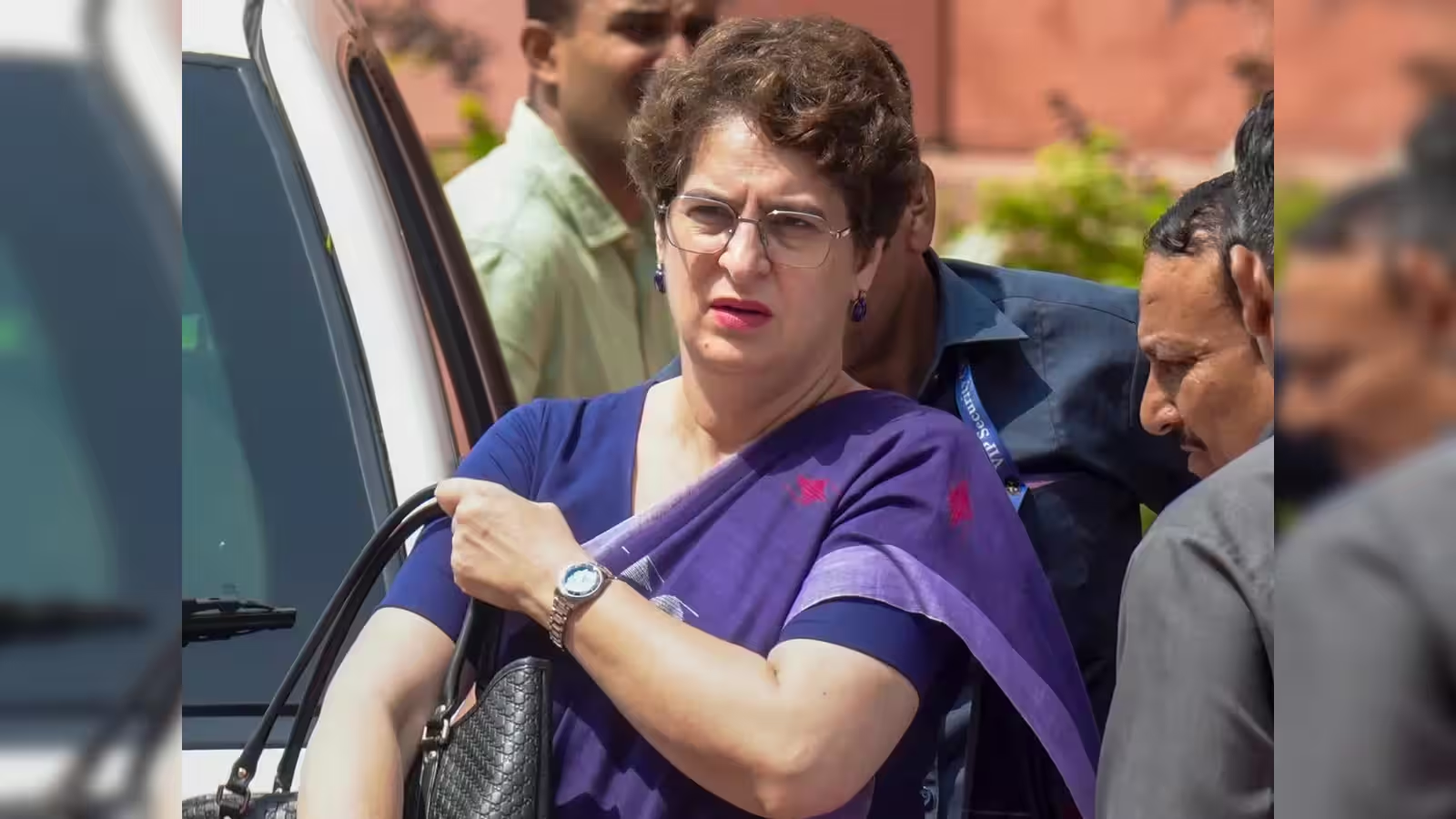
Students’ Protests Followed NEET Paper Leak Controversy
The current political debate is rooted in widespread student protests that followed allegations surrounding the NEET examination paper leak.
Across several states, students organised demonstrations demanding:
- Fair and transparent examinations.
- Strong action against paper leak syndicates.
- Institutional accountability.
- Better examination security.
- Protection of students’ rights.
The protests eventually became a nationwide movement, drawing support from education activists, opposition parties, and civil society organisations.
Several demonstrations were organised in Delhi, including gatherings near Jantar Mantar and marches demanding parliamentary discussion on examination reforms.
Government Defends Its Position
During the debate, government representatives defended the proposed amendments and maintained that the Centre has acted decisively following examination irregularities.
Supporters of the Bill argued that:
- The government ordered investigations into paper leak cases.
- Action has been initiated against those allegedly involved.
- Stronger laws are necessary to dismantle organised examination fraud networks.
- Students deserve a transparent and secure examination system.
The government also stated that the amendment aims to create a more foolproof examination process while strengthening legal deterrence against future paper leaks.
Political Debate Intensifies in Parliament
The anti-paper leak legislation has emerged as one of the most politically significant issues of the ongoing Monsoon Session.
Congress, along with other opposition parties, has repeatedly demanded detailed discussion on:
- Examination reforms.
- Student safety.
- Police action during protests.
- Accountability of public institutions.
- Government response to repeated paper leak incidents.
Meanwhile, the ruling alliance has maintained that the proposed legislation reflects its commitment to protecting students and ensuring fairness in public examinations.
The sharp exchanges highlighted deep political divisions over both education policy and the handling of public protests.
Education Experts Call for Structural Reforms
Experts believe stronger criminal laws can deter organised examination fraud but caution that legal reforms alone may not be sufficient.
Education specialists have suggested several long-term measures, including:
- End-to-end digital encryption of examination papers.
- Stronger cybersecurity systems.
- Independent examination oversight authorities.
- Improved monitoring of question paper distribution.
- Better coordination among examination agencies.
- Faster investigation of fraud cases.
- Greater transparency in recruitment and entrance examinations.
Many experts argue that restoring public confidence requires both institutional reform and consistent enforcement.
Youth Confidence Emerges as Central Issue
Throughout the debate, one recurring theme was the confidence of young people in India’s examination system.
Priyanka Gandhi argued that repeated paper leaks, combined with allegations of force against student protesters, have created a trust deficit among aspirants.
Government speakers responded that the amendment represents a decisive effort to rebuild confidence by ensuring stricter punishment for offenders and stronger protection of examination integrity.
Both sides agreed that the future of millions of students depends upon maintaining credibility in competitive examinations, although they differed sharply on how accountability should be ensured.
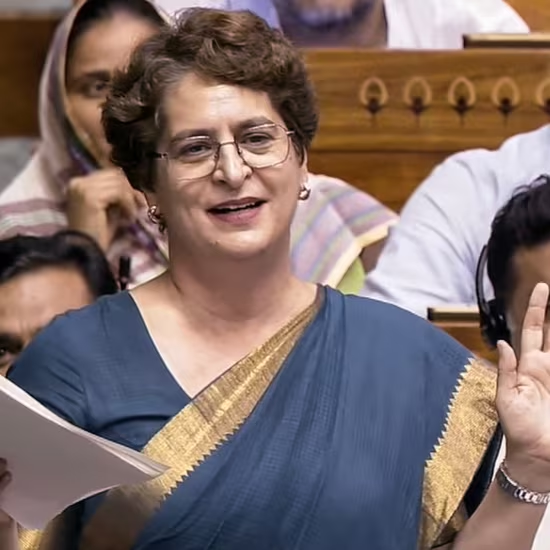
The Significance of the Amendment Bill
The Public Examinations (Prevention of Unfair Means) Amendment Bill, 2026 represents one of the government’s most significant legislative efforts to combat organised examination fraud.
If enacted, the amendments are expected to:
- Strengthen punishment for paper leak offences.
- Improve investigative capabilities.
- Increase deterrence against organised fraud.
- Protect the integrity of competitive examinations.
- Enhance confidence among students and parents.
The legislation comes after months of public debate following examination controversies that affected lakhs of aspirants across the country.
The Lok Sabha debate on the Anti-Paper Leak Bill evolved into a wider discussion about accountability, student rights, and the future of India’s education system. While the Centre defended the proposed amendments as a landmark step to curb examination fraud, Congress MP Priyanka Gandhi Vadra argued that meaningful reform also requires answers over the reported use of force against students protesting for fair examinations.
Her questions about who authorised police action during the protests added a new dimension to the parliamentary debate, ensuring that concerns over both examination integrity and the treatment of demonstrators remained at the centre of national attention.
As Parliament continues deliberating on the proposed amendments, students, educators, policymakers, and citizens will closely watch whether the new legislation—alongside demands for greater accountability—results in lasting reforms that strengthen public trust in India’s examination system while safeguarding democratic rights.