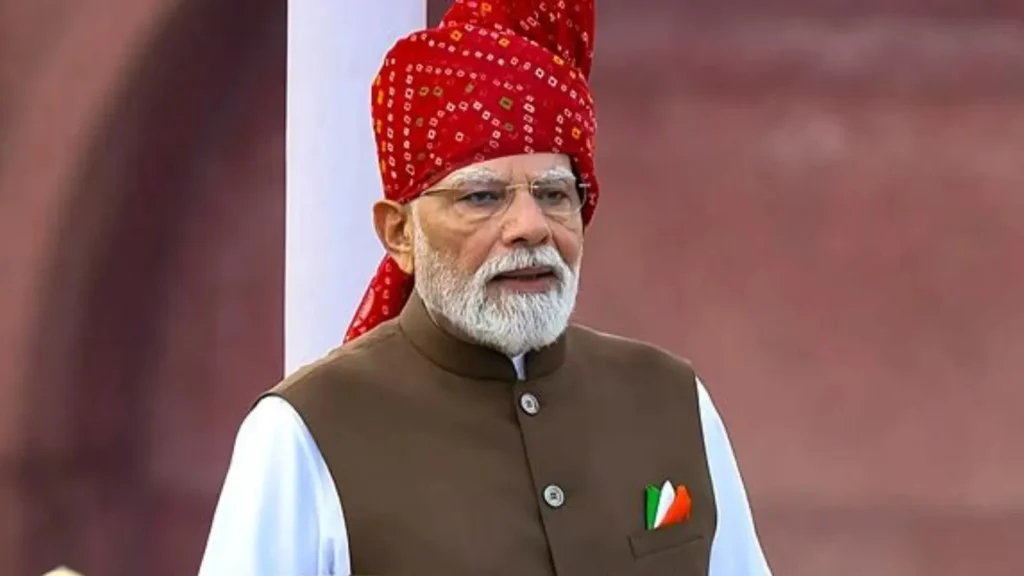
Prime Minister Narendra Modi’s traditional red Bandhej turban became one of the most noticeable elements of his appearance at the Red Fort on India’s 80th Independence Day on August 15, 2026. The striking tie-and-dye headgear, paired with a white kurta, brown Nehru jacket and tricolour pocket squares, once again brought India’s regional textile traditions into the national spotlight.
While the turban immediately attracted attention for its colour and distinctive dotted pattern, its significance goes beyond fashion. Bandhej, also known as Bandhani, is a traditional resist-dyeing craft strongly associated with Rajasthan and Gujarat. Its characteristic patterns are created by tightly tying tiny portions of fabric before dyeing, producing intricate dots and designs when the bindings are removed.
Modi’s choice is also part of a tradition he has followed since his first Independence Day address from the Red Fort in 2014, when he wore a red Jodhpuri Bandhej turban. Over the years, his Independence Day headgear has featured different regional styles, colours and textile traditions, including Bandhani and Leheriya.
Table of Contents
What Is Bandhej?
Bandhej is a traditional Indian tie-and-dye textile technique in which portions of fabric are tied or bound before the cloth is dyed. The tied sections resist the dye, creating characteristic patterns once the bindings are opened.
The technique is particularly associated with western India, especially Rajasthan and Gujarat, where Bandhani textiles have a long cultural history. The craft is used to create sarees, dupattas, odhnis, turbans and other traditional garments.
The defining feature of Bandhej is its intricate pattern of small dots. These are produced through numerous tiny bindings made across the fabric before dyeing. Depending on the design and technique, the finished textile can feature elaborate arrangements and combinations of colours.
This makes every carefully crafted Bandhej piece more than simply a coloured fabric. It represents a combination of textile knowledge, manual skill, regional traditions and artistic expression.
How Is Bandhej Made?
The process behind Bandhej requires considerable precision.
Traditionally, the fabric is pinched at numerous small points and tied tightly, creating areas that resist the dye. The cloth is then immersed in dye. After the dyeing process, the bindings are removed to reveal patterns formed by the contrast between dyed and protected areas.
The process can be repeated with different sections of fabric and different colours to create more complicated designs.
Traditional Bandhani production has involved skilled artisans working with very small sections of cloth. Historical descriptions of the craft note the use of different tying techniques and dyeing methods to produce distinctive patterns.
The apparent simplicity of dots and colour contrasts can therefore hide a highly detailed production process.
Why Is PM Modi’s Bandhej Turban Special?
The significance of Modi’s 2026 turban lies partly in the way it connects traditional craftsmanship with a major national occasion.
On August 15, the Prime Minister addresses the country from the Red Fort, making his clothing highly visible to audiences across India and around the world. His decision to wear a regional textile technique places that craft in a prominent national setting.
In 2026, Modi wore a red-to-maroon Bandhani-style safa featuring yellow and white motifs. He paired it with a white kurta-pyjama, a chocolate-brown Nehru jacket and tricolour pocket squares.
The combination created a balance between traditional Indian clothing and the symbolism of Independence Day.
A Link Between Rajasthan and Gujarat
Bandhej is particularly connected with the textile traditions of Rajasthan and Gujarat.
Although the craft has developed in different forms across regions, western India has remained an important centre for Bandhani production. The patterns, colours and styles can vary according to the region and local traditions.
This regional association gives the textile a cultural identity that extends beyond its visual appeal.
By choosing a Bandhej-style turban for a national celebration, the traditional craft becomes part of a broader story about India’s cultural diversity.
The Meaning Behind Tie-and-Dye Craftsmanship
Tie-and-dye techniques are found in many parts of the world, but Indian traditions such as Bandhej have developed distinctive regional identities.
The craft demonstrates how textile-making can combine design, technique and cultural memory.
The small dots visible on Bandhej fabric are not simply printed decorations. They are the result of the resist-dyeing process, in which sections of the fabric are deliberately protected from the dye.
This is one reason handmade Bandhej textiles are valued for their craftsmanship.
Bandhej and the Tradition of Turbans
Bandhani textiles have historically been used for different forms of traditional clothing, including men’s turbans and women’s garments.
The use of colourful textiles for turbans has particular importance in Rajasthan, where different styles of headgear have long been associated with regional identity and ceremonial occasions.
The Bandhej turban therefore fits naturally into the broader tradition of Indian headgear.
Modi’s Independence Day turbans have brought this tradition into contemporary public life, giving different regional styles an unusually large audience.
PM Modi’s Independence Day Turban Tradition Since 2014
The 2026 Bandhej turban was not an isolated fashion choice.
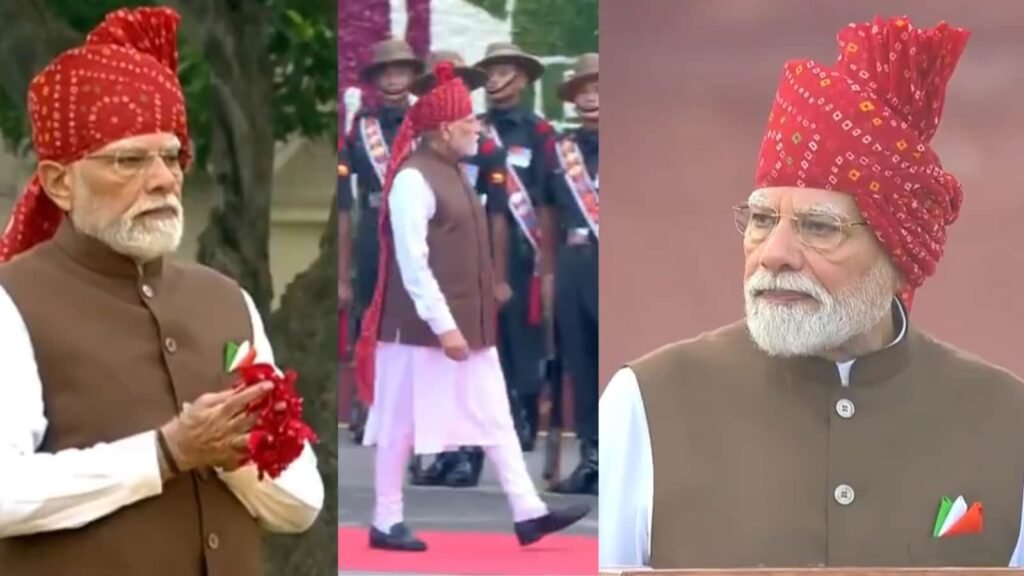
Modi’s distinctive Independence Day turbans have become a recurring feature of his appearances at the Red Fort. The tradition began with his first Independence Day address in 2014, when he wore a red Jodhpuri Bandhej turban.
Since then, his turbans have changed from year to year.
Different appearances have featured varying colours and textile styles, including Bandhani and Leheriya. The choices have often highlighted India’s regional textile traditions.
In 2025, for example, Modi wore a Rajasthani Leheriya-style turban, while earlier years featured other colourful regional designs.
This evolving collection of turbans has effectively become a visual record of Indian textile traditions.
From Bandhani to Leheriya
Bandhej is not the only traditional tie-and-dye technique associated with Modi’s Independence Day appearances.
Leheriya, another traditional textile technique associated particularly with Rajasthan, produces flowing wave-like patterns. The name is linked to the idea of waves, and the technique involves folding, rolling and tying fabric before dyeing it.
Bandhej and Leheriya therefore represent different approaches to resist dyeing.
Bandhej is known especially for its dotted patterns, while Leheriya is recognised for its characteristic wave designs.
Both demonstrate the diversity of India’s traditional textile craftsmanship.
Why Red Is Significant in the 2026 Look
The rich red or maroon colour of Modi’s 2026 Bandhej turban was among its most striking features.
Reports have described the shade variously as red or maroon, with the distinction partly influenced by lighting and photography. The turban also featured yellow and white motifs that stood out against the darker base.
The colour combination gave the headgear a strong visual presence while allowing the rest of the outfit to remain relatively understated.
The white kurta and brown jacket provided a neutral foundation, while the turban became the centrepiece of the look.
Tricolour Elements Added to the Outfit
The Bandhej turban was accompanied by three pocket squares in saffron, white and green, adding a direct visual connection with India’s national colours.
This combination brought together two different forms of symbolism.
The Bandhej turban represented regional craftsmanship and India’s textile heritage, while the tricolour elements connected the outfit to Independence Day.
Together, they created a look that combined regional cultural identity with national symbolism.
Why Traditional Crafts Matter Today
Traditional crafts such as Bandhej remain important because they preserve knowledge passed between generations.
Handcrafted textile techniques require specialised skills that can take years to learn. Maintaining interest in such crafts can help sustain artisan communities and keep traditional knowledge relevant.
When traditional textiles appear in major national events, they receive attention from audiences that may not otherwise encounter the craft.
The visibility created by prominent public figures can therefore contribute to wider awareness of India’s diverse textile traditions, although the long-term sustainability of crafts also depends on artisan livelihoods, markets and continued demand.
Bandhej Is More Than a Fashion Trend
It would be easy to view the 2026 turban simply as a fashion statement. However, the history and technique behind Bandhej demonstrate why it represents much more.
The textile carries regional associations, traditional production knowledge and distinctive artistic characteristics.
Its appearance at the Red Fort also placed that heritage within one of India’s most important annual national ceremonies.
This is what makes the turban particularly interesting from a cultural perspective: a traditional craft became part of a contemporary national visual narrative.
The Craft Behind the Symbol
A finished Bandhej turban can appear effortless, but the intricate patterns are the result of careful preparation.
Tiny sections of fabric have to be manipulated and tied before dyeing. The final pattern emerges only after the bindings are removed.
This relationship between human skill and visual result is central to traditional textile craftsmanship.
The process also explains why handmade Bandhej textiles can have subtle variations. Such variations can reflect the human hand involved in their creation rather than being flaws.
A Continuing Celebration of India’s Textile Heritage
Modi’s 2026 Independence Day appearance continues a pattern in which traditional Indian textiles have featured prominently in his public attire.
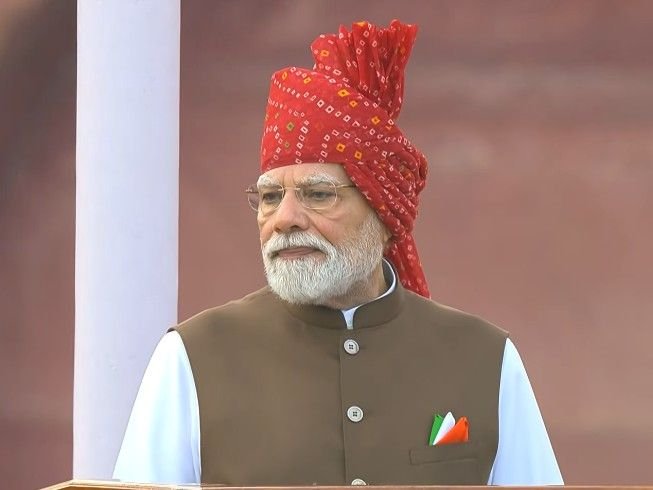
From Bandhej and Bandhani to Leheriya and other regional styles, the turbans worn at the Red Fort have drawn attention to different aspects of India’s textile culture.
The practice has made the Prime Minister’s Independence Day headgear a subject of public interest in its own right.
Each year’s selection offers a different combination of colour, design and regional identity.
PM Narendra Modi’s red Bandhej turban on the 80th Independence Day was more than a distinctive piece of headgear. It highlighted an Indian tie-and-dye tradition associated strongly with Rajasthan and Gujarat and brought the craftsmanship into the national spotlight.
The tiny dotted patterns characteristic of Bandhej are created through a detailed resist-dyeing process in which sections of fabric are carefully tied before colouring. The technique represents generations of textile knowledge and remains an important part of western India’s cultural heritage.
For the 2026 Independence Day ceremony, the traditional turban was paired with a white kurta, brown Nehru jacket and saffron-white-green pocket squares, creating a visual combination of regional craftsmanship, traditional Indian attire and national symbolism.
Ultimately, the significance of the Bandhej turban lies not only in how it looked at the Red Fort but also in the story woven into the fabric itself: a reminder that India’s cultural identity is expressed through countless regional crafts, colours, techniques and traditions.