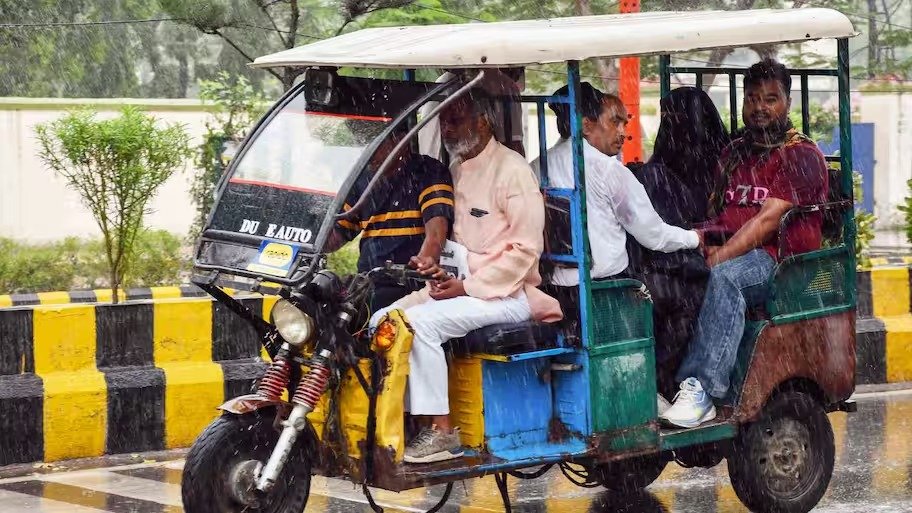
E-rickshaw drivers across India have received significant relief after the Central government directed Google and Apple to remove the BAT-BMS application from their respective app stores. The decision comes after serious concerns emerged that the app could allegedly be misused to remotely switch off an e-rickshaw through unsecured Bluetooth connectivity, putting both drivers and passengers at risk. The move reflects the government’s growing focus on cybersecurity, public safety, and the protection of millions of people who rely on e-rickshaw services for their daily livelihood.
The action was announced by Ministry of Electronics and Information Technology (MeitY) Secretary S. Krishnan during the Confederation of Indian Industry (CII) Cybersecurity Summit in New Delhi. According to government officials, the app had become a potential safety threat after multiple viral videos showed individuals exploiting its Bluetooth connection to stop moving vehicles without the knowledge or consent of drivers.
The decision has been welcomed by transport experts, cybersecurity professionals, and driver associations, many of whom had raised concerns over the lack of security controls within the application.
Table of Contents
Why the Government Took Action
The government’s intervention was triggered after several videos circulated on social media demonstrating how an e-rickshaw could allegedly be disabled remotely using the BAT-BMS application. These videos showed pranksters connecting to nearby vehicles through unsecured Bluetooth signals and switching off their battery management systems while the vehicles were operating on public roads.
Although such demonstrations were initially presented as online pranks, authorities viewed the issue as far more serious.
A moving e-rickshaw suddenly losing power in traffic can create dangerous situations, particularly on crowded urban roads where vehicles, pedestrians, cyclists, and motorcycles share limited space. A sudden shutdown may increase the risk of collisions, traffic congestion, or injuries.
Beyond physical safety, officials also highlighted the financial impact on drivers whose daily income depends entirely on uninterrupted operations.
Understanding the BAT-BMS Application
The BAT-BMS app was designed to communicate with the Battery Management System (BMS) installed in certain lithium-ion battery packs used by an e-rickshaw.
Battery Management Systems play a critical role in electric vehicles. They monitor battery temperature, charging cycles, voltage levels, battery health, and overall performance. Through companion mobile applications, users can often view battery information, diagnose technical issues, or monitor charging status.
However, investigators found that in some cases, the Bluetooth communication between the app and the battery system lacked sufficient authentication and security measures.
This meant that someone within Bluetooth range could potentially connect to the battery if security protections were weak or absent.
Instead of being restricted to the rightful owner, the system allegedly allowed unauthorized users to establish a connection and interfere with the battery controls.
How the Security Flaw Worked
Cybersecurity experts explain that Bluetooth technology itself is not unsafe. The real concern arises when devices are designed without proper authentication protocols.
Normally, a Bluetooth-enabled device requires secure pairing, passwords, encryption, or owner verification before allowing control functions.
If those protections are missing, another nearby smartphone may detect the device and establish a connection.
In the case involving the BAT-BMS application, reports suggested that unauthorized users could allegedly access battery controls without adequate verification.
As demonstrated in viral videos, this vulnerability allowed pranksters to remotely switch off an e-rickshaw while it was in operation.
Such incidents raised immediate concerns because they transformed what appeared to be a software weakness into a genuine public safety issue.
Impact on e-rickshaw Drivers
For thousands of drivers, an e-rickshaw is not simply a vehicle—it represents their primary source of income.
Unlike private vehicle owners, commercial drivers often complete dozens of trips every day to earn enough money for household expenses, loan repayments, vehicle maintenance, and battery charging costs.
Unexpected shutdowns can lead to:
- Loss of passengers
- Cancellation of rides
- Reduced daily earnings
- Vehicle damage in traffic
- Increased accident risks
- Emotional stress and uncertainty
Driver associations argued that operators should not suffer because of security weaknesses in software developed by manufacturers or third-party companies.
The government’s decision is therefore being viewed as an important step toward protecting both livelihoods and road safety.

Cybersecurity Is Now a Transport Issue
The incident highlights how cybersecurity is becoming increasingly important in the transportation sector.
Modern vehicles—including an e-rickshaw—are no longer entirely mechanical machines. They increasingly rely on software, mobile applications, digital communication systems, and smart battery technologies.
As more transport systems become connected through smartphones and wireless communication, cybersecurity vulnerabilities can quickly become real-world safety problems.
Experts believe manufacturers must now treat software security with the same seriousness as mechanical safety.
Features designed for user convenience should never compromise the safe operation of a moving vehicle.
Government’s Growing Focus on Digital Safety
The removal of the BAT-BMS application also reflects India’s broader emphasis on digital trust and secure technology adoption.
Over the past few years, government agencies have repeatedly stressed that digital innovation must be accompanied by strong cybersecurity practices.
Whether involving banking applications, digital payment platforms, connected vehicles, or Internet of Things (IoT) devices, software developers are increasingly expected to implement secure authentication, encrypted communication, and regular security updates.
Officials have indicated that public safety cannot be compromised because of weak application design.
By directing Google and Apple to remove the application from their platforms, authorities have effectively prevented new downloads while investigations and corrective measures continue.
Importance of Secure Battery Management Systems
Battery Management Systems are among the most important components in an electric vehicle.
Their primary responsibilities include:
- Monitoring battery temperature
- Preventing overheating
- Managing charging cycles
- Protecting batteries from overcharging
- Improving battery lifespan
- Maintaining safe voltage levels
Because these systems directly control the battery, any unauthorized access can have serious consequences.
Experts believe future Battery Management Systems should include:
- Strong password protection
- Device-specific authentication
- End-to-end encrypted communication
- Multi-factor verification
- Automatic security updates
- Restricted administrative access
These measures significantly reduce the possibility of unauthorized control.
Rising Popularity of e-rickshaw in India
The issue has attracted widespread attention because the e-rickshaw sector has grown rapidly across India over the last decade.
An e-rickshaw has become one of the country’s most affordable and environmentally friendly modes of urban transportation.
These vehicles provide last-mile connectivity between metro stations, railway stations, bus terminals, residential colonies, and marketplaces.
They also generate employment for lakhs of drivers, particularly in small towns and expanding urban centres.
Compared with conventional fuel-powered vehicles, an e-rickshaw offers lower operating costs, reduced emissions, and quieter operation, making it an increasingly attractive transport option.
As India’s electric mobility ecosystem expands, ensuring the digital security of connected vehicle systems will become just as important as improving battery technology and charging infrastructure.
Industry May Need Stronger Standards
Cybersecurity professionals believe this incident could encourage regulators to introduce stronger technical standards for software connected to electric vehicles.
Possible future requirements may include:
- Mandatory security testing before launch.
- Regular vulnerability assessments.
- Independent cybersecurity certification.
- Software penetration testing.
- Secure Bluetooth implementation.
- Faster security patch deployment.
Such standards already exist in several international automotive markets and are becoming increasingly relevant as connected mobility grows worldwide.
Developers may also be required to conduct regular software audits to identify weaknesses before applications reach consumers.
Social Media Played a Key Role
Interestingly, the issue came to official attention because of viral online videos.
The widespread circulation of demonstrations exposed how easily the vulnerability could allegedly be exploited.
While authorities discourage misuse of such weaknesses, the videos also served as evidence that immediate intervention was necessary.
This illustrates how social media can sometimes help regulators identify technological risks that might otherwise remain unnoticed for longer periods.
However, experts caution that publicly demonstrating security flaws without responsible disclosure can also encourage misuse before fixes become available.
What Happens Next?
Although the BAT-BMS application has now been removed from Google Play Store and Apple’s App Store following government directions, the incident is expected to trigger broader discussions around cybersecurity standards for connected electric vehicles.
Manufacturers may now face greater scrutiny regarding how their mobile applications communicate with vehicle components.
Security researchers are likely to examine similar applications used in an e-rickshaw and other electric vehicles to ensure that comparable vulnerabilities do not exist elsewhere.
For millions of drivers who depend on an e-rickshaw every day, the government’s swift action offers reassurance that digital technology must enhance convenience without compromising safety. As India’s electric mobility revolution continues, this case serves as a reminder that software security is no longer just an IT concern—it is an essential part of road safety, public trust, and the future of connected transportation.