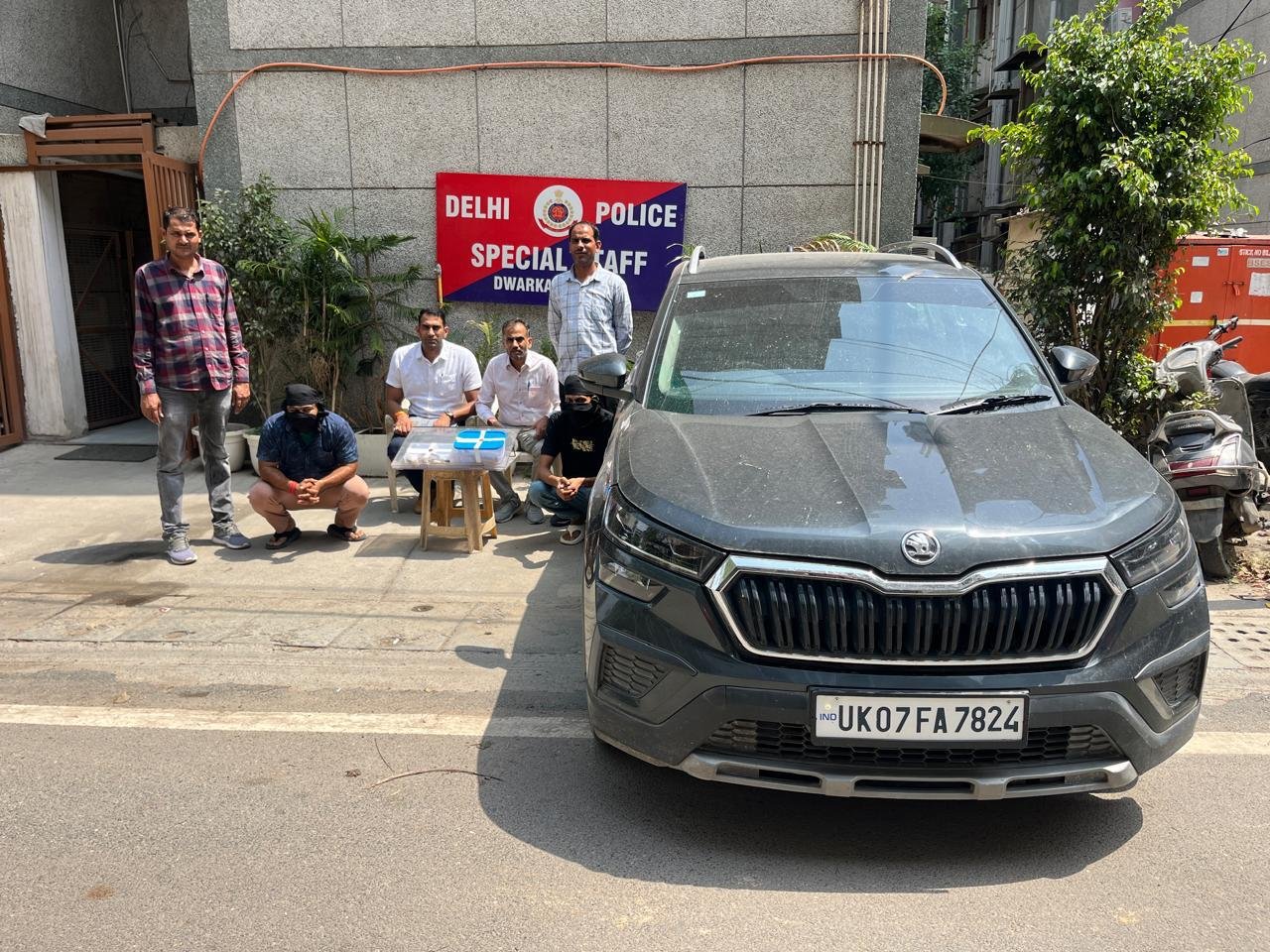
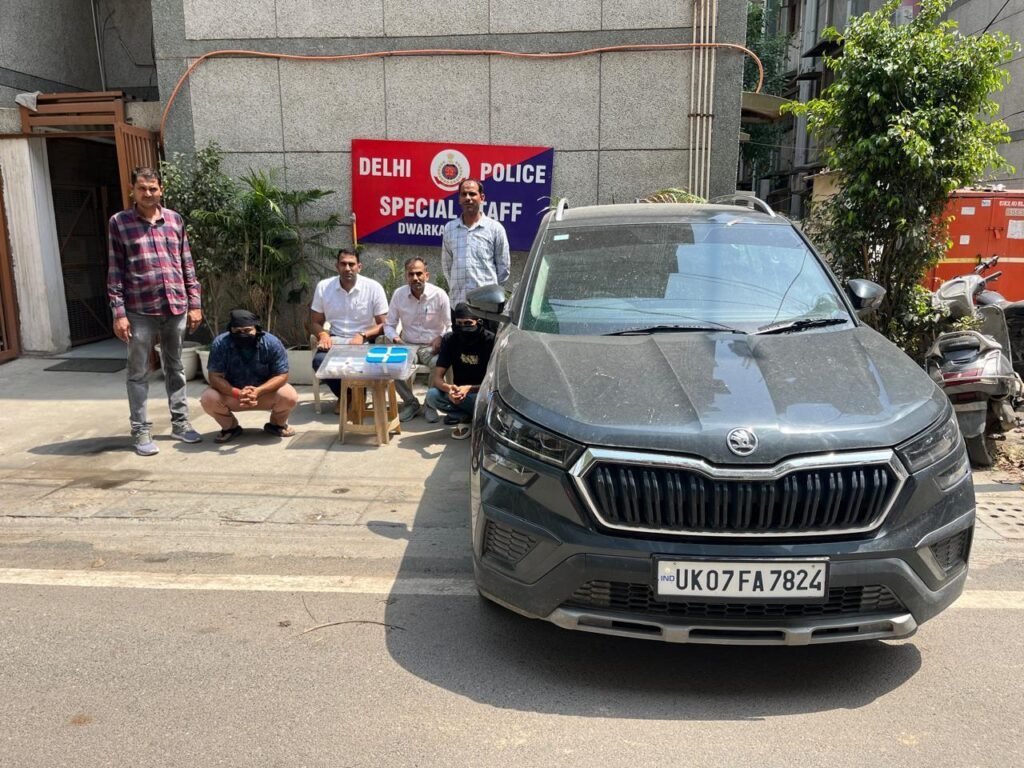
The Delhi Police’s ongoing anti-crime campaign, No Guns No Gangs, has led to another significant breakthrough with the arrest of two alleged criminals, including an associate of the notorious Kapil Sangwan alias Nandu gang. During the operation, officers of the Special Staff in Dwarka District recovered two country-made pistols, two live cartridges, and a stolen Skoda car that was allegedly being used with a fake registration number to evade police detection.
The operation forms part of the wider No Guns- No Gangs initiative launched by Dwarka District Police to curb the circulation of illegal firearms, dismantle organised criminal networks, and prevent violent crimes before they occur. Rather than waiting for criminal incidents to take place, the campaign focuses on identifying habitual offenders, tracing illegal weapons, and disrupting gang activities through intelligence-led policing.
Police officials said the latest arrests highlight the importance of continuous surveillance, technical intelligence, and coordinated field operations in tackling repeat offenders who continue to pose a threat to public safety.
Table of Contents
No Guns- No Gangs Continues Crackdown on Organized Crime
Illegal firearms remain one of the biggest concerns for law enforcement agencies in metropolitan cities. Country-made pistols are frequently recovered in cases involving extortion, robbery, attempted murder, gang rivalry, property disputes, and vehicle theft. Criminal groups often rely on such weapons because they are inexpensive, easily concealed, and capable of intimidating victims.
Recognising these challenges, Delhi Police has intensified enforcement under No Guns- No Gangs, a campaign aimed at reducing the availability of illegal weapons while targeting habitual offenders and organised criminal networks operating across different parts of the capital.
According to police officials, the latest operation was carried out under the leadership of Deputy Commissioner of Police (Dwarka) Kushal Pal Singh, IPS. The Special Staff team worked under the supervision of ACP Operations Subhash Malik and was led by Inspector Kamlesh Kumar along with a dedicated team of investigating officers, head constables, and constables who had been monitoring the activities of known criminals for several days.
Intelligence-Based Investigation Led to Breakthrough
The success of No Guns- No Gangs was the result of detailed planning rather than a chance encounter.
Police officials said surveillance was mounted on individuals with known criminal backgrounds, while historical crime records and movement patterns were analysed to identify potential suspects. No Guns No Gangs Multiple checkpoints were established in sensitive areas, and confidential sources were deployed to gather real-time information regarding the movement of habitual offenders.
Investigators eventually received a specific intelligence input indicating that a habitual criminal involved in multiple serious offences was moving around the Dabri area in a stolen Skoda car fitted with a fake registration plate.
Instead of launching a random search, officers relied on both technical surveillance and human intelligence to trace the suspect’s exact location. No Guns No Gangs Such intelligence-driven policing has increasingly become an important strategy for modern law enforcement agencies because it allows police to focus resources on high-risk offenders.
Gang Associate Arrested in Bindapur
Acting on the intelligence, the Special Staff reached Kesho Ram Park in the Bindapur area, where they intercepted the suspect while he was travelling in a Skoda car.
The accused was identified as Sonu Choudhary alias Sahil, 36, a resident of Hastsal in Uttam Nagar.
During his search, police recovered one country-made pistol along with live ammunition. Further verification revealed that the Skoda car had been stolen from the jurisdiction of Police Station Maurya Enclave in northwest Delhi.
Investigators also found that the vehicle was allegedly being driven with a fake registration number belonging to Uttarakhand in an apparent attempt to avoid detection during police checks and CCTV surveillance.
Police subsequently registered a case under the Arms Act and relevant provisions of the Bharatiya Nyaya Sanhita before taking the accused into custody.
Link to Kapil Sangwan Alias Nandu Gang
During interrogation, investigators found that Sonu Choudhary had allegedly maintained links with associates of Kapil Sangwan alias Nandu, a gangster whose network has remained under the scanner of law enforcement agencies for several years.
According to police records, Sonu had earlier come into contact with Vicky alias Sanyasi, described as a close associate of the gang.
Police further alleged that in 2023 he was involved in a firing incident linked to a property dispute in the Palam area, where shots were allegedly fired at a woman during an attempt to grab a plot.
He had previously been arrested in that case but allegedly resumed criminal activities after securing release from jail.
Investigators are now examining whether his recent activities were connected to organised gang operations or independent criminal acts.
Facilitator Arrested During Follow-Up Raid
The investigation did not end with the first arrest.
After obtaining police custody of Sonu Choudhary, investigators continued questioning him while simultaneously analysing technical evidence and surveillance data.
Based on fresh leads generated during interrogation, police conducted another raid in Burari.
During the operation, officers arrested Shivender alias Harsh alias Jakee, who was allegedly responsible for arranging the illegal firearm and the stolen vehicle used by Sonu.
Police recovered another country-made pistol along with one live cartridge from his possession.
During questioning, Shivender allegedly admitted that he had stolen the Skoda car to earn money through criminal activities.
Investigators are continuing to verify his disclosures and examine No Guns No Gangs whether additional stolen vehicles or illegal weapons may be linked to him.
Long Criminal Histories Raise Concern
One aspect that makes the latest arrests significant is the criminal history of both accused.
Police records indicate that Sonu Choudhary has previously been involved in twelve criminal cases, including allegations relating to attempted murder, kidnapping for carjacking, robbery, theft, and violations under the Arms Act.
Similarly, Shivender has an even longer criminal record.
According to investigators, he has been involved in twenty-nine criminal cases and is listed as a Bad Character (BC) at Police Station Subzi Mandi in North Delhi.
Repeat offenders often remain under continuous police monitoring because of the possibility of re-engaging in organised criminal activity after release from custody.
Crime experts have frequently observed that individuals with lengthy criminal histories often possess established networks capable of facilitating No Guns No Gangs offences involving stolen vehicles, illegal firearms, extortion, and violent crimes.
Recovery Highlights Continuing Challenge of Illegal Firearms
The recoveries made during No Guns- No Gangs underline the continuing challenge posed by illegal weapons in Delhi and neighbouring regions.
Police recovered:
- Two country-made pistols.
- Two live cartridges.
- One stolen Skoda car.
- A vehicle allegedly fitted with a fake registration number.
Although the number of weapons recovered may appear limited, law enforcement experts note that even a single illegal firearm has the potential to be used in multiple violent crimes.
Recovering such weapons before they are used helps reduce risks to public safety and may prevent future offences.
Stolen vehicles also frequently play a role in organised crime because they allow offenders to travel anonymously while No Guns No Gangs reducing the chances of identification through automated surveillance systems.
Why Intelligence-Led Policing Matters
Operations such as No Guns- No Gangs demonstrate the increasing reliance of police agencies on intelligence-led investigations rather than purely reactive policing.
Instead of responding only after crimes occur, investigators now analyse criminal databases, monitor known offenders, No Guns No Gangs gather information from confidential sources, and use technical surveillance to identify potential threats before violence takes place.
This approach allows law enforcement agencies to focus their resources on individuals considered most likely to be involved in organised criminal activity.
Security specialists believe preventive policing has become increasingly important in urban centres where organised gangs often operate across multiple jurisdictions.
Illegal Firearms and Organised Crime
Illegal firearms remain closely associated with organised crime across several parts of India.
Country-made pistols are often used because they are cheaper than factory-manufactured weapons and are easier to obtain through illegal networks.
Law enforcement agencies have repeatedly pointed out that the availability of such firearms contributes to violent crimes, including extortion, targeted attacks, robberies, and gang rivalries.
Campaigns such as No Guns No Gangs therefore aim not only to arrest offenders but also to disrupt the supply chains responsible for manufacturing, transporting, and distributing illegal weapons.
Investigators are expected to continue tracing the origin of the recovered firearms as part of the ongoing investigation.
Continuing Investigation
Police have registered the necessary criminal cases under the Arms Act and relevant provisions of the Bharatiya Nyaya Sanhita. Investigators are examining digital evidence, technical surveillance records, and disclosures made during interrogation to identify whether other individuals may have assisted the accused or supplied the illegal firearms.
The investigation is also expected to focus on possible links between the accused and organised criminal networks, the source of the recovered weapons, and the circumstances surrounding the theft and use of the Skoda vehicle.
The latest action under No Guns No Gangs reflects the continued efforts of the Special Staff of Dwarka District to identify repeat offenders, recover illegal weapons, and disrupt criminal activity through intelligence-based policing. The operation showcases the careful planning, coordination, and vigilance of the police teams involved, whose timely action led to the seizure of illegal firearms and a stolen vehicle before they could allegedly be used in further criminal activities.