BMW X1 LWB 2026 brings a significant change to BMW’s smallest SUV in India by adding a longer wheelbase and substantially more rear-seat space. While the standard-wheelbase X1 continues to be available, the new long-wheelbase version is designed to appeal particularly to buyers who prioritise passenger comfort and chauffeur-driven usability.
The X1 LWB is not an entirely new concept for BMW. China has offered a long-wheelbase version of the BMW X1 for several years, while India received the all-electric iX1 LWB last year. The latest model extends that formula to the internal-combustion X1 range, combining the familiar BMW SUV design with a more spacious rear cabin.
BMW is expected to announce the BMW X1 LWB’s price on August 21, with an estimated ex-showroom price of around Rs 50 lakh to Rs 55 lakh. At that price, the SUV will take on premium compact luxury SUVs such as the Mercedes-Benz GLA and Audi Q3, while differentiating itself primarily through rear-seat space.
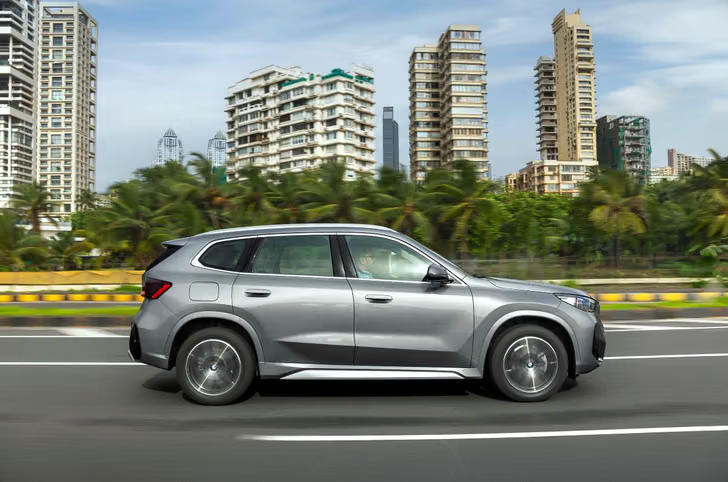
Table of Contents
BMW X1 LWB Gets a Longer and More Spacious Body
The most important change to the BMW X1 LWB is its increased length and wheelbase.
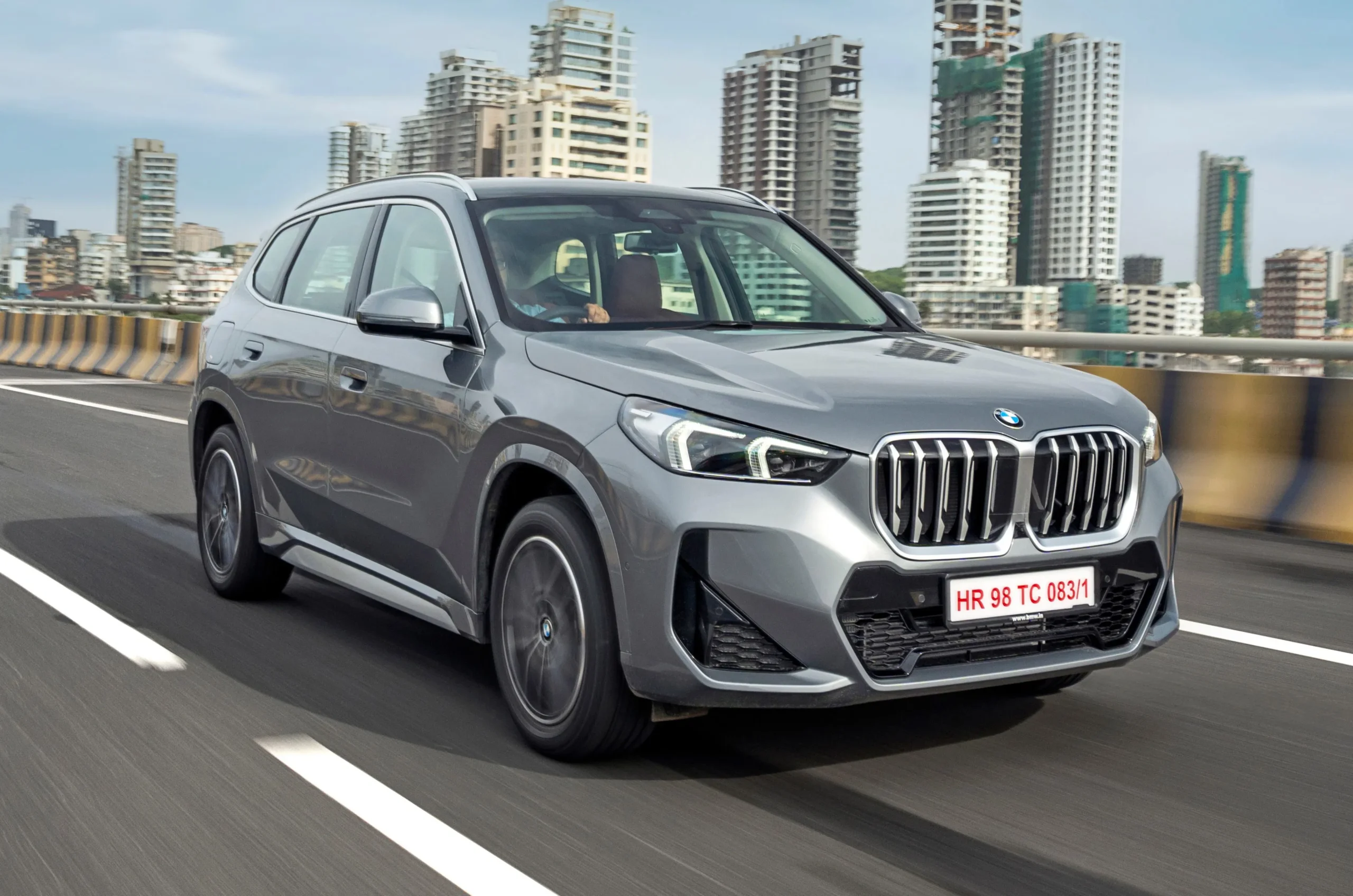
Compared with the standard-wheelbase X1, the long-wheelbase model is 116mm longer overall, with 108mm of the additional length added to the wheelbase. This increase might sound significant on paper, but BMW has managed to maintain balanced proportions.
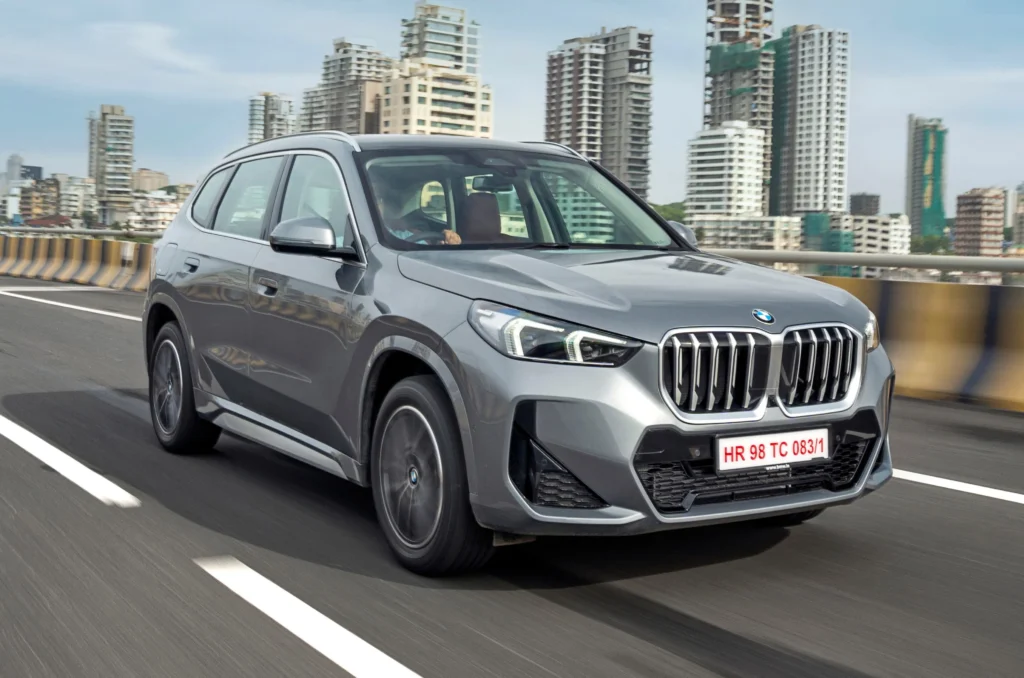
Unlike some long-wheelbase vehicles that can look stretched, the BMW X1 LWB retains the overall visual character of the standard BMW X1. The extended body is relatively discreet, allowing the SUV to maintain its familiar premium appearance.
The front-end design remains recognisable, with BMW’s familiar headlamp treatment and grille. The model is also equipped with the M Sport styling package, giving it a more aggressive appearance.
At the rear, the SUV carries over the sharp-looking tail-lamp design. The 18-inch alloy wheels are also shared with other BMW X1 variants, although larger or more distinctive wheels could have given the LWB version a stronger visual identity.
One of the subtle differences is the use of a chrome surround around the large side windows. The standard BMW X1 uses a black-effect treatment, making the chrome detailing one of the easiest ways to distinguish the LWB model.
The conventional front grille also separates the petrol-powered X1 LWB from the electric iX1 LWB, which uses a closed-off grille design.
Rear Seat Space Is the X1 LWB’s Biggest Strength
The biggest reason to consider the BMW X1 LWB is undoubtedly its rear cabin.
The longer wheelbase has created substantially more legroom, making the SUV significantly more accommodating for rear passengers. Even occupants around six feet tall should find the available legroom generous.
Getting into the rear cabin is also easy thanks to the wide-opening rear doors and large door apertures.
Once seated, passengers benefit from the SUV’s large glasshouse, which creates an airy feeling inside. The panoramic glass roof adds further brightness to the cabin, although it does not open.
The rear windows are also relatively large, helping visibility and making the cabin feel less enclosed. However, the absence of adjustable sunshades on the rear windows is a notable omission for a vehicle that places such emphasis on passenger comfort.
BMW has also revised the rear seats. The cushioning has been enhanced, while the seat base is 15mm longer, providing additional thigh support.
The rear backrest can also be reclined by a couple of degrees, allowing passengers to adopt a more relaxed seating position on longer journeys.
The additional legroom also benefits the middle passenger. There is more space to position the feet on either side of the centre tunnel, although the rear bench is still best suited to two adults for maximum comfort.
Familiar BMW Cabin Up Front
While the rear cabin has received substantial attention, the front section of the X1 LWB remains largely unchanged from the standard BMW X1.
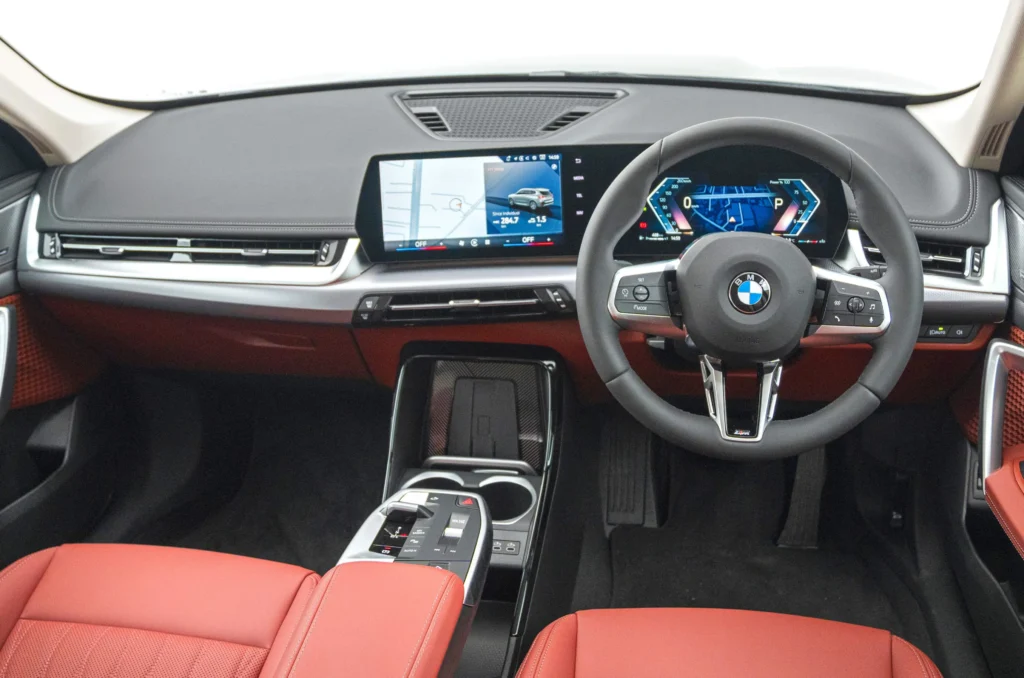
The dashboard has a modern and youthful appearance, highlighted by asymmetric air vents and BMW’s curved display arrangement.
A vertically positioned wireless smartphone charging pad is located at the base of the dashboard, while the floating centre console houses several important controls, including the gear selector, volume control and driving-mode buttons.
There is also storage underneath the front centre armrest. However, the lid opens towards the passenger side, which may not be the most convenient arrangement for the driver.
BMW offers different upholstery themes, including the brown interior seen on the reviewed vehicle and a white-and-black combination.
The front seats provide good support and have a sporty design. However, BMW has removed the massage function from the X1 LWB. Seat ventilation is also unavailable.
The M Sport steering wheel comes as standard, although its chunky design may not suit every driver’s hands. The steering wheel also misses out on paddle shifters.
Interior Quality Is Good but Not Class-Leading
The X1 LWB’s cabin generally feels premium, particularly at key touchpoints.
The dashboard features padded materials, while the textured metal-like trim adds visual interest. However, the cabin does not deliver quite the same level of detailing found in more expensive BMW models.
For example, the USB ports on the dashboard are not backlit, which can make them difficult to locate at night.
The ambient lighting is another area where the BMW X1 LWB falls slightly behind some rivals. Mercedes-Benz models such as the GLA offer a more visually dramatic lighting experience.
Boot practicality remains strong. BMW claims a 540-litre boot capacity, providing sufficient room for large bags and luggage.
A space-saver spare wheel is positioned underneath the boot floor, adding another layer of practicality for Indian conditions.
BMW X1 LWB Gets a Long List of Features
The X1 LWB is available in a single M Sport trim, with a reasonably comprehensive equipment list.
The dashboard uses BMW’s Curved Display, comprising a 10.25-inch digital instrument cluster and a 10.7-inch touchscreen infotainment system.
The digital instrument display provides all the necessary information, although its hexagonal graphical themes may not appeal to every user.
The touchscreen is sharp and responsive, but the extensive integration of functions into the display can make the interface complicated while driving. Climate controls, for example, are accessed through the touchscreen rather than conventional physical controls.
One of the standout features is the 360-degree camera, which provides a clear view around the vehicle and is particularly useful when manoeuvring in tight spaces.
The X1 LWB also gets BMW’s Reversing Assistant. The system can remember the vehicle’s previous path and automatically retrace it while reversing for up to 50 metres, making it useful in narrow or difficult locations.
BMW also offers subscription-based access to certain additional digital features, including advanced maps, customisable icons and additional display themes.
Other features include a digital key that can be shared with up to 18 friends and family members, as well as a 12-speaker Harman Kardon sound system.
Panoramic Roof and Rear Comfort Features
The panoramic glass roof is among the major comfort features of the X1 LWB.
Although the roof does not open, its large glass area allows plenty of light into the cabin.
Front passengers receive power-adjustable seats, while rear occupants get dedicated air-conditioning vents and USB Type-C charging.
A fold-down rear armrest is also provided.
However, the rear section does not receive a dedicated climate-control zone, which could be viewed as a missed opportunity considering the X1 LWB’s focus on rear passenger comfort.
Safety and Driver Assistance Features
BMW has equipped the X1 LWB with a comprehensive safety package.
The SUV gets eight airbags, along with ABS, electronic stability control and ISOFIX child-seat mounting points.
The ADAS package includes features such as automatic emergency braking and lane-departure warning and assistance.
However, adaptive cruise control is not offered.
For a premium SUV positioned in the Rs 50 lakh-plus price range, the absence of adaptive cruise control may be disappointing for some buyers.
1.5-Litre Turbo-Petrol Engine Produces 156hp
The BMW X1 LWB is currently available with a single petrol engine.
The 1.5-litre three-cylinder turbo-petrol engine produces 156hp and 230Nm. Power is sent exclusively to the front wheels through a seven-speed dual-clutch automatic transmission.
The engine is E25-compliant, while a diesel option is not currently available.
Interestingly, the long-wheelbase model gets an upgraded output compared with the standard-wheelbase X1. The latter’s version of the engine produces 136hp, while the X1 LWB develops 156hp.
Despite the increase in power, the engine does not transform the X1 LWB into a particularly sporty SUV.
In city traffic, the available performance is adequate. The engine provides enough power for everyday commuting and normal urban driving.
However, once speeds increase, the limitations of the three-cylinder engine become more apparent.
Performance Is Adequate Rather Than Exciting
The X1 LWB’s performance is unlikely to be its biggest attraction.
In Sport mode, throttle response becomes more immediate and the engine feels more energetic. However, the three-cylinder character becomes more noticeable under harder acceleration.
During overtaking manoeuvres, there can be a slight delay between pressing the accelerator and the engine delivering its response.
The engine note also lacks the refined character expected from a premium BMW.
The tested 0-100kph time was 9.58 seconds, which is respectable but not particularly quick for a luxury SUV.
However, this should be viewed in context.
The X1 LWB is primarily designed around passenger comfort and practicality rather than outright driving excitement. Buyers who spend most of their time in the rear seat may not consider the modest performance a major drawback.
At relaxed speeds, engine noise is relatively well contained, allowing the cabin to remain comfortable.
Ride Quality Is One of Its Strong Points
BMW has made suspension changes to accommodate the longer-wheelbase configuration.
The result is a comfortable and composed ride. The suspension works quietly and absorbs most road imperfections effectively.
There is some firmness in the setup, but it is generally noticeable only when paying close attention.
The SUV also retains a certain sharpness in its steering and direction changes despite being front-wheel drive.
The steering provides a reasonable sense of connection with the road, but the engine’s modest performance prevents the X1 LWB from becoming a driver’s SUV.
For buyers looking for a luxury vehicle primarily for rear-seat comfort, however, this may not be a major concern.
Expected Mileage and Efficiency
BMW has not yet established a comprehensive real-world fuel-economy figure for the X1 LWB based on the testing information provided.
Given its larger dimensions and three-cylinder turbo-petrol engine, the SUV could potentially be more efficient than some rival four-cylinder turbo-petrol models.
Real-world urban fuel economy is expected to fall in the region of 7-10kpl, while highway driving could potentially deliver around 9-12kpl.
Actual efficiency will depend on driving conditions, traffic, speeds and driving style.
BMW X1 LWB Price and Verdict
BMW is expected to announce prices for the X1 LWB on August 21. The estimated price is between Rs 50 lakh and Rs 55 lakh, ex-showroom.
At this price, the X1 LWB will compete against premium compact luxury SUVs such as the Mercedes-Benz GLA and Audi Q3.
Its biggest advantage is clear: rear-seat space.
The additional wheelbase transforms the BMW X1 into a considerably more accommodating vehicle for passengers, particularly those who regularly travel in the back.
The large rear legroom, improved seat cushioning, reclining backrest and panoramic roof make the X1 LWB a strong proposition for chauffeur-driven buyers.
However, the driving experience is less compelling. The 1.5-litre three-cylinder engine provides adequate performance but lacks the character and punch expected from a BMW. The 9.58-second 0-100kph time further confirms that this is not a performance-oriented SUV.
Ultimately, the 2026 BMW X1 LWB is best understood as a premium compact SUV that prioritises passenger comfort over driver involvement. For buyers who want the BMW badge, a sophisticated cabin and significantly more rear-seat space than the standard BMW X1, it could prove to be an appealing option.
Its biggest selling point is not outright speed or sporty handling. Instead, it is the transformation of BMW’s smallest SUV into a much more practical and spacious vehicle for passengers.