

PM Modi, In a major policy announcement amid the nationwide controversy over examination paper leaks, Prime Minister Narendra Modi has declared that the Central Government will establish fast-track courts to ensure the speedy trial and strict punishment of individuals involved in examination paper leak cases.
The announcement comes at a time when the country is witnessing widespread student protests, political confrontations, and parliamentary disruptions over the alleged NEET-UG paper leak and other competitive examination irregularities. Student groups, civil society organisations, and opposition parties have been demanding stronger accountability, transparent investigations, and long-term reforms to restore faith in India’s examination system.
Sharing the announcement through social media, Prime Minister Modi reaffirmed that protecting the future of India’s youth remains one of the government’s highest priorities and warned that those attempting to destroy students’ careers through paper leak rackets would face severe legal consequences.
Table of Contents
The government’s latest move is being viewed as an attempt to strengthen the legal framework against organised examination fraud while assuring millions of students that stricter action will be taken against those involved in compromising the integrity of competitive examinations.
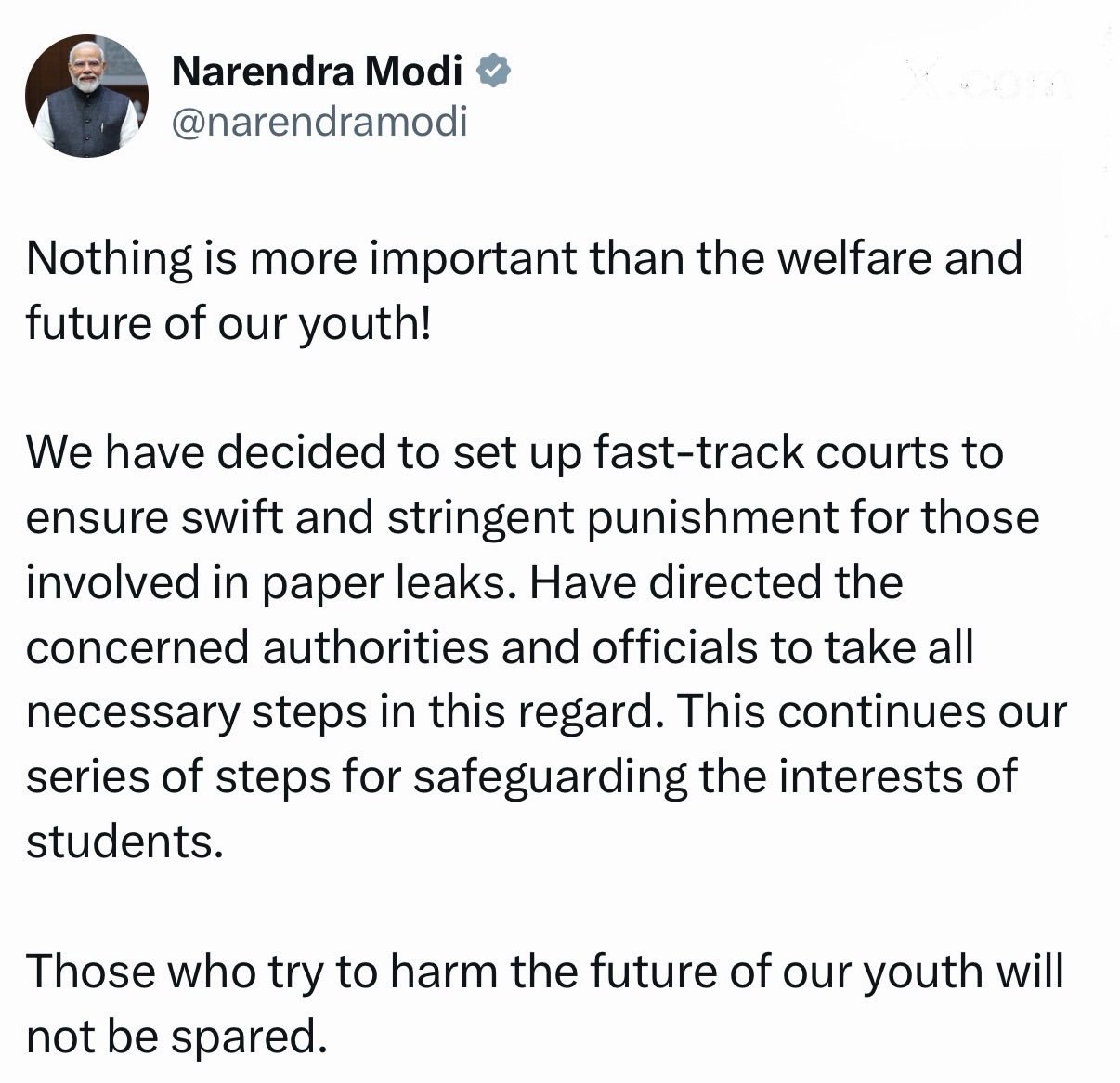
PM Modi Announces Fast-Track Courts for Paper Leak Cases
Prime Minister Narendra Modi announced that the government has decided to establish dedicated fast-track courts to ensure that examination paper leak cases are heard without unnecessary delays.
According to the Prime Minister, lengthy investigations and prolonged court proceedings often reduce the effectiveness of legal action against organised criminal networks involved in examination fraud. Fast-track courts are expected to accelerate judicial proceedings and ensure that guilty individuals receive punishment within a shorter timeframe.
The initiative is intended to create a stronger deterrent against those attempting to manipulate competitive examinations for financial gain or other illegal purposes.
The announcement also signals the government’s intention to treat paper leak offences as serious crimes affecting not only students but also the credibility of India’s education and recruitment systems.
Government Says Youth’s Future Remains the Highest Priority
While making the announcement, Prime Minister Modi emphasized that nothing is more important than safeguarding the interests and future of India’s youth.
He stated that the government has already directed all concerned ministries, departments, investigating agencies, and administrative authorities to immediately begin implementing the required procedures for setting up the proposed fast-track courts.
According to the Prime Minister, these measures are part of a broader series of reforms aimed at strengthening examination security, improving transparency, and ensuring fairness for every student appearing in competitive examinations.
He also reiterated that the government remains committed to creating an education system where honest students receive equal opportunities without being affected by organised cheating or criminal activities.
Strong Warning Against Paper Leak Networks
Prime Minister Modi also issued a firm warning to individuals involved in examination fraud.
He stated that those attempting to damage the future of India’s youth through paper leaks, organised cheating, or examination scams would not be spared under any circumstances.
The government’s message indicates a tougher legal approach toward criminal syndicates that allegedly operate across multiple states and exploit students by illegally obtaining and distributing confidential examination papers.
Officials believe that quicker convictions through dedicated courts could significantly discourage such criminal activities in the future.
Announcement Comes Amid Nationwide NEET Paper Leak Controversy
The Prime Minister’s announcement comes during one of the biggest examination-related controversies witnessed in recent years.
Allegations surrounding the NEET-UG paper leak have triggered protests across multiple cities, with students demanding transparent investigations, cancellation of compromised examinations where necessary, and stronger safeguards against future leaks.
The issue has also become a major political flashpoint during the ongoing Monsoon Session of Parliament.
Several opposition parties have accused the government of failing to protect the integrity of competitive examinations, while the government has maintained that strict action is already being taken against those responsible.
Student Protests Continue Across the National Capital
Delhi has emerged as the centre of the ongoing student movement.
Student organisations, including members of the Cockroach Janta Party (CJP), have been staging continuous demonstrations at Jantar Mantar demanding accountability over alleged examination irregularities.
The protests intensified after police action against demonstrators during the Parliament march, leading to fresh political debates over students’ rights and the handling of peaceful protests.
Demonstrators continue to demand stronger legal reforms, transparent investigations, and accountability from authorities responsible for conducting competitive examinations.
Political Pressure Mounts During Parliament Session
The paper leak controversy has dominated proceedings during the Monsoon Session of Parliament.
Opposition parties, including the Congress, Samajwadi Party, and the Aam Aadmi Party, have repeatedly demanded a detailed debate on the issue inside Parliament.
Several opposition leaders have argued that the matter concerns the future of millions of students and therefore deserves immediate attention in both Houses.
While the government has expressed its willingness to hold a discussion on the issue, disagreements continue regarding procedural rules and demands made by opposition parties.
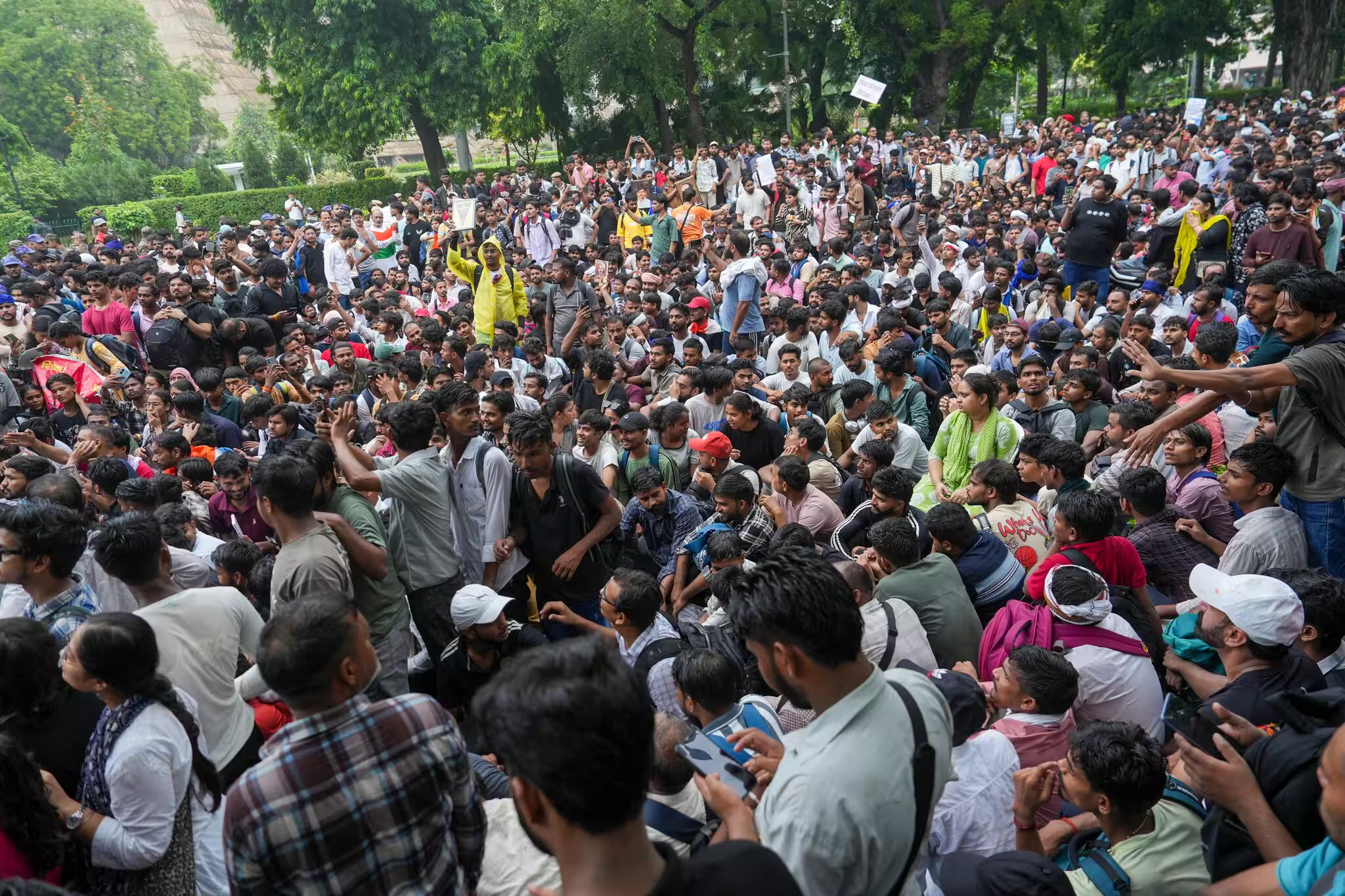
CJP Continues Protest at Jantar Mantar
Even after the government’s announcement regarding fast-track courts, members of the Cockroach Janta Party (CJP) have continued their protest at Jantar Mantar.
The organisation has maintained its demand for the resignation of Union Education Minister Dharmendra Pradhan, arguing that political accountability should accompany legal reforms.
CJP National Spokesperson Ashutosh Ranka stated that the movement would continue until concrete action is taken.
According to him, public anger is no longer confined to the Education Ministry alone but is increasingly focused on the government’s overall handling of examination-related issues.
The organisation believes that restoring confidence in India’s education system requires both institutional reforms and political accountability.
Opposition Questions Government’s Previous Record
While welcoming stronger legal measures against paper leaks, opposition leaders questioned why similar mechanisms had not been introduced earlier.
Samajwadi Party MP Ram Gopal Yadav argued that paper leak incidents have occurred repeatedly over the years and demanded greater transparency regarding previous investigations.
He questioned how many examination leak cases had occurred during the current government’s tenure, how many accused had been prosecuted, how many convictions had taken place, and whether existing legal mechanisms had been effective.
He also called for the publication of a comprehensive white paper detailing all examination leak cases and subsequent legal action.
Why Fast-Track Courts Could Be Significant
Legal experts believe dedicated fast-track courts may substantially improve the handling of examination fraud cases.
Currently, many criminal cases involving examination scams remain pending for extended periods due to heavy judicial workloads.
Faster hearings could help:
- Ensure timely justice.
- Prevent accused persons from delaying legal proceedings.
- Strengthen public confidence in the judicial process.
- Deter organised criminal networks involved in paper leaks.
- Improve the credibility of future examinations.
Experts also note that speedy convictions often serve as a stronger deterrent than severe punishments delivered after prolonged delays.
Growing Concern Over Examination Integrity
India conducts hundreds of competitive examinations every year for admissions into educational institutions and recruitment into government services.
Millions of students invest years preparing for these examinations.
Whenever allegations of paper leaks emerge, students often face uncertainty regarding examination results, career opportunities, and future planning.
Repeated controversies have increased demands for stronger technological safeguards, secure printing processes, encrypted digital systems, better monitoring of transportation, and stricter accountability throughout the examination process.
Government’s Broader Reform Agenda
Officials have indicated that the proposal for fast-track courts is expected to complement other ongoing reforms designed to strengthen examination security.
These measures may include:
- Improved coordination between examination agencies and law enforcement.
- Enhanced digital monitoring systems.
- Stronger cybersecurity measures.
- Better protection during printing and transportation of question papers.
- Stricter penalties for organised cheating networks.
The government believes that combining preventive measures with faster judicial action can significantly reduce future incidents.
Students Continue Seeking Long-Term Solutions
Although many students have welcomed the government’s announcement as a positive step, several protest groups continue to demand broader structural reforms.
Students argue that preventing future paper leaks requires improvements in examination administration, recruitment transparency, accountability of officials, and protection for honest candidates.
Many believe that merely punishing offenders after leaks occur may not be sufficient unless preventive systems are strengthened simultaneously.
Impact on Public Trust
Education experts point out that public confidence in competitive examinations is essential for maintaining the credibility of India’s education and recruitment systems.
Every paper leak affects not only individual students but also institutions responsible for conducting examinations.
Repeated controversies may discourage deserving candidates and create uncertainty among families investing significant resources in education.
Consequently, legal reforms, technological improvements, and transparent investigations are increasingly viewed as equally important components of restoring trust.
Prime Minister Narendra Modi’s announcement to establish dedicated fast-track courts for examination paper leak cases represents one of the government’s strongest responses yet to the growing concern over examination integrity.
By promising swift trials and stringent punishment, the Centre aims to reassure millions of students that organised examination fraud will be dealt with more decisively.
However, the announcement also comes amid continuing protests, political demands, and calls for broader reforms in the country’s examination system.
As Parliament continues debating issues related to competitive examinations and student welfare, the effectiveness of these proposed fast-track courts will ultimately depend on their implementation, coordination with investigative agencies, and the government’s ability to introduce comprehensive reforms that both prevent future paper leaks and restore public confidence in India’s education system.