

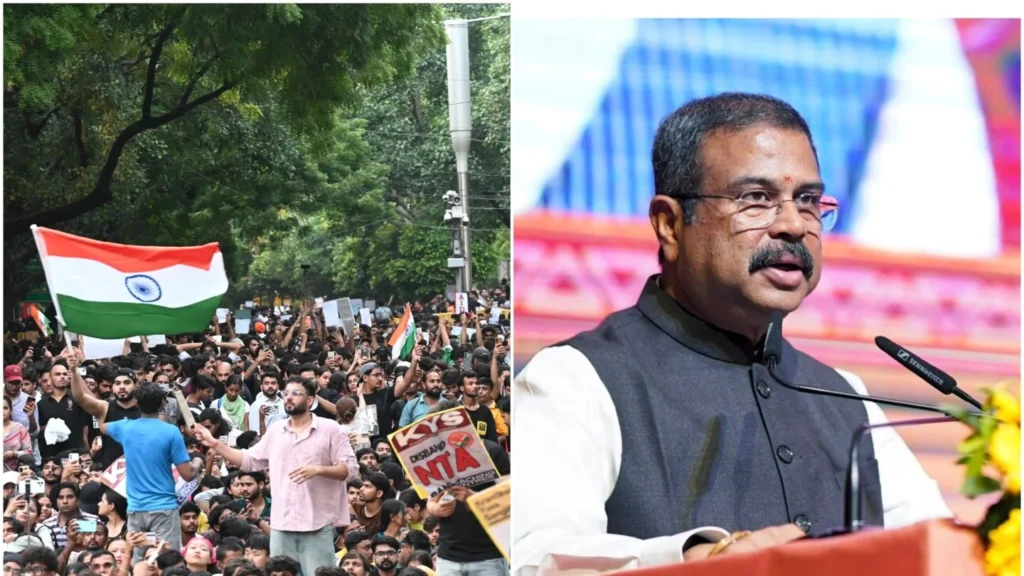
The political spotlight has once again turned towards Union Education Minister Dharmendra Pradhan amid the ongoing controversy surrounding examination irregularities and the protests led by the Cockroach Janta Party (CJP). The student organisation has intensified its campaign demanding Pradhan’s resignation over alleged examination-related issues, adding a new chapter to the political debate surrounding India’s education system.
While the opposition and protest groups continue to question the government’s handling of examination controversies, Dharmendra Pradhan’s supporters highlight his long political experience, organisational skills, and administrative journey spanning more than four decades.
From his early days as a student activist in Odisha to becoming one of the senior leaders of the Bharatiya Janata Party (BJP) and eventually handling the crucial Education Ministry, Pradhan’s career reflects a steady rise through student politics, organisational responsibilities, electoral victories, and ministerial roles.
Table of Contents
Against the backdrop of the current political confrontation, a look at Dharmendra Pradhan’s journey provides insight into how he emerged as one of the BJP’s prominent leaders.
Early Political Journey: Beginning as an ABVP Student Activist
Dharmendra Pradhan entered politics through student activism, a route followed by several prominent Indian political leaders.
His political journey began in 1983 when he joined the Akhil Bharatiya Vidyarthi Parishad (ABVP), the student organisation associated with the Rashtriya Swayamsevak Sangh (RSS).
During his college years at Talcher College in Odisha, Pradhan actively participated in student activities and gradually developed leadership skills.
His involvement in student politics gave him his first opportunity to understand organisational functioning, public issues, and grassroots mobilisation.
As a student leader, he was elected as the President of the Student Union at Talcher College, marking his first significant leadership responsibility.
This early role helped him gain experience in managing student concerns, coordinating activities, and representing young people’s issues.
Over time, his organisational abilities helped him rise within ABVP. He eventually became the National Secretary of ABVP, giving him exposure beyond Odisha and allowing him to work at the national level.
His years in student politics played an important role in shaping his political approach, which later focused heavily on organisation-building and grassroots engagement.
Dharmendra Pradhan’s Entry Into Electoral Politics and BJP Organisation
After establishing himself through student politics, Dharmendra Pradhan moved towards mainstream electoral politics.
He comes from a politically active family background. His father, Devendra Pradhan, was a senior BJP leader and served as a Union Minister of State during the government led by former Prime Minister Atal Bihari Vajpayee.
Following this political legacy, Dharmendra Pradhan entered electoral politics in the year 2000.
He contested and won the Pallahara Assembly constituency election in Odisha, becoming a Member of the Legislative Assembly (MLA).
This victory marked his formal entry into legislative politics and provided him with experience in governance and public representation.
His political growth continued when he contested the 2004 Lok Sabha elections from Deogarh constituency in Odisha and entered national politics.
Later, he represented Odisha in the Rajya Sabha, allowing him to participate in parliamentary discussions and national policy matters.
Rise Within BJP’s Youth Leadership Structure
Alongside electoral politics, Dharmendra Pradhan built a strong identity within the BJP organisation.
Recognising his organisational capabilities and experience among young workers, the party appointed him as the National President of Bharatiya Janata Yuva Morcha (BJYM), the BJP’s youth wing.
This position was considered significant as BJYM plays an important role in expanding the party’s youth network across the country.
During his tenure, Pradhan worked on strengthening party structures, connecting with young voters, and increasing participation among youth workers.
His organisational experience helped him become a trusted leader within the BJP leadership circle.
Over the years, he developed a reputation as a leader capable of managing party responsibilities and coordinating large-scale political campaigns.
Ministerial Journey in Narendra Modi Government
After the BJP-led NDA government came to power under Prime Minister Narendra Modi in 2014, Dharmendra Pradhan received important ministerial responsibilities.
He was appointed as the Union Minister of State (Independent Charge) for Petroleum and Natural Gas, one of the key economic ministries of the government.
The petroleum sector plays a crucial role in India’s economy, and Pradhan’s tenure focused on expanding energy access and implementing major government initiatives.
One of the significant programmes associated with his ministry was the Pradhan Mantri Ujjwala Yojana, which aimed to provide LPG connections to women from economically weaker households.
The scheme became one of the government’s major welfare initiatives in the energy sector.
During his ministerial tenure, Pradhan also handled additional responsibilities, including the Ministry of Skill Development and Entrepreneurship and later the Ministry of Steel.
These portfolios expanded his administrative experience across multiple sectors, including employment generation, industrial development, and economic policy.
Appointment as Union Education Minister
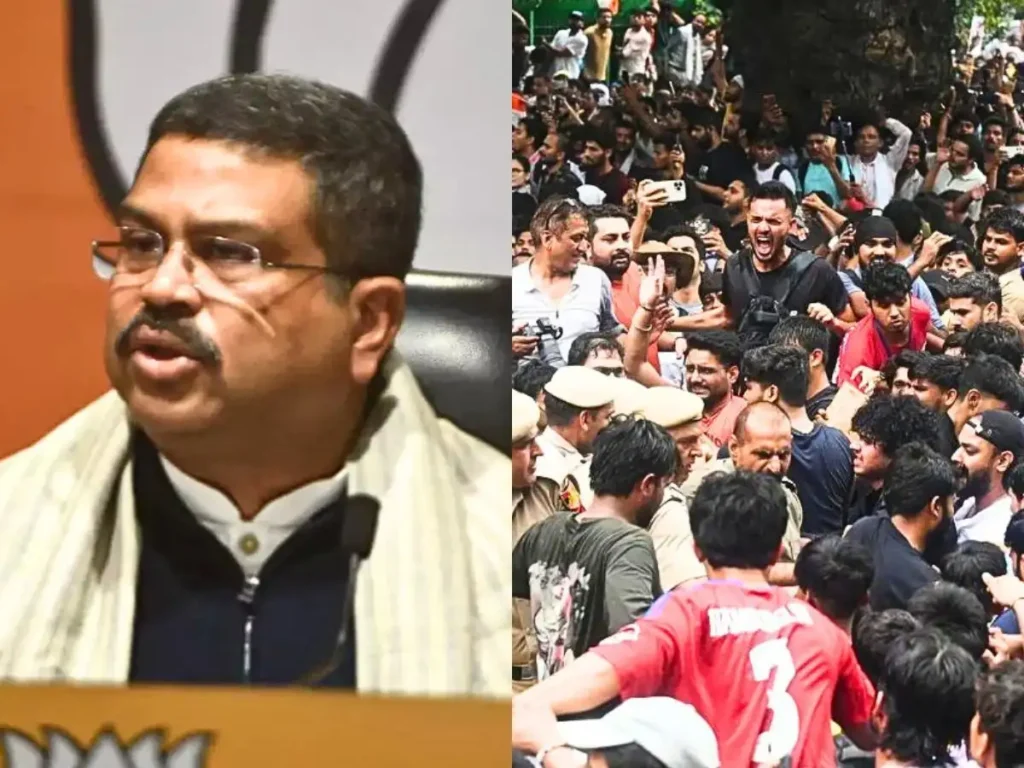
In July 2021, Dharmendra Pradhan was appointed as the Union Minister of Education, taking charge of one of the country’s most important ministries.
The Education Ministry plays a crucial role in shaping policies affecting millions of students across schools, colleges, and universities.
One of the biggest responsibilities during his tenure has been the implementation of the National Education Policy (NEP) 2020.
The policy aims to introduce structural reforms in India’s education system, including changes in school education, higher education, skill development, and research.
Pradhan has repeatedly emphasised the importance of improving education quality, increasing accessibility, and aligning education with future employment opportunities.
His ministry has focused on implementing various aspects of NEP 2020, including skill-based learning and reforms in educational institutions.
Retaining Education Portfolio After 2024 Elections
Following the NDA government’s victory in the 2024 general elections, Dharmendra Pradhan continued as the Union Education Minister.
His continuation in the ministry reflected the government’s confidence in his leadership and ongoing policy responsibilities.
However, his tenure has also faced criticism from opposition parties and student groups, particularly over issues related to competitive examinations and alleged irregularities.
The current protests led by CJP have placed renewed political pressure on the Education Ministry, with protesters demanding accountability and raising concerns about examination systems.
CJP Protest and Political Controversy
The ongoing controversy surrounding Dharmendra Pradhan has intensified after the CJP announced that it would continue nationwide protests demanding his resignation.
CJP spokesperson Ashutosh Ranka described discussions with Union Minister J.P. Nadda as unsuccessful, stating that the organisation would continue its campaign.
The group has linked its demand to concerns regarding examination irregularities and student grievances.
The issue has also become part of a larger political debate, with opposition parties questioning the government’s response and demanding stronger accountability measures.
Meanwhile, supporters of Dharmendra Pradhan point towards his long administrative experience and argue that examination-related issues require systemic solutions rather than political targeting.
A Long Political Career Facing a New Challenge
Dharmendra Pradhan’s political journey represents a transition from student activism to national-level governance.
Starting as an ABVP activist in Odisha, he gradually moved through organisational responsibilities, electoral politics, and important government positions.
His career has included roles in energy, skill development, industry, and education sectors.
As Education Minister, he has been responsible for implementing major reforms while managing challenges affecting millions of students.
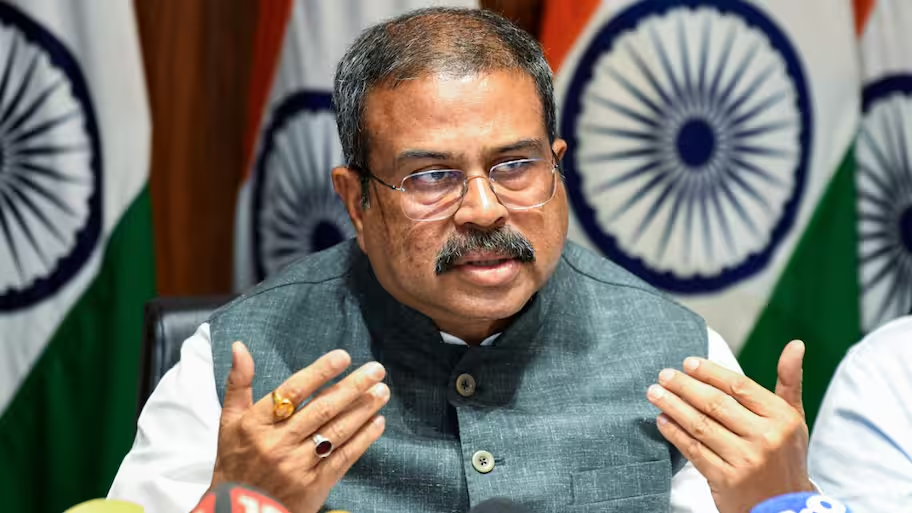
The current examination controversy represents one of the biggest challenges of his political career, bringing renewed attention to his leadership of the Education Ministry.
Dharmendra Pradhan’s journey from a student leader in Odisha to Union Education Minister reflects decades of political experience, organisational work, and administrative responsibility.
His rise within the BJP has been shaped by grassroots politics, youth leadership, electoral victories, and ministerial assignments.
While his supporters highlight his contribution to various government initiatives and policy reforms, critics continue to question his handling of education-related controversies.
As protests over examination issues continue, the political debate around Dharmendra Pradhan’s leadership is expected to remain intense.
The coming period will determine how the government addresses student concerns and whether the Education Minister can overcome the political challenges surrounding his tenure.