

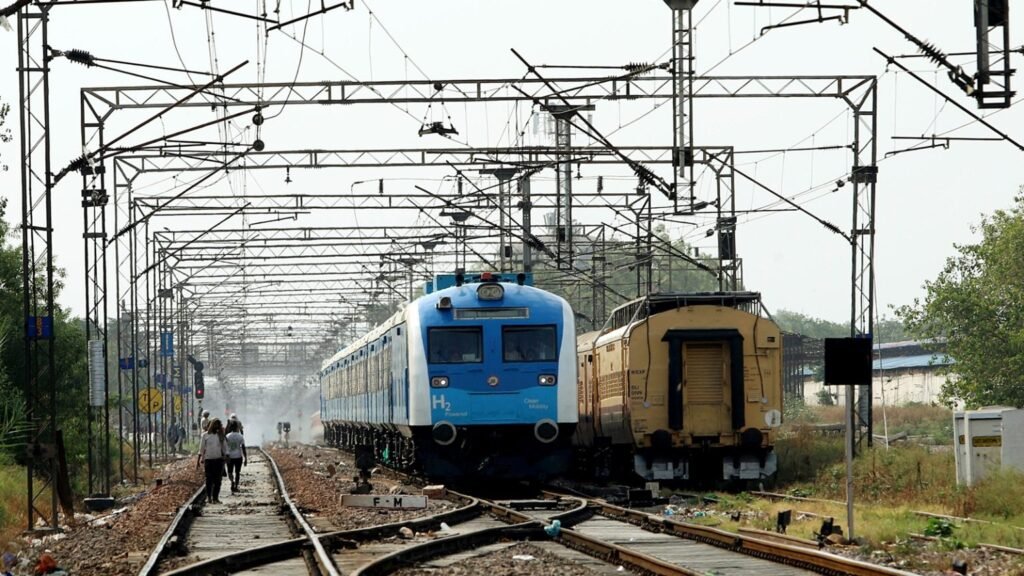
Hydrogen Train has become a defining milestone in India’s clean transportation journey as the country officially launches its first hydrogen-powered passenger train from Haryana’s Jind district. The historic project places India among a select group of nations exploring hydrogen-based railway technology, reflecting the government’s growing focus on sustainable mobility, energy security, and reducing carbon emissions.
The Hydrogen Train will operate on the Jind-Sonipat railway section, which has been chosen as the pilot corridor for this ambitious initiative. The launch has generated widespread excitement among residents, railway officials, environmental experts, and technology enthusiasts, with many describing it as a landmark achievement for both Haryana and Indian Railways.
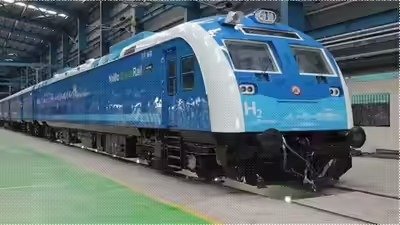
Decorated with flowers and balloons ahead of its inauguration by Prime Minister Narendra Modi, the train symbolizes more than just a new railway service. It represents India’s transition toward environmentally friendly transportation and demonstrates the country’s commitment to adopting innovative technologies that can transform public infrastructure.
Table of Contents
Jind Celebrates a Historic Moment
The atmosphere in Jind resembled a festival as local residents gathered to witness the arrival of the Hydrogen Train. People from different parts of the district assembled at the railway station to celebrate what many described as a once-in-a-generation event.
Residents expressed pride that their town had been selected for the country’s first hydrogen-powered railway project. Many believe the initiative will improve transportation, encourage investment, create new opportunities, and strengthen Jind’s identity on the national map.
Several local commuters welcomed the new service, saying it would reduce travel difficulties and save valuable commuting time. Others called it a historic achievement that future generations would remember as the beginning of India’s hydrogen railway era.
The enthusiasm reflected not only excitement about a new train service but also growing public awareness of environmentally sustainable transport solutions.
What Makes the Hydrogen Train Special?
Unlike conventional diesel locomotives, the Hydrogen Train uses hydrogen fuel cells to generate electricity.
The technology works by combining hydrogen with oxygen inside fuel cells to produce electrical energy. During this process, the only major by-product released into the atmosphere is water vapour, making the system significantly cleaner than traditional fossil fuel-powered trains.
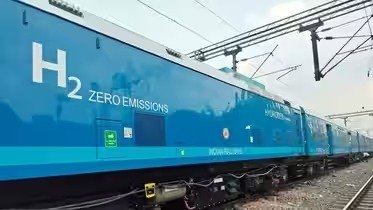
Because there is no direct combustion of diesel or coal, hydrogen-powered trains produce minimal greenhouse gas emissions during operation.
This makes Hydrogen Train an attractive alternative for railway routes where complete electrification may not yet be practical or economically feasible.
Many countries are increasingly investing in hydrogen-powered transportation because it offers an opportunity to reduce dependence on fossil fuels while supporting global climate goals.
Why India Chose the Jind-Sonipat Route
Indian Railways selected the Jind-Sonipat railway section as the pilot route for introducing Hydrogen Train technology.
The route provides suitable operational conditions for testing the performance, reliability, maintenance requirements, and commercial viability of hydrogen-powered passenger services.
Launching the project on a pilot corridor allows engineers and railway officials to collect operational data before considering expansion to other railway routes across the country.
Successful implementation could pave the way for introducing Hydrogen Train services on additional non-electrified railway sections in the coming years.
The pilot project is expected to provide valuable insights into fuel efficiency, maintenance costs, passenger experience, and long-term sustainability.
Indigenous Hydrogen Infrastructure Developed
One of the most significant aspects of the project is that India has developed dedicated hydrogen infrastructure to support railway operations.
A specialised hydrogen storage and refuelling facility has been established at Jind to ensure uninterrupted operation of the Hydrogen Train.
The facility has received the required approval from the Petroleum and Explosives Safety Organisation (PESO), which has granted the necessary licence for storing and dispensing compressed hydrogen gas.
Developing domestic hydrogen infrastructure represents an important achievement because reliable fuel supply systems are essential for the successful deployment of hydrogen-powered transportation.
The project also strengthens India’s capabilities in handling advanced clean-energy technologies within its railway network.
Supporting India’s Clean Energy Vision
The introduction of Hydrogen Train aligns closely with India’s long-term environmental and energy goals.
India has committed to achieving net-zero carbon emissions by 2070 while significantly expanding the use of renewable and clean energy technologies across various sectors.
Transportation remains one of the largest contributors to greenhouse gas emissions globally. As a result, governments around the world are investing in electric mobility, hydrogen fuel technologies, biofuels, and other sustainable alternatives.
Hydrogen-powered railways represent an important component of this transition because they offer cleaner mobility without compromising operational efficiency.
The project also supports India’s National Green Hydrogen Mission, which aims to position the country as a global leader in hydrogen production, utilisation, and technological innovation.
Environmental Benefits of Hydrogen Train
One of the biggest advantages of Hydrogen Train is its environmental performance.
Traditional diesel locomotives emit carbon dioxide, nitrogen oxides, and particulate matter that contribute to air pollution and climate change.
Hydrogen-powered trains operate differently.
The fuel cells generate electricity without burning fossil fuels, significantly reducing emissions during train operations.
Apart from lower emissions, hydrogen-powered trains are generally quieter than conventional diesel locomotives, helping reduce noise pollution in urban and semi-urban areas.
Improved air quality, reduced carbon footprint, and lower environmental impact make hydrogen technology an increasingly attractive solution for modern transportation systems.
Innovation Within Indian Railways
Indian Railways has been investing heavily in technological modernization over the past several years.
Alongside railway electrification, high-speed corridors, modern signalling systems, station redevelopment, and indigenous train manufacturing, Hydrogen Train represents another major step toward future-ready transportation.
The railway network has already expanded the use of electric locomotives across much of the country, reducing dependence on imported diesel fuel.
Hydrogen-powered trains offer an additional solution for routes where electrification remains challenging or where alternative clean-energy technologies may prove more efficient.
The successful implementation of this project could strengthen India’s position as a leader in railway innovation.
Global Interest in Hydrogen Rail Technology
India joins a small but growing list of countries exploring hydrogen-powered railway systems.
Several European nations have already introduced hydrogen passenger trains on selected routes to reduce emissions while maintaining efficient rail services.
Countries including Germany, France, Italy, and the United Kingdom have experimented with hydrogen rail technology as part of broader efforts to decarbonise transportation.
Japan and South Korea have also invested significantly in hydrogen-powered mobility solutions.
India’s entry into this emerging field demonstrates its ambition to adopt advanced technologies while supporting domestic innovation and sustainable infrastructure development.
As hydrogen technology becomes more commercially viable, experts expect greater international collaboration in research, manufacturing, fuel production, and railway engineering.
Economic and Regional Development Opportunities
Beyond environmental benefits, Hydrogen Train has the potential to support regional economic development.
Improved railway connectivity often encourages business activity, tourism, investment, and employment generation.
Residents of Jind believe the project will contribute to local development while making travel more convenient for daily commuters.
Some local citizens have also suggested extending the service beyond Sonipat to Panipat in the future to improve passenger demand and enhance regional connectivity.
If future expansion takes place, additional districts may benefit from improved transportation and stronger economic integration.
Infrastructure projects of this scale often create opportunities in engineering, maintenance, manufacturing, logistics, safety management, and technical services.
Challenges and Future Expansion
While Hydrogen Train offers numerous advantages, successful large-scale implementation will require continued investment in hydrogen production, storage facilities, refuelling stations, and specialised maintenance infrastructure.
Producing green hydrogen remains relatively expensive compared to conventional fuels, although costs are expected to decline as technology advances and production capacity increases.
Railway engineers will also closely monitor the operational performance of the pilot project to evaluate maintenance requirements, fuel efficiency, reliability, passenger satisfaction, and long-term commercial feasibility.
The experience gained from the Jind-Sonipat corridor will help determine whether Hydrogen Train services can be introduced on additional railway routes across India.
As Indian Railways continues to modernise its operations, the launch of the country’s first Hydrogen Train marks an important step towards cleaner transportation, advanced railway technology, and sustainable public infrastructure. The pilot project reflects India’s growing commitment to innovation, environmental responsibility, and energy-efficient mobility while opening new possibilities for the future of railway travel.