

India’s benchmark equity indices Sensex and Nifty opened on a cautious note on Tuesday as weak signals from Asian markets and a sharp selloff in global semiconductor stocks dampened investor sentiment. Despite a positive rebound in the domestic market during the previous session, investors remained cautious amid rising concerns over intensifying competition in the global memory chip industry and mixed cues from international markets.
The Sensex opened at 76,831.75, slipping just 4 points (0.01%), while the Nifty 50 started the day at 23,971.25, down 24.70 points (0.10%). The muted opening reflected uncertainty among market participants as global technology stocks came under pressure following a sharp decline in semiconductor shares.
Although the benchmark indices traded almost flat during the opening session, sector-specific movements painted a mixed picture. Information Technology (IT) stocks emerged as the biggest gainers, while energy and public sector banking stocks witnessed selling pressure.
Table of Contents
Sensex Opens Flat After Monday’s Strong Recovery
The flat opening comes a day after the domestic equity markets staged a notable recovery.
On Monday, the Nifty ended a five-session losing streak by gaining 228 points to close at 23,995. From its recent low of 23,606 recorded on Friday, the benchmark has recovered over 400 points, providing relief to investors after a period of sustained market weakness.
Despite this rebound, analysts believe the market remains vulnerable to global developments, especially in the technology sector.
The cautious opening of the Sensex indicates that investors are balancing optimism from domestic recovery against uncertainty arising from international markets.

Global Semiconductor Selloff Weighs on Market Sentiment
One of the biggest reasons behind Tuesday’s cautious market opening was the sharp decline in global semiconductor stocks.
Investor concerns intensified after the highly anticipated market debut of China’s ChangXin Memory Technologies (CXMT), which raised fears of increasing competition within the global memory chip industry.
The possibility of additional supply entering the semiconductor market has created uncertainty regarding pricing power and future profitability for established chip manufacturers.
As semiconductor companies occupy a significant weight in global technology indices, weakness in this segment quickly spread across broader equity markets.
Technology-heavy exchanges in the United States and Asia witnessed selling pressure, influencing investor sentiment across emerging markets, including India.
IT Sector Emerges as the Bright Spot
Despite global weakness in semiconductor shares, India’s Information Technology sector outperformed the broader market.
Among sectoral indices:
- Nifty IT surged nearly 2%, emerging as the top-performing sector.
- Nifty MidSmall IT & Telecom gained around 1%.
- Realty stocks traded higher.
- Healthcare shares remained in positive territory.
- Pharmaceutical companies also witnessed buying interest.
Analysts believe investors continued accumulating select Indian IT stocks due to expectations of stable global technology spending and relatively attractive valuations following recent corrections.
The resilience of India’s software services companies also helped offset weakness seen in semiconductor-related technology businesses worldwide.
Energy and PSU Banking Stocks Under Pressure
While IT shares attracted buyers, energy stocks remained under pressure during early trading.
Among the major laggards:
- Nifty Oil & Gas declined 0.30%.
- Nifty PSU Bank slipped 0.26%.
Weakness in crude oil prices and cautious investor positioning ahead of further global developments contributed to subdued trading in energy-related counters.
Public sector banks also witnessed profit booking after recent gains.
Analysts See Continued Volatility
Market experts believe Indian equities may continue witnessing volatility in the near term due to external factors.
According to analysts, domestic fundamentals remain relatively stable, but global developments continue influencing short-term investor sentiment.
Key concerns include:
- Weak Asian markets
- Global semiconductor correction
- Foreign investor activity
- International crude oil prices
- US economic indicators
- Geopolitical developments
Until greater clarity emerges on these factors, market participants may prefer a cautious approach.
Technical Outlook for Sensex and Nifty
Technical analysts continue monitoring key support and resistance levels for the benchmark indices.
According to market experts:
Important Support Level
The 23,606 level remains a significant technical support for the Nifty.
This level aligns with the rising trendline connecting:
- April swing low: 22,182
- June swing low: 23,070
Holding above this trendline is considered important for maintaining the broader bullish market structure.
Immediate Support
Analysts identify 23,800 as the immediate support zone.
A sustained move below this level could trigger renewed selling pressure.
Key Resistance
For stronger bullish momentum to develop, the Nifty would need to register a decisive close above 24,200.
Crossing this resistance could encourage fresh institutional buying and potentially lead to new upward momentum in benchmark indices.
Asian Markets Trade Lower
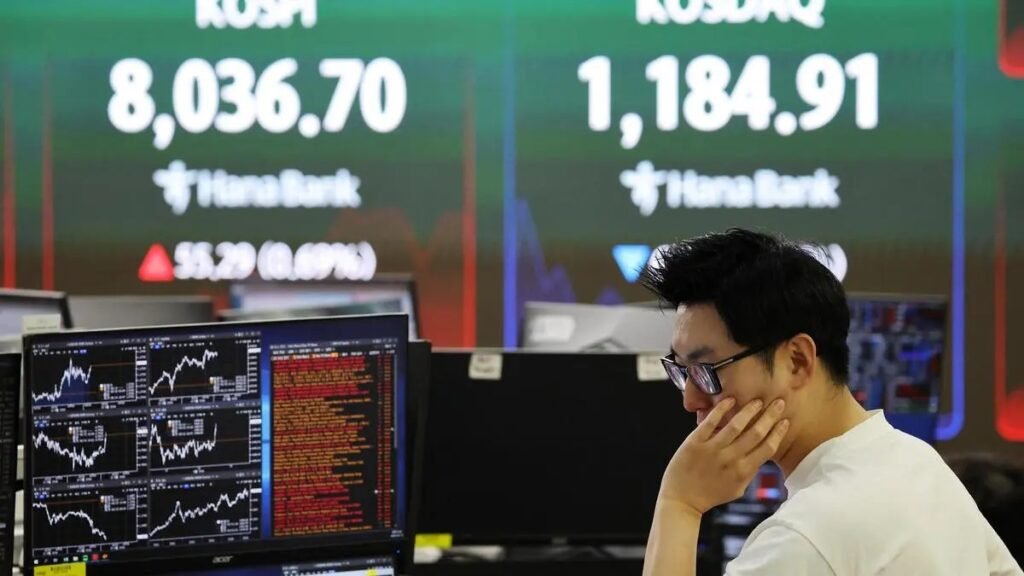
Asian equity markets largely remained under pressure on Tuesday, reflecting growing concerns surrounding the global technology sector.
Major indices traded as follows:
- Japan’s Nikkei declined more than 4%.
- South Korea’s KOSPI slumped nearly 10%.
- Hong Kong’s Hang Seng traded largely flat.
The weakness across Asia primarily stemmed from concerns over semiconductor stocks and broader technology valuations.
The sharp fall in Japanese and South Korean indices, both heavily exposed to semiconductor manufacturing, significantly influenced overall regional market sentiment.
Wall Street Ends Mixed Overnight
US equity markets delivered mixed performances overnight.
Among the major indices:
- Dow Jones Industrial Average gained 0.5%.
- S&P 500 ended almost unchanged.
- Nasdaq Composite slipped 0.2%.
The technology-heavy Nasdaq came under pressure due to the broad selloff in semiconductor stocks.
Although other sectors provided some support to Wall Street, weakness in technology companies prevented stronger gains.
Indian investors closely monitor US markets because foreign institutional investors often adjust their emerging market allocations based on movements in global equities.

Crude Oil Prices Continue to Ease
Another important development influencing investor sentiment was the continued decline in international crude oil prices.
During early trading:
- Brent Crude declined 1.62% to around $86.50 per barrel.
- West Texas Intermediate (WTI) fell 1.68% to approximately $80.64 per barrel.
Lower crude oil prices are generally considered positive for India because the country imports a significant portion of its energy requirements.
A decline in oil prices can help:
- Reduce import bills.
- Ease inflationary pressures.
- Improve corporate profitability.
- Strengthen fiscal stability.
- Support consumer spending.
However, lower oil prices can also negatively impact shares of oil exploration and energy companies.
Foreign Investors Likely to Remain Watchful
Foreign Portfolio Investors (FPIs) continue to play a significant role in determining the direction of Indian equity markets.
Recent global volatility has encouraged overseas investors to adopt a selective investment strategy.
Market participants will closely monitor:
- FPI inflows and outflows.
- US Federal Reserve policy signals.
- Global technology earnings.
- Inflation trends.
- Currency movements.
Positive foreign investment flows could support the recent recovery in Indian equities despite global uncertainties.
Domestic Fundamentals Continue to Support Markets
Despite short-term volatility, India’s broader economic fundamentals remain relatively strong.
Factors supporting long-term investor confidence include:
- Robust GDP growth expectations.
- Stable banking sector performance.
- Healthy corporate earnings.
- Continued infrastructure spending.
- Strong domestic consumption.
- Government capital expenditure.
These structural strengths continue attracting both domestic institutional investors and long-term global funds.
What Investors Should Watch Going Forward
In the coming sessions, investors are expected to focus on several important market-moving factors.
These include:
- Global semiconductor sector developments.
- Asian market performance.
- Corporate earnings announcements.
- Crude oil price movements.
- Foreign institutional investment flows.
- Technical resistance near 24,200 on the Nifty.
- Domestic macroeconomic indicators.
The direction of these factors will likely determine whether the recent recovery extends or markets enter another consolidation phase
The Sensex opened almost unchanged on Tuesday as investors adopted a cautious stance amid weak Asian market cues and a global semiconductor selloff. Nifty While benchmark indices remained largely flat, sector-specific action highlighted the resilience of India’s IT sector, which outperformed despite global technology concerns.
Energy and PSU banking stocks faced selling pressure, whereas healthcare, realty, and pharmaceutical sectors traded positively. Nifty Meanwhile, declining crude oil prices offered some support to the broader market by improving India’s macroeconomic outlook.
Although domestic equities have recovered significantly from recent lows, analysts believe external developments—particularly global semiconductor trends, foreign investment flows, and Asian market performance—will continue to influence short-term market direction. Investors are expected to remain watchful as the Sensex , Nifty attempts to build on its recent recovery while navigating ongoing global uncertainties.