New Delhi, If you’ve ever received a call from a “digital arrest” officer demanding money, or a fake customer care agent asking for your OTP, you know the sinking feeling. For years, cyber fraudsters have operated with near-impunity, hiding behind fake bank accounts, disposable SIM cards, and a maze of digital transactions. But today, Delhi Police has fired back loud and clear.
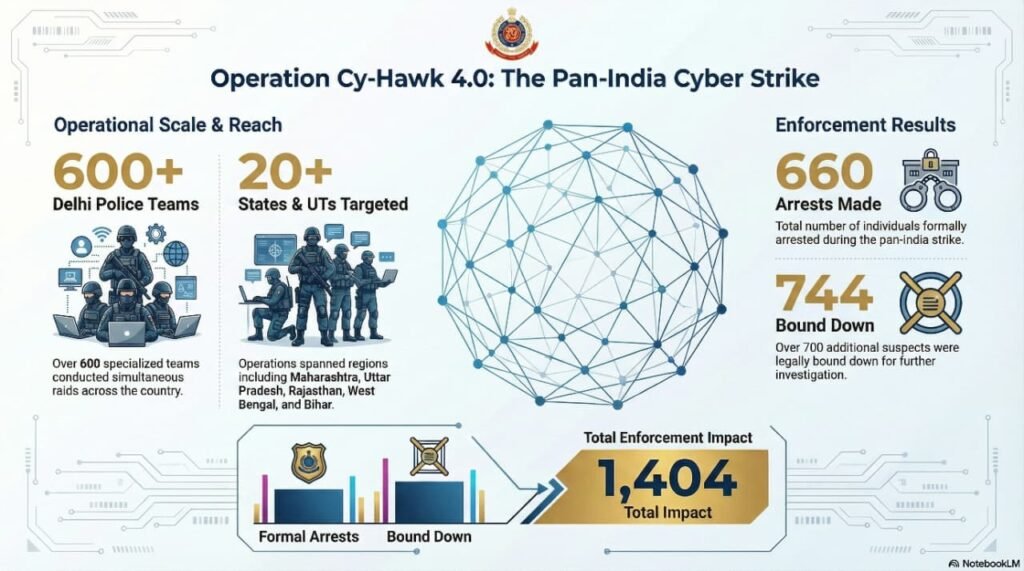
In what is being called one of the largest intelligence-driven crackdowns on cyber crime in recent Indian history, the force has concluded Operation CyHawk. The numbers are staggering. The strategy is ruthless. And the message is unmistakable: Your mule accounts won’t save you anymore.
Let’s break down what happened, why it matters, and how this operation changes the game for every citizen who has ever feared getting scammed online.
Table of Contents
The Big Picture: Why Operation CyHawk Was Necessary
Over the past three years, India has witnessed an explosion of cyber fraud. From “digital arrest” scams that terrorise senior citizens to fake job offers that trap young graduates, the methods have become more sophisticated. According to National Cyber Crime Reporting Portal (NCRP) data, Indians lost thousands of crores to online fraud in 2025 alone. But here’s the dirty secret: most arrests so far have targeted the small fish—the money mules or the call centre operators at the bottom of the chain. The real kingpins? They stayed safe, shielded by layers of fake identities and shell companies.
Delhi Police’s Commissioner, Sh. Satish Golchha, IPS, decided that had to change. Operation CyHawk wasn’t about catching one or two dozen scammers. It was about dismantling the entire financial backbone of cyber syndicates operating from the National Capital.
“This operation marks a strategic shift from reactive detection to proactive disruption,” Golchha said in the official release.
In plain English: instead of waiting for you to get scammed and then trying to trace the money, Delhi Police went hunting for the infrastructure before the next wave of fraud could happen.
The Anatomy of the Operation: A Month of Silent Intelligence
You don’t pull off something like this overnight. The operation was conceived under Golchha’s leadership and executed on the ground by two Special Commissioners—Sh. Madhup Tewari (Law & Order) and Sh. Anil Shukla (Special Cell), with joint coordination from Sh. Rajneesh Gupta (IFSO) and Sh. Vijay Singh (SR).
But the real unsung hero? The Indian Cyber Crime Coordination Centre (I4C) under the Ministry of Home Affairs. For nearly one month, Delhi Police worked hand-in-glove with I4C to:
- Map cyber hotspots across the capital
- Analyse suspicious mobile numbers and their call patterns
- Identify “mule accounts”—bank accounts opened fraudulently or rented by criminals to park stolen money
- Correlate digital trails with thousands of pending complaints
Think of I4C as the national cyber intelligence hub. They provided real-time backend support, turning raw data—transaction hashes, IP addresses, SIM card registrations—into actionable leads. Without that, the ground action would have been blind.
The Strike: Numbers That Demand Attention
On the day of the operation, Delhi Police launched a coordinated, city-wide sweep across multiple districts. The results, released this morning, are nothing short of historic.
| Metric | Figure |
|---|---|
| Individuals rounded up for questioning | 8,371 |
| Arrested or legally bound down (strong evidence) | 1,429 |
| Notices issued under Section 35 of BNSS (backward linkages) | 2,203 |
| New FIRs registered during the operation | 499 |
| Pending cyber cases that got breakthroughs | 324 FIRs |
| NCRP complaints successfully linked to mule accounts | 3,564 |
| Defrauded amount linked (nationwide complaints) | ₹519+ Crore |
| Illegal call centres neutralised | Multiple (ongoing assessment) |
Let’s sit with that ₹519 crore figure for a moment. That’s not money Delhi Police seized—it’s the total amount reported by victims across the country that has now been traced to specific mule accounts and suspect mobile numbers identified during CyHawk. In other words, the police now have a financial map of where the stolen money flowed. That is gold for prosecutors.
What They Found: Raids, Devices, and a Digital Treasure Trove
During the raids, police recovered a staggering haul of digital evidence:
- Mobile phones (hundreds)
- Laptops and hard drives
- SIM cards (many pre-activated with fake IDs)
- Debit and credit cards
- Financial ledgers and diaries with coded entries
All of this is now with cyber forensic experts. And here’s the key: this isn’t just about the 1,429 people arrested. The 2,203 notices issued to individuals linked to “backward financial chains” mean that the investigation is expanding upstream—towards the people who control the mule networks, the ones who launder the money, and possibly the kingpins themselves.
“Several leads are being actively pursued. A major impact is anticipated in the coming days,” the press release notes. That’s police-speak for: we’re coming for the big fish next.
Why Targeting “Mule Accounts” Is a Game-Changer
If you’re not familiar with the term, here’s a quick explainer. When you get scammed, you don’t send money directly to the fraudster. You send it to a bank account—often belonging to some unsuspecting person who rented it out for a small fee, or opened under a fake name. That’s a mule account. The money then gets quickly transferred through 5–10 such accounts, mixed with legitimate funds, and finally withdrawn as cash or converted into crypto.
Until now, police would freeze one or two mule accounts, but the rest of the money would disappear. Operation CyHawk flipped the script. By mapping 3564 NCRP complaints directly to identified mule accounts and suspect mobile numbers, they’ve essentially created a heat map of the entire money-laundering pipeline.
Real-world example: Imagine a job scam where a victim pays ₹50,000 for a “work-from-home data entry position.” That money goes into Mule Account A. Within hours, it’s split into Accounts B, C, and D. Then to E, F, G. Operation CyHawk traced multiple complaints back to the same cluster of accounts, revealing that one syndicate was running not just job scams, but also digital arrest scams and fake customer care calls simultaneously.
That’s the power of linking complaints across the NCRP database.
The Human Side: Neutralising Call Centres and Stopping Ongoing Scams
Numbers aside, the operation had a direct, real-time impact. Multiple illegal call centres were raided and shut down. These weren’t the glamorous “call centres” you see in movies—they were dingy rooms in residential areas, filled with young men and women reading from scripts that promised fake loans, tech support, or “refunds” from e-commerce sites.
One such centre, according to sources, was running a sophisticated “digital arrest” scam. Fraudsters would call victims pretending to be from the Telecom Department or CBI, claiming that their Aadhaar was used in a money-laundering case. They’d keep the victim on video call for hours, in “digital custody,” until the terrified person transferred their life savings to a “safe account.” Operation CyHawk put at least three such modules out of business.
The Public Advisory: What You Must Do Now
Delhi Police has also released a practical, no-nonsense advisory for citizens. The centerpiece is the mantra given by the Hon’ble Prime Minister: STOP – THINK – ACT.
But here’s the actionable list worth saving:
- Never share bank details, PIN, CVV, or OTP with anyone who calls you. Not even if they say they’re from your bank’s fraud department.
- Do not trust unsolicited job offers, “easy earning” schemes, or investment tips on WhatsApp.
- Verify customer care numbers from the official website only—not from a Google search result that might be a paid ad for a fake number.
- Avoid installing screen-sharing apps (TeamViewer, AnyDesk) if a stranger asks you to. That’s how they take control of your phone.
- Enable 2-factor authentication on email and banking apps.
- Keep your phone software updated—many scams exploit known vulnerabilities.
And most importantly: report cyber fraud immediately. Delhi Police has set up an Integrated Help Desk in every police station. If you’ve been scammed, walk into your nearest station or call 1930 (the national cyber helpline). Prompt reporting increases the chances of freezing fraudulent transactions before the money is withdrawn.
You can also report suspicious calls/SMS on the Sanchar Saathi app (DoT) or through the “Report Suspect to I4C” button on cybercrime.gov.in. Always take a screenshot first.
Beyond Enforcement: Cyber Awareness as a Weapon
Arrests alone won’t win this war. That’s why Delhi Police has simultaneously ramped up awareness programmes across the city. Live sessions are being held at schools, community centres, RWAs, and even vegetable markets. Teachers are being trained to recognise cyber traps so they can pass that knowledge to students.
The goal is to create a culture of “cyber hygiene”—where verifying before trusting becomes second nature. Follow @CyberDost (MHA) and @DelhiPolice on X for regular updates on emerging scam methods.