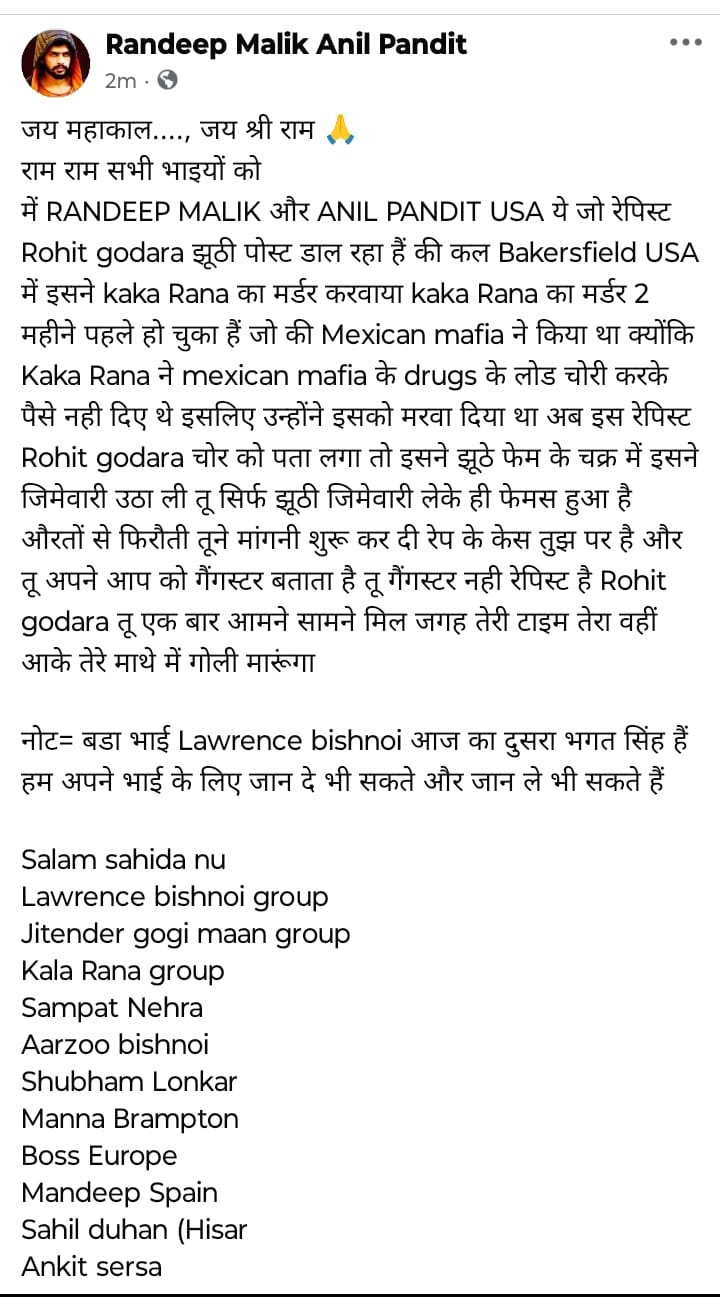
A controversial and threatening social media post, allegedly linked to individuals claiming association with organized crime groups, has gone viral, raising serious concerns about the growing misuse of digital platforms for spreading intimidation, misinformation, and criminal propaganda. The post, written in Hindi and widely circulated across messaging apps and social media, contains direct threats, unverified claims about a murder case in the United States, and open glorification of gang culture.
While authorities have not officially verified the authenticity of the claims made in the post, its tone and content have once again brought attention to the dangerous intersection of crime, social media, and public perception.
Table of Contents
What the Viral Message Says
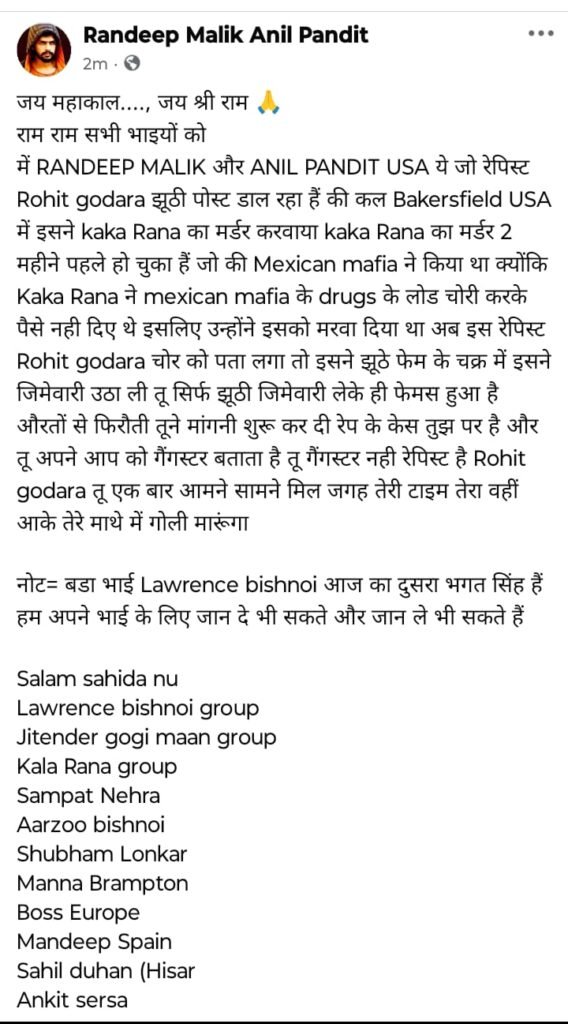
The message begins with religious greetings and introduces the speakers as individuals named Randeep Malik and Anil Pandit, claiming to be based in the United States. It then directly targets a person identified as Rohit Godara, accusing him of spreading false information regarding a murder in Bakersfield, California.
According to the post, a man referred to as “Kaka Rana” was allegedly murdered two months ago by members of a Mexican criminal network due to a dispute involving stolen drug consignments and unpaid money. The message claims that Rohit Godara later falsely took responsibility for this murder in order to gain attention and build a reputation.
The authors of the post go further, accusing him of criminal activities such as extortion and misconduct, while repeatedly using abusive language to undermine his credibility. The post attempts to portray him not as a gangster, but as someone falsely claiming criminal status for personal gain.
Threats That Cannot Be Ignored
One of the most alarming aspects of the viral message is the direct and explicit threat of violence. The authors challenge the accused individual to meet them face-to-face, stating that they would shoot him. Even if such statements are made online, they carry serious legal implications and are treated as credible threats by law enforcement agencies.
Such language not only escalates tensions between rival groups but also creates an atmosphere of fear among the public. Experts warn that even when these threats are meant as intimidation tactics, they can quickly translate into real-world violence if not addressed in time.
Glorification of Crime and Gang Culture
Beyond the immediate threats, the post also reflects a broader and deeply concerning trend—the glorification of criminal figures and gang culture on social media. The message praises certain individuals, referring to them in heroic terms and expressing loyalty to organized groups. It suggests a willingness to “give and take lives” for the sake of allegiance.
This kind of narrative is particularly dangerous because it normalizes violence and presents criminal activity as a symbol of power and respect. For younger audiences, who are highly active on social media, such messaging can create a distorted perception of reality, where crime is seen as a pathway to fame and influence.
Misinformation and the Battle for Narrative Control
At the heart of this controversy lies a critical issue—misinformation. The post claims that the murder in question had already occurred months earlier and was unrelated to the person now taking responsibility online. If accurate, this suggests a deliberate attempt to manipulate public perception.
In the digital age, controlling the narrative has become almost as important as the crime itself. Individuals and groups often use social media to:
- Claim credit for incidents they were not involved in
- Exaggerate their influence or reach
- Spread fear among rivals
- Gain followers and recognition
This not only misleads the public but can also complicate ongoing investigations by introducing false leads and confusion.
A Growing Pattern Across Platforms
Law enforcement agencies and cybercrime experts have been increasingly vocal about the rise of such online behavior. Over the past few years, there has been a noticeable increase in:
- Videos and posts showcasing weapons or threats
- Public declarations of gang affiliations
- Online feuds between rival groups
- Attempts to build a “digital reputation” through fear
In many cases, individuals involved in such activities are not traditional criminals but are drawn into this culture due to the attention and influence it brings.
Legal Consequences and Enforcement Challenges
Posting threats, spreading false information, and promoting criminal activity online are punishable offences under various laws. However, enforcing these laws can be challenging, especially when posts originate from different countries or involve anonymous accounts.
Authorities often rely on cyber forensics, IP tracking, and international cooperation to investigate such cases. Even then, identifying the real individuals behind these posts can take time.
Despite these challenges, law enforcement agencies have made it clear that online threats are taken seriously, and those responsible can face strict legal action.
Impact on Society and Public Perception
For the general public, such posts can be deeply unsettling. The mix of real names, violent threats, and claims of organized crime creates confusion and fear. It becomes difficult to distinguish between fact and fiction.
Moreover, repeated exposure to such content can lead to desensitization, where people begin to see threats and criminal behavior as normal or routine. This can have long-term effects on how society perceives law, order, and justice.
The Need for Digital Responsibility
Experts emphasize that tackling this issue requires more than just law enforcement action. There is a growing need for:
- Public awareness about misinformation and online safety
- Responsible use of social media platforms
- Stronger content moderation by tech companies
- Quick reporting of harmful or threatening posts
Users must understand that sharing or amplifying such content, even unintentionally, contributes to its spread and impact.