Bollywood stars Shah Rukh Khan, Ajay Devgn and Tiger Shroff have come under scrutiny from the Maharashtra Food and Drug Administration (FDA) over their appearances in advertisements for Vimal Elaichi. The state regulator has issued show-cause notices to the three actors, alleging that the campaign could amount to surrogate advertising for a pan masala brand that is prohibited in Maharashtra. The FDA has warned that the actors could face a fine of up to ₹10 lakh at the initial stage if their responses to the notices are found unsatisfactory.
The action has brought renewed attention to the long-running debate surrounding celebrity endorsements of products associated with pan masala and other restricted or health-sensitive products. The case also highlights the regulatory challenges involved when a legally marketed product shares branding and promotional identity with another product facing restrictions.
Table of Contents
FDA Issues Show-Cause Notices to Bollywood Stars
The Maharashtra FDA issued the notices on August 14, asking Shah Rukh Khan, Ajay Devgn and Tiger Shroff to explain their roles in the Vimal Elaichi advertising campaign and their association with the brand. The regulator has questioned whether the advertisement indirectly promotes Vimal Pan Masala through the promotion of a chewing cardamom product.
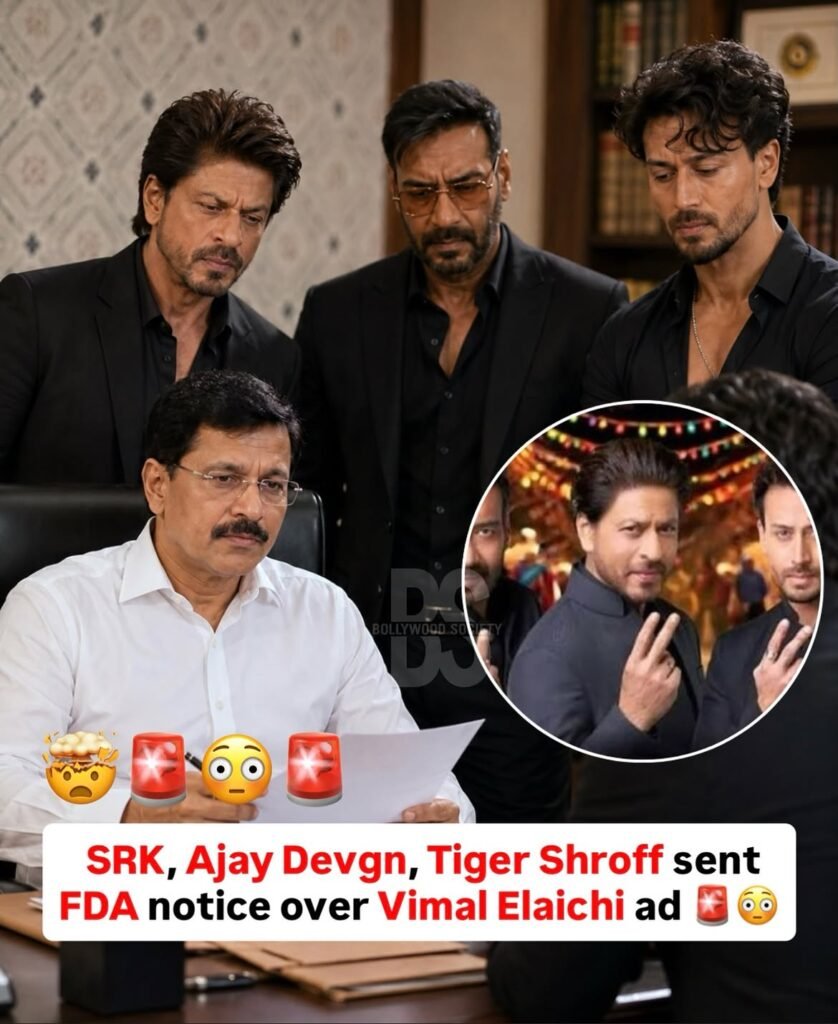
The notices reportedly seek information concerning the actors’ endorsement arrangements, including details about their involvement in the campaign. The FDA’s action is based on its preliminary assessment that the advertisement may fall within the scope of surrogate advertising.
The notices were reportedly delivered to Ajay Devgn at his Juhu residence, Shah Rukh Khan at Mannat in Bandra and Tiger Shroff through his production company, Tiger Shroff Productions LLP.
Importantly, the notices do not mean that the three actors have already been found guilty of an offence. They have been asked to provide explanations, after which the authorities will determine what further action, if any, is warranted.
Why Are the Actors Facing FDA Action?
The central issue is the concept of surrogate advertising.
Surrogate advertising refers broadly to a marketing approach in which a brand associated with a restricted product promotes another product or category while retaining elements of the same brand identity. In this case, the Maharashtra FDA believes that advertising Vimal Elaichi could indirectly reinforce the Vimal brand’s association with pan masala.
The regulator has reportedly examined elements such as the product’s presentation, brand name, dialogue and the broader market context in which the advertisement appears.
According to the FDA’s position, the concern is not simply whether the advertised product is cardamom. Instead, the regulator is examining whether the advertisement functions as an indirect promotional mechanism for a product that faces restrictions in Maharashtra.
This distinction is at the heart of the case and will have to be assessed through the actors’ responses and the regulator’s further proceedings.
Maharashtra FDA Commissioner Tukaram Mundhe Issues Warning
Maharashtra FDA Commissioner Tukaram Mundhe has made it clear that the regulator intends to take the matter seriously.
Mundhe said that surrogate and misleading advertisements are subject to restrictions under food-safety regulations. He acknowledged that the notices came after some delay but defended the timing by saying that officials had been examining the matter.
The commissioner has warned that if the responses submitted by the actors are not satisfactory, a fine of up to ₹10 lakh could be imposed at the first stage. He further indicated that additional action could follow under relevant provisions concerning prohibited products if the regulator remains dissatisfied.
The warning has therefore shifted the controversy from a celebrity endorsement debate to a formal regulatory process.
What Does the ₹10 Lakh Fine Mean?
The reported ₹10 lakh figure represents a potential penalty at the initial stage if the authorities find the responses inadequate and determine that the relevant provisions have been violated.
It is important to distinguish between a warning of possible action and an actual penalty. As of now, the actors have been served notices and asked to explain their involvement. The final outcome will depend on the regulatory proceedings.
The FDA’s action could therefore result in different outcomes depending on the explanations and evidence presented by the parties involved.
The actors may provide details regarding their contracts, the nature of the advertised product, their understanding of the campaign and the due diligence undertaken before participating in the endorsement.
What Is the Connection With Vimal Pan Masala?
The FDA’s concern stems from the relationship between the Vimal Elaichi branding and Vimal Pan Masala.
The regulator has argued that the advertisement may indirectly promote the Vimal brand, which is associated with pan masala. Maharashtra has restrictions on the manufacture, storage, transportation, distribution and sale of certain prohibited pan masala products under food-safety regulations.
This has led authorities to examine whether the promotion of a related product can effectively maintain visibility for a restricted product.
The case therefore goes beyond the individual actors. It raises questions about how brand extensions are advertised when the wider brand is associated with a product subject to regulatory restrictions.

Celebrity Endorsements Come Under Fresh Scrutiny
The controversy has also revived the wider debate over the responsibility of celebrities when endorsing commercial products.
Shah Rukh Khan, Ajay Devgn and Tiger Shroff are among the most recognisable names in Indian cinema, and their advertisements can reach millions of viewers across television, digital platforms and social media.
That reach is one reason regulators and public-health advocates have increasingly focused on celebrity endorsements.
When a celebrity appears in an advertisement, audiences may associate the actor’s public image with the product being promoted. This has led to continuing discussion about whether celebrities should conduct additional due diligence before accepting endorsement assignments, particularly where a brand has links with products facing health or regulatory concerns.
Veteran actor Mukesh Khanna has also publicly supported the FDA’s action and argued that celebrities should take responsibility for the messages associated with advertisements they endorse.
Actors Asked to Provide Details of Endorsements
The FDA has reportedly sought information that could help establish the nature of the actors’ relationship with the campaign.
Such information may include endorsement contracts, campaign details and other material concerning the advertising arrangement. The regulator has also sought information relating to remuneration and due diligence, according to reports.
This could become significant because the authorities are examining not only the advertisement itself but also the actors’ role in promoting the brand.
The information could help determine how the campaign was structured and what the endorsers understood about the product and its branding.
Social Media Promotion Also Under the Scanner
The controversy is not limited to traditional television or video advertising.
Reports say the actors were asked to remove promotional content from their social media platforms within a specified period. This reflects the changing nature of advertising, where celebrity endorsements can remain accessible online long after an original campaign has aired.
Digital platforms create an additional regulatory challenge because promotional material can be shared, reposted and viewed by audiences long after its original publication.
The FDA’s action therefore also highlights the importance of examining digital advertising as part of broader consumer-protection efforts.
Maharashtra’s Restrictions on Pan Masala Products
Maharashtra has maintained restrictions on gutkha and certain pan masala products containing tobacco or nicotine for years. The state’s food-safety authorities have periodically conducted enforcement drives against prohibited products and their illegal distribution.
The latest action adds another dimension by focusing on advertising rather than only the physical sale of restricted products.
The regulator’s position is that promotional strategies should not be used to indirectly maintain visibility for prohibited products.
This approach places greater emphasis on the advertising ecosystem surrounding such products, including brands, agencies and celebrity endorsers.
Why Surrogate Advertising Is a Major Issue
The controversy illustrates why surrogate advertising remains a difficult regulatory issue.
A company may advertise a legally marketed product that carries the same or similar brand identity as another product. From a purely product-specific perspective, the advertisement may appear to promote the legal item. However, regulators can examine whether the campaign’s wider effect is to strengthen recognition of a restricted product.
The question is therefore one of intent, presentation and overall impact, rather than simply the name of the product shown in an advertisement.
In the Vimal case, the Maharashtra FDA is examining whether the elaichi campaign crosses that line.
The regulator’s findings will determine how the campaign is treated under applicable food-safety provisions.
What Could Happen Next?
The immediate next step is for Shah Rukh Khan, Ajay Devgn and Tiger Shroff to respond to the notices.
The FDA will then examine their explanations and the available evidence before deciding whether further proceedings are necessary.
If the responses are considered unsatisfactory, the regulator has indicated that a fine of up to ₹10 lakh could be imposed at the first stage. Further action may also be considered under provisions concerning prohibited products.
At this point, however, no final penalty against the three actors has been established.
The proceedings could also have wider implications for advertisers and celebrity endorsers who participate in campaigns involving brands connected with restricted products.
A Larger Question for Bollywood and Advertising
The FDA’s action has once again placed celebrity advertising at the centre of a public discussion.

For Bollywood stars, endorsements are an important part of the commercial entertainment industry. However, regulatory scrutiny can increase when the promoted brands have connections with products that are restricted or considered harmful to public health.
The case involving Shah Rukh Khan, Ajay Devgn and Tiger Shroff could therefore become an important example of how regulators approach celebrity-led surrogate advertising.
It may also encourage brands and advertising agencies to undertake more detailed legal and regulatory checks before launching campaigns featuring high-profile personalities.
The Maharashtra FDA’s action against Shah Rukh Khan, Ajay Devgn and Tiger Shroff has brought fresh attention to the issue of surrogate advertising and celebrity responsibility.
The three actors have received show-cause notices over their appearances in Vimal Elaichi advertisements. The FDA believes the campaign may indirectly promote a Vimal pan masala product associated with restrictions in Maharashtra.
FDA Commissioner Tukaram Mundhe has warned that the actors could face a fine of up to ₹10 lakh at the initial stage if their explanations are found unsatisfactory. The regulator has also indicated that further action could follow under applicable food-safety provisions.
For now, the matter remains at the notice-and-response stage. The actors’ explanations and the FDA’s subsequent assessment will determine what happens next.
Beyond the immediate controversy, the case has raised a broader question about the responsibilities of celebrities, brands and advertising agencies when promoting products whose branding may be associated with restricted goods. As regulators increasingly examine both traditional and digital advertising, the outcome of this case could add another significant chapter to India’s evolving debate over surrogate advertising and celebrity endorsements.