
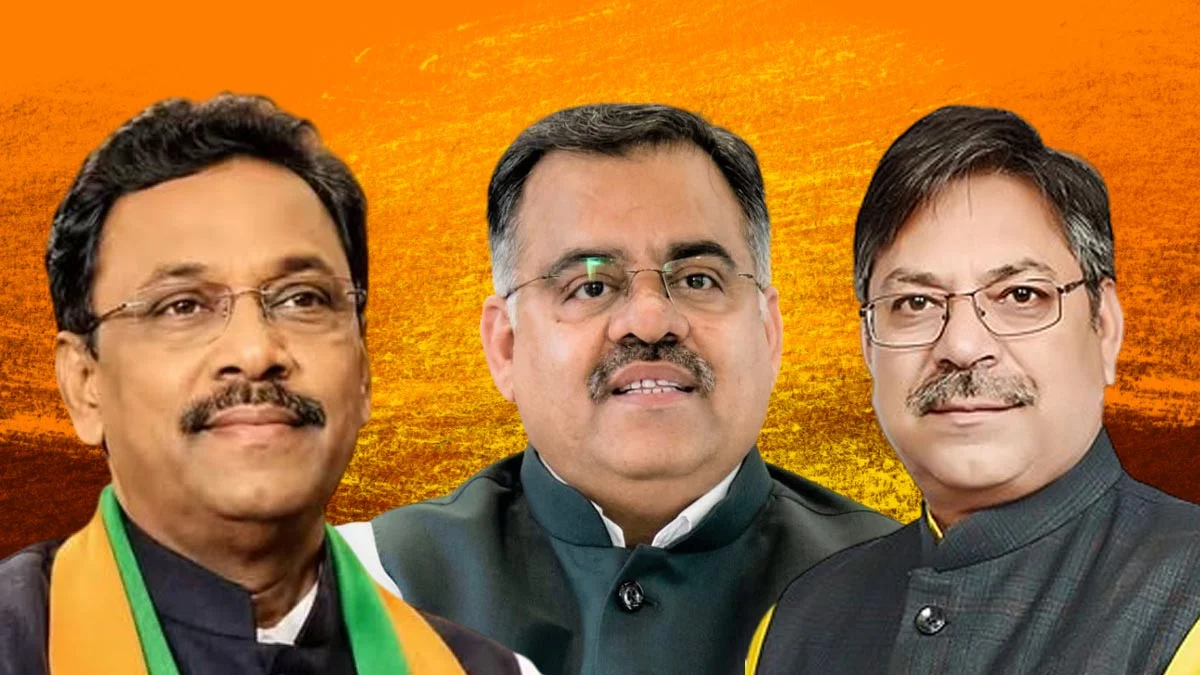
The Bharatiya Janata Party (BJP) has announced new state in-charges for key poll-bound states, assigning senior leader Vinod Tawde the responsibility of Uttar Pradesh and BJP national general secretary Satish Poonia the charge of Punjab. The appointments were announced by BJP national president Nitin Nabin on August 18, 2026, as the party begins strengthening its organisational preparations ahead of the 2027 Assembly elections.
The organisational reshuffle also includes Rajya Sabha MP Tarun Chugh, who has been appointed the party’s in-charge for Gujarat. Jagdish Ishwarbhai Patel has been named co-in-charge for Uttar Pradesh.
The appointments assume significance because Uttar Pradesh, Punjab and Gujarat are scheduled to hold Assembly elections next year. The BJP’s decision to deploy experienced organisational leaders in these states indicates the importance the party is placing on early preparation, organisational coordination and electoral strategy.
Table of Contents
Vinod Tawde Gets Crucial Uttar Pradesh Responsibility
Vinod Tawde’s appointment as BJP in-charge for Uttar Pradesh puts him in charge of organisational affairs in one of India’s most politically significant states.
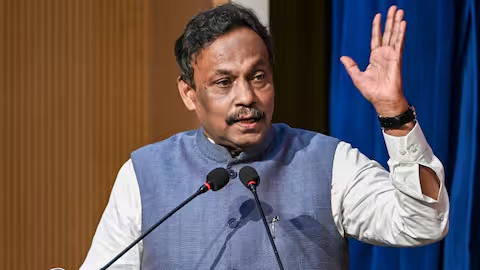
Uttar Pradesh has the largest number of Lok Sabha seats in the country, making its political importance extend beyond the Assembly election itself. The 2027 Assembly contest is therefore expected to be closely watched as parties prepare for the next phase of state and national politics.
Vinod Tawde has considerable organisational experience within the BJP. He currently serves as a national general secretary and has previously been given responsibilities related to several election campaigns. His earlier organisational work has included Bihar, while he has also handled assignments connected with difficult constituencies and state-level electoral strategy.
His appointment to Uttar Pradesh also follows months of speculation about the BJP’s choice for the state in-charge. Reports in June had noted that Vinod Tawde had already been active in Uttar Pradesh and was involved in important organisational discussions, although his formal appointment had not yet been announced at that time.
Vinod Tawde’s Earlier Electoral Experience
Vinod Tawde’s organisational record is one of the reasons his appointment to Uttar Pradesh has attracted attention.
In 2022, he was given responsibility for coordinating the BJP’s election strategy across five states—Uttar Pradesh, Punjab, Goa, Manipur and Uttarakhand. The BJP won four of those five states, with Punjab being the exception.
He was also involved in the party’s strategy for a group of constituencies considered challenging during the 2024 Lok Sabha election. Such assignments have helped establish his profile as an organisational strategist within the BJP.
His experience is now being brought to bear in Uttar Pradesh, where the party faces the task of preparing its organisation well ahead of the 2027 Assembly polls.
Why Uttar Pradesh Is So Important for the BJP
Uttar Pradesh occupies a central position in Indian electoral politics.
The state sends 80 members to the Lok Sabha, the highest number from any state. Consequently, political developments in Uttar Pradesh are closely linked to national electoral calculations.
The 2027 Assembly election will also be important for the BJP’s state-level organisation. The party will have to coordinate its government, state organisation and grassroots network while responding to opposition campaigns.
The BJP’s choice of an experienced national general secretary as the state in-charge suggests that the party intends to maintain close coordination between its central leadership and the Uttar Pradesh unit.
Tawde’s responsibilities are expected to include organisational coordination, communication with state leaders and helping the party prepare its election machinery. The exact strategy will evolve as the election approaches.
Jagdish Ishwarbhai Patel Named UP Co-In-Charge
Alongside Vinod Tawde, the BJP has appointed Jagdish Ishwarbhai Patel as the co-in-charge for Uttar Pradesh.
The co-in-charge will work alongside the state in-charge and assist with organisational responsibilities.
Such arrangements are designed to divide the workload associated with managing a large state organisation. Uttar Pradesh’s geographical size and political diversity make coordination a significant organisational task.
The appointments therefore provide the BJP with a dedicated leadership structure for the state as preparations for the Assembly election gather pace.
Satish Poonia Gets Punjab Assignment
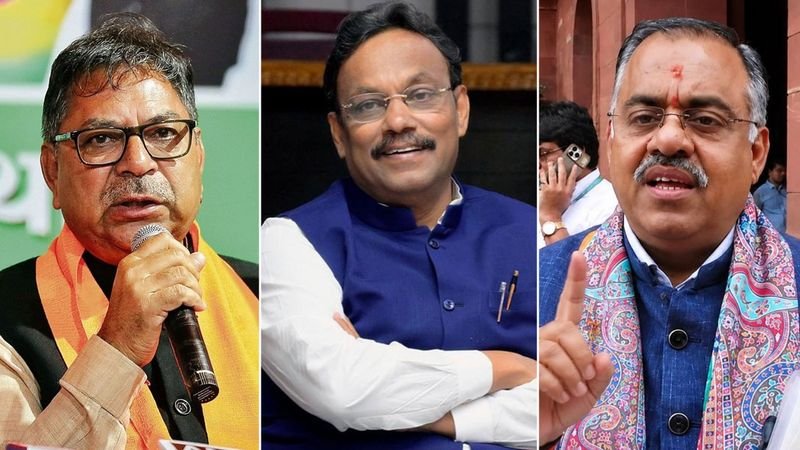
The BJP has also appointed Satish Poonia as its in-charge for Punjab.
Poonia is a senior Rajasthan BJP leader and national general secretary. He previously served as BJP Rajasthan president and Leader of Opposition in the Rajasthan Assembly. He has also been associated with the party’s organisational and electoral work in Haryana.
His selection for Punjab comes at a time when the BJP is seeking to strengthen its organisational structure in the state ahead of the 2027 Assembly election.
Poonia’s previous responsibilities in Haryana are particularly relevant. He was appointed Haryana in-charge in July 2024 and was regarded by party observers as an important part of the BJP’s organisational strategy during the 2024 Assembly election, when the party returned to power for a third consecutive term in the state.
BJP Looks to Strengthen Punjab Organisation
Punjab presents a different political landscape from Uttar Pradesh.
The BJP has been working to expand its independent organisational presence in the state and prepare for the next Assembly election.
Satish Poonia‘s appointment is expected to give the party an experienced organisational hand as it works on strengthening its grassroots network and coordinating with state leaders.
Reports before the formal announcement had already indicated that Poonia was being considered for the Punjab responsibility and had begun engaging with senior Punjab BJP leaders.
The formal appointment now gives him an official mandate to oversee the party’s organisational affairs in the state.
From Haryana to Punjab: Why Poonia’s Experience Matters
Poonia’s recent experience in Haryana is likely to be closely watched in Punjab.
The BJP’s performance in Haryana in 2024 demonstrated the importance of booth-level organisation, campaign coordination and leadership management in Assembly elections. Poonia was viewed as one of the organisational figures involved in that campaign.
Punjab, however, has its own political dynamics, voter priorities and party structure. Poonia will therefore have to adapt his organisational approach to the state’s specific circumstances.
The immediate task will be strengthening the party organisation and ensuring coordination among its state and district-level units.
Tarun Chugh Assigned Gujarat
The latest appointments also include Tarun Chugh, who has been given charge of Gujarat.
Chugh is a Rajya Sabha MP and senior BJP leader. His appointment completes the latest set of key state-level organisational responsibilities announced by Nitin Nabin.
Although Gujarat is traditionally a strong BJP state, the party’s organisational leadership continues to be important for maintaining its political strength.
The three appointments—Tawde in Uttar Pradesh, Poonia in Punjab and Chugh in Gujarat—represent a broader effort to assign experienced leaders to important state organisations.
Nitin Nabin’s Organisational Reshuffle
The appointments come shortly after Nitin Nabin unveiled a revamped BJP national team.
The party’s leadership restructuring has been described as an organisational reset aimed at combining experienced election strategists with newer faces.
The latest state-level appointments are therefore part of a larger organisational exercise rather than isolated changes.
By putting senior leaders in charge of states that will face elections in 2027, the BJP is creating a structure through which the national leadership can monitor preparations and coordinate with state units.
2027 Assembly Elections Already Taking Shape
Assembly elections in Uttar Pradesh and Punjab are scheduled for 2027, making the BJP’s latest appointments significant well before polling begins.
Political parties typically begin organisational preparations months ahead of an election. These preparations include strengthening booth-level networks, assessing local political conditions, coordinating with state leaders and identifying areas where the party needs additional organisational attention.
The appointment of dedicated in-charges gives the BJP senior leaders who can focus on these responsibilities while maintaining communication with the national leadership.
The election itself is still some distance away, meaning the political environment could change considerably before campaigning formally begins.
Challenges Ahead for Vinod Tawde
Vinod Tawde’s Uttar Pradesh assignment will come with several organisational challenges.
The state has a highly diverse electorate and significant regional differences. Political dynamics can vary substantially between western Uttar Pradesh, central regions, Bundelkhand and eastern Uttar Pradesh.
The BJP will therefore need a carefully coordinated organisational approach.
Another important task will be maintaining coordination among the state government’s leadership, the BJP’s state unit and the party’s grassroots organisation.
Vinod Tawde’s previous organisational experience could prove useful in handling these responsibilities, although Uttar Pradesh presents a different set of political circumstances from the states where he has previously worked.
Challenges for Satish Poonia in Punjab
Poonia’s task in Punjab will also require a strong organisational focus.
The BJP will need to strengthen its network across the state’s districts and constituencies while developing an electoral strategy suited to local political conditions.
Poonia’s experience in Rajasthan and Haryana gives him familiarity with state-level organisational management, but Punjab has its own political history and electoral dynamics.
His ability to coordinate with local leaders and strengthen the party structure will therefore be an important part of his new responsibility.
What the Appointments Mean for BJP’s Election Strategy
The BJP’s latest appointments indicate that the party is moving early to prepare its organisation for the 2027 Assembly elections.
Instead of waiting for the formal election schedule, the party has placed experienced leaders in key organisational positions.
For Uttar Pradesh, Vinod Tawde brings national-level organisational experience and a record of handling election-related responsibilities.
For Punjab, Poonia brings experience from Rajasthan and Haryana, including his work around the 2024 Haryana Assembly election.
For Gujarat, Chugh brings his own experience within the BJP’s national organisational structure.
Together, the appointments provide the party with a leadership framework for three important states.
BJP Focuses on Organisation Ahead of 2027 Polls
The latest reshuffle demonstrates the continuing importance of organisational management in the BJP’s election strategy.
State in-charges act as an important link between the party’s central leadership and state units. They can help coordinate organisational activities, communicate central directives and monitor preparations on the ground.
Their role becomes particularly significant during election periods, when multiple layers of the party organisation have to work together.
With the 2027 Assembly elections approaching, the BJP’s decision to finalise these responsibilities early gives the newly appointed leaders time to understand their states and begin organisational preparations.
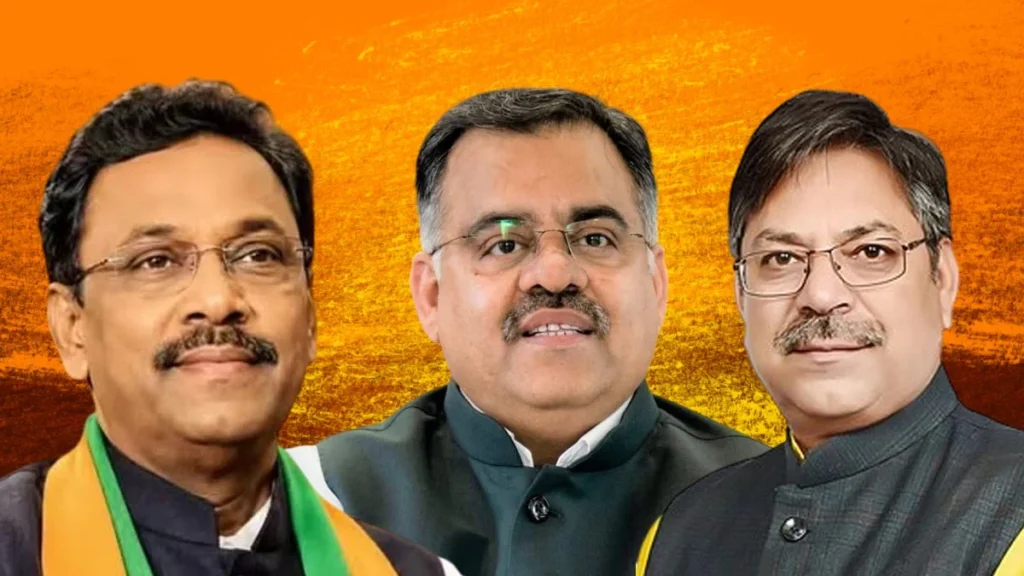
The BJP’s appointment of Vinod Tawde as Uttar Pradesh in-charge and Satish Poonia as Punjab in-charge marks an important organisational step ahead of the 2027 Assembly elections. Tarun Chugh’s appointment as Gujarat in-charge is part of the same reshuffle announced by BJP president Nitin Nabin.
Vinod Tawde enters Uttar Pradesh with extensive organisational experience and previous involvement in election strategy across multiple states. Poonia, meanwhile, takes charge of Punjab after significant organisational responsibilities in Haryana and a long political career in Rajasthan.
The appointments come at an early stage of the 2027 election cycle, giving the leaders considerable time to work with state units and strengthen organisational preparations.
For the BJP, the focus now shifts towards building election readiness on the ground. For Vinod Tawde and Satish Poonia, their new assignments represent major responsibilities in two politically important states where the party will seek to strengthen its position in the next Assembly elections.