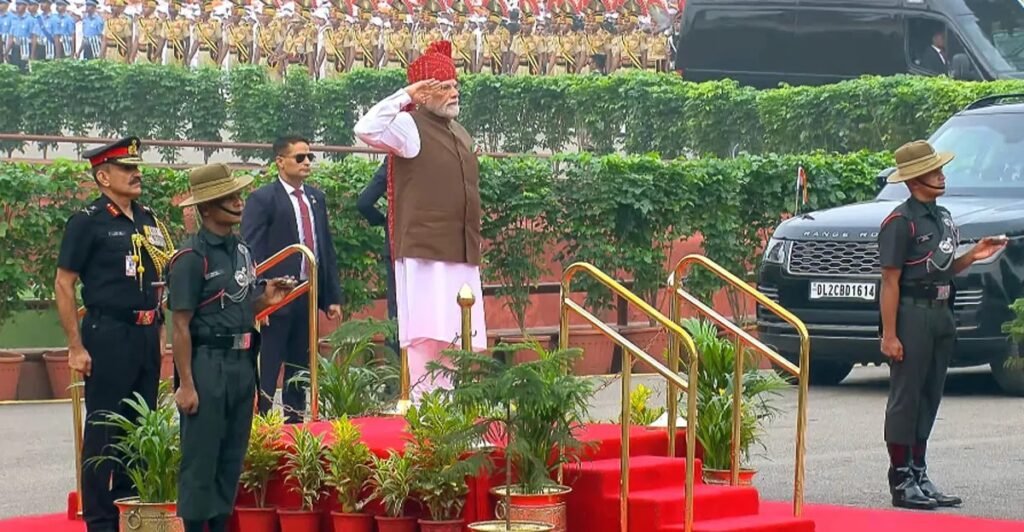
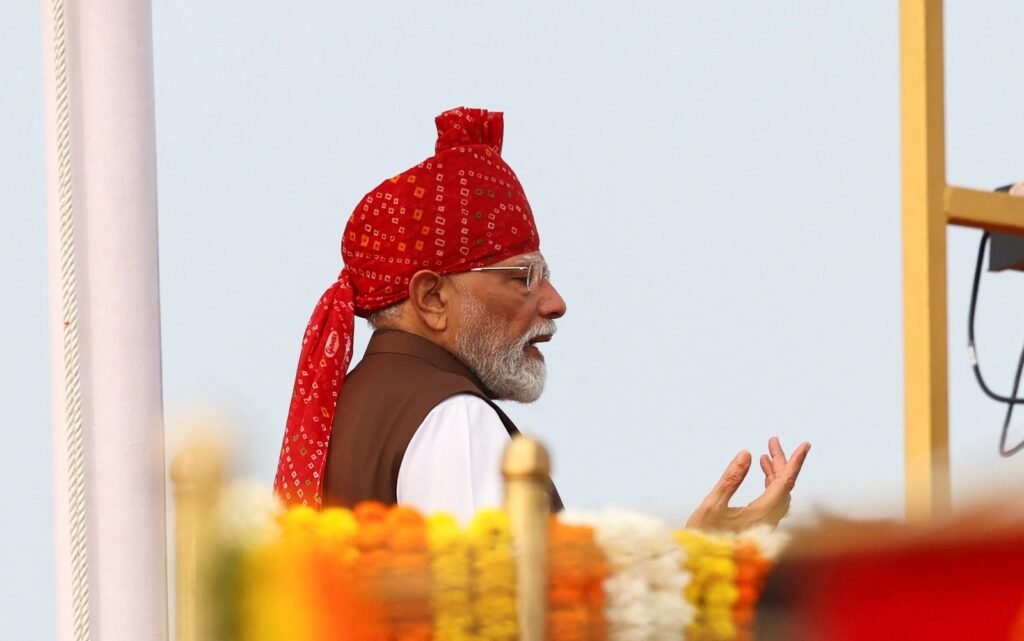
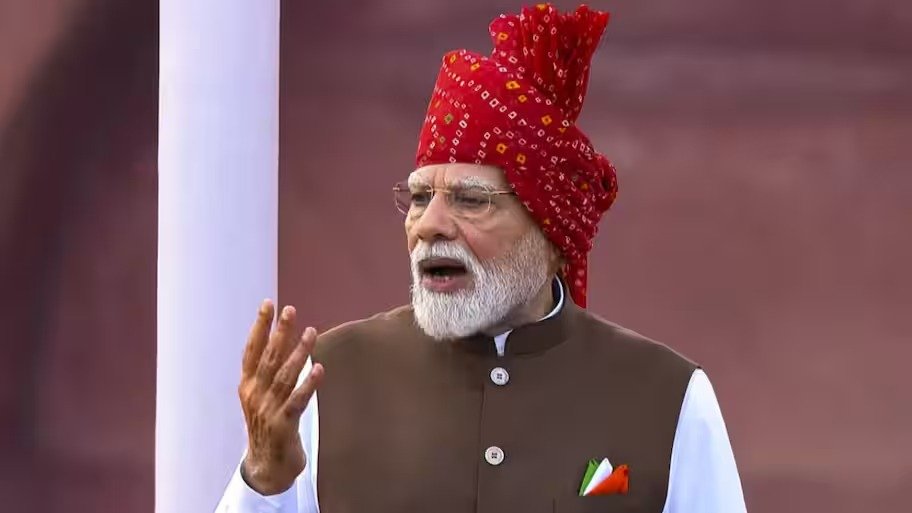
India’s 80th Independence Day 2026 on August 1,, Prime Minister Narendra Modi announced a series of major initiatives and long-term targets spanning artificial intelligence, education, civil defence, sports, semiconductor manufacturing and nuclear energy in his address to the nation from the Red Fort.
The announcements placed India’s youth and technological capabilities at the centre of the government’s broader Viksit Bharat 2047 vision. Among the headline measures were a plan to provide AI skill training to one crore young people within a year, a nationwide system for free online coaching for competitive examinations, and a talent-identification programme for children aged five to 15.
The Prime Minister also announced plans to create a modern Civil Defence volunteer network, expand India’s semiconductor manufacturing capacity and work towards 100 GW of nuclear power capacity by 2047.
The official Prime Minister’s Office described the announcements as including AI skilling for one crore youth, free online coaching, a nationwide sports talent hunt, a modern Civil Defence network, additional semiconductor plants and the nuclear-power target.
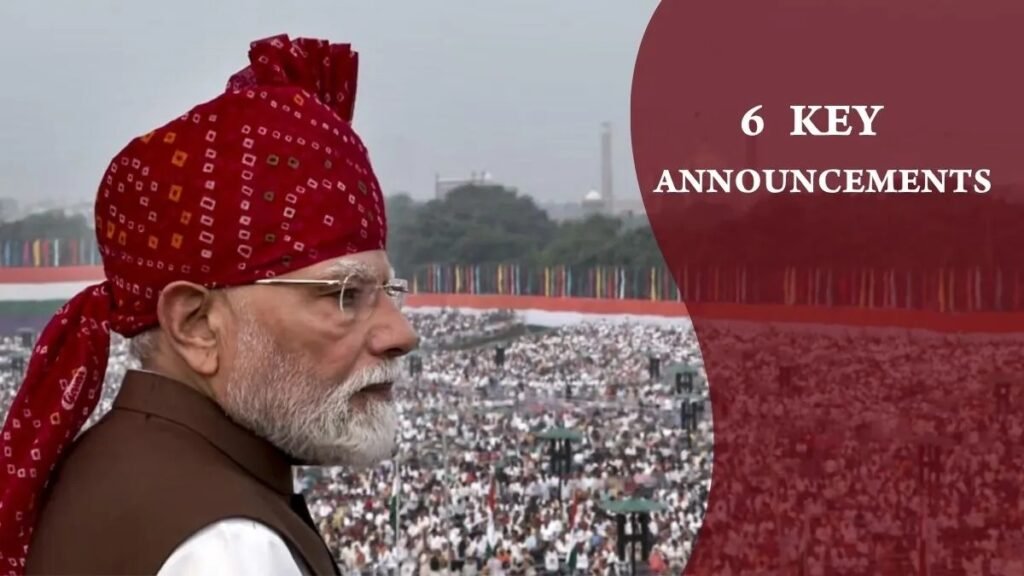
Here is a closer look at the six major announcements and what they could mean for India.
Table of Contents
1. AI Skill Training for One Crore Youth
One of the most prominent announcements in the Independence Day 2026 address was the government’s plan to provide Artificial Intelligence skill training to one crore, or 10 million, young people over the next year.
PM Modi said the initiative is intended to prepare Indian youth to take a leading role in the rapidly expanding AI ecosystem.
The announcement comes at a time when artificial intelligence is transforming industries ranging from information technology and finance to healthcare, manufacturing, education and transportation. As AI adoption increases, demand is also growing for workers who understand AI tools, data, automation and related technologies.
The government’s proposed programme seeks to expand access to these skills beyond India’s traditional technology hubs.
The Prime Minister linked the announcement to India’s broader push to build capabilities in emerging technologies and referred to the country’s recent AI Summit. The official PMO summary confirms the target of training one crore youth in AI within one year.
Why the AI announcement matters
India has one of the world’s largest young populations, making large-scale skill development an important component of its economic strategy.
Training one crore young people, however, represents a significant scale-up. The effectiveness of the initiative will depend not only on the number of people enrolled but also on the quality, accessibility and practical relevance of the training.
For students and young job seekers, the programme could potentially create new pathways into AI-enabled occupations and technology-related sectors.
The challenge will be ensuring that training reaches young people in smaller cities, towns and rural areas, rather than being concentrated primarily in established technology centres.
2. Free Online Coaching for Competitive Examinations
The second major announcement directly addressed one of the most expensive aspects of India’s competitive-examination ecosystem: private coaching.
PM Modi announced plans to create a free online coaching network for various competitive examinations, arguing that coaching costs have become a significant financial burden for poor and middle-class families.
The government intends to use India’s existing digital infrastructure and pool together teachers and educational resources to build the proposed system.
The Prime Minister said the objective is to allow students to prepare for examinations without necessarily having to spend large amounts on private coaching or relocate to major coaching hubs.
The official announcement confirms that the proposed network will provide free online coaching for competitive examinations.
Potential impact on students
Competitive examinations such as those for government jobs and professional courses attract millions of aspirants every year. Many students travel from smaller towns to cities known for coaching, creating additional expenses for accommodation, food, transportation and study materials.
A free online coaching network could reduce some of these barriers by allowing students to access classes from home.
However, the success of the initiative will depend on the availability of high-quality faculty, reliable digital access, comprehensive study material, doubt-resolution mechanisms, mock tests and regular assessments.
It will also need to ensure that students without high-speed internet or expensive devices are not excluded from the programme.
3. Modern Civil Defence Volunteer Network
PM Modi also announced plans to establish a vibrant and modern Civil Defence network capable of responding to contemporary emergencies and security challenges.
The proposed volunteer force would receive modern training and become familiar with systems designed to protect citizens during crises.
Civil Defence traditionally focuses on protecting civilians and assisting communities during emergencies. With the nature of threats evolving, the government intends to modernise the system and improve preparedness.
The PMO has described the proposal as a modern Civil Defence network designed to meet contemporary challenges.
Focus on preparedness and public participation
A large volunteer-based network could strengthen community-level emergency preparedness if supported by proper training, communication systems and coordination with professional emergency-response agencies.
The initiative also reflects a broader recognition that disaster and emergency response cannot depend exclusively on government personnel. Trained community volunteers can potentially play an important role during natural disasters, infrastructure emergencies and other crises.
The exact structure, recruitment process, training curriculum and responsibilities of the proposed network will determine how effectively it can operate.
4. Nationwide Sports Talent Hunt for Children Aged 5 to 15
Sports was another major focus of the Independence Day address.
PM Modi announced a nationwide talent hunt for children between five and 15 years of age to identify promising athletes from different parts of the country.
Children identified through the programme would receive special training with the aim of developing them into world-class athletes.
The initiative is closely connected to India’s ambitions in international sports and the country’s preparations for future Olympic participation. PM Modi said India wants to increase its participation across Olympic disciplines and highlighted programmes such as Target Olympic Podium Scheme (TOPS), Khelo India Games and University Games.
The PMO confirmed the nationwide sports talent hunt for children aged five to 15 as one of the key announcements.
India’s Olympic ambitions
India has increasingly focused on building a stronger sports ecosystem through athlete development, sports science, nutrition, medicine and grassroots programmes.
However, the country continues to have relatively limited participation in several Olympic disciplines.
PM Modi said India aims to participate in at least three-fourths of Olympic events by 2036. The talent hunt is intended to identify potential athletes at a much earlier age and create a larger pipeline of sporting talent.
Such a programme could be particularly significant for children from regions where organised sports training is less accessible.
The challenge will be creating a system capable of identifying talent fairly and providing sustained coaching, equipment, nutrition, medical support and competition opportunities after identification.
5. Major Push for Semiconductor Manufacturing
The fifth major announcement focused on semiconductors, a sector considered strategically important for India’s technological and economic ambitions.
PM Modi highlighted the importance of semiconductor chips in modern economies, noting their role in electronic products, medical equipment and transportation systems.
He said India has already established three major semiconductor facilities and that production has begun for exports. He further said five to eight additional semiconductor plants are expected to commence operations over the coming years.
The PMO also listed additional semiconductor plants among the major announcements made during the Independence Day address.
Why semiconductors are strategically important
Semiconductors are fundamental components of modern electronics. They are used in smartphones, computers, automobiles, industrial equipment, telecommunications systems, medical devices and a wide range of other products.
The global semiconductor supply chain has also become a major strategic issue, with countries seeking greater control over critical technologies and manufacturing capabilities.
For India, expanding domestic semiconductor manufacturing could support several objectives simultaneously: reducing import dependence, strengthening electronics manufacturing, creating specialised jobs and integrating the country more deeply into global technology supply chains.
The proposed expansion therefore represents more than an industrial investment. It is also part of India’s broader Aatmanirbhar Bharat and technology self-reliance strategy.
6. Nuclear Energy Target of 100 GW by 2047
The sixth major announcement concerned India’s long-term energy security.
PM Modi announced a target of achieving 100 GW of nuclear power capacity by 2047, when India will mark 100 years of independence.
He also announced plans to commission five new nuclear reactors during the current decade.
The Prime Minister described nuclear energy as an important component of India’s energy security and referred to India’s progress in fast-breeder nuclear technology. The official PMO announcement confirms both the 100 GW target for 2047 and the plan for five new reactors during the decade.
Nuclear power and India’s energy needs
India’s electricity demand is expected to rise as the economy expands, urbanisation continues and more sectors become electrified.
Nuclear power can provide large-scale electricity generation without direct carbon emissions during operation, making it a potential component of India’s longer-term energy mix.
The 100 GW target, however, represents a major expansion and will require substantial investment, new reactor capacity, technological development, skilled manpower and long-term infrastructure planning.
The announcement therefore represents a multi-decade energy strategy rather than an immediate increase in electricity generation.
How the Six Announcements Fit Into Viksit Bharat 2047
Although the six initiatives cover very different sectors, they share a common objective: strengthening India’s capabilities ahead of 2047, the centenary of independence.
The AI programme focuses on human capital and future skills.
Free online coaching addresses educational access and affordability.
The Civil Defence network focuses on national preparedness and citizen participation.
The sports talent hunt seeks to strengthen India’s athletic pipeline.
The semiconductor push focuses on technological and manufacturing self-reliance.
The nuclear-energy programme addresses long-term energy security.
Together, the announcements reflect a development strategy that combines human-resource development with strategic investments in technology, infrastructure and national capabilities.
The broader Independence Day address also placed these initiatives within the government’s vision of building a developed India by 2047. PM Modi said India’s long-term goal is to build a Viksit Bharat by the country’s 100th year of independence.
Youth at the Centre of Independence Day 2026 Announcements
A notable feature of this year’s announcements was the emphasis on India’s younger population.
The AI training initiative targets one crore youth, while the free coaching programme is aimed at students and competitive-examination aspirants. The sports talent hunt goes even further by targeting children as young as five.
These Independence Day 2026 initiatives reflect the government’s focus on preparing younger generations for a technology-driven and increasingly competitive global economy.
At the same time, Independence Day 2026 their implementation will be closely watched. Large-scale programmes require clear eligibility criteria, transparent delivery mechanisms, adequate funding, monitoring and measurable outcomes.
From Digital Education to Strategic Technology
The Independence Day 2026 announcements also demonstrate how India’s development priorities are increasingly interconnected.
Digital infrastructure can support education and AI skilling. AI skills can contribute to technology and manufacturing industries. Independence Day 2026 Semiconductor manufacturing can support India’s electronics ecosystem, while nuclear energy can contribute to the power requirements of an expanding industrial economy.
This creates a broader policy picture in which education, technology, manufacturing and energy are treated as interconnected elements of national development.
What Happens Next?
The announcements made during Independence Day 2026 establish ambitious targets, but implementation will ultimately determine their impact.
For the AI programme, attention will turn to the curriculum, training providers, delivery platforms and certification mechanisms.
For free online coaching, students will want to know which examinations will be covered, when classes will begin and how the government will ensure access to high-quality teachers and study materials.
The Independence Day 2026 sports programme will require a nationwide identification mechanism and a pathway from initial talent discovery to professional-level training.
Meanwhile, semiconductor and nuclear targets will depend on large-scale investment, infrastructure, technology, regulatory frameworks and execution over several years.
Independence Day 2026: A Technology and Youth-Focused Roadmap
The six major announcements from PM Modi’s Independence Day 2026 address covered a wide range of national priorities, but their central theme was India’s preparation for the future.
The Independence Day 2026 government has set a target of training one crore youth in AI within one year, promised a free online coaching network for competitive examinations, announced a modern Civil Defence volunteer force and launched plans for a nationwide sports talent hunt for children aged five to 15.
At the strategic level, the Prime Minister announced Independence Day 2026 further expansion of semiconductor manufacturing and set an ambitious target of 100 GW of nuclear power capacity by 2047, alongside plans for five new nuclear reactors during this decade.
The Independence Day 2026 initiatives now move from announcement to implementation. Their eventual success will depend on how effectively they translate ambitious national targets into accessible opportunities, new capabilities and measurable outcomes for citizens across the country.
Independence Day 2026 ,For India’s youth in particular, the announcements signal a policy focus on skills, education, technology and opportunity, while the semiconductor and nuclear initiatives point towards a longer-term effort to strengthen India’s strategic and economic self-reliance.