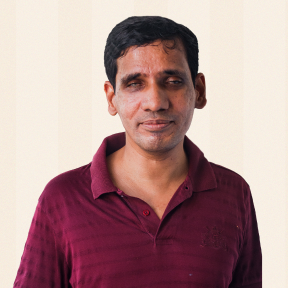
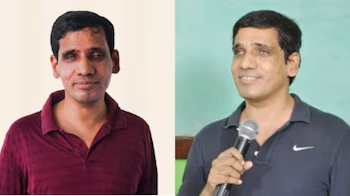
For many students, Hemachandran Karah higher education is primarily a journey of examinations, academic competition and career choices. For Dr Hemachandran Karah, an Associate Professor at the Indian Institute of Technology Madras (IIT Madras), the journey has also been about challenging assumptions surrounding disability, accessibility and who gets to participate fully in academic life.
Karah, who is visually impaired, has built an academic career that has taken him from navigating barriers in education to earning a PhD from the University of Cambridge and joining the faculty at IIT Madras. Today, his work extends beyond conventional teaching. Through research, disability studies, accessibility initiatives and conversations about art and knowledge, he is working to change how institutions understand inclusion.
His story has recently drawn attention after a report highlighted the barriers he encountered during his education and the mentors who encouraged him to aim beyond the limitations others placed around him.
Table of Contents
From Educational Barriers to Academic Achievement
Karah’s journey is significant because it illustrates a larger issue faced by students with disabilities: educational systems are not always designed with diverse learning needs in mind.
For a visually impaired student, ordinary classroom practices can create additional obstacles. Printed material, visual presentations, diagrams and conventional examination systems may require adaptation. These challenges are not necessarily connected to a student’s intellectual ability, but they can influence how easily that ability can be demonstrated.
According to the recent profile of Karah, his own educational journey involved navigating such barriers. Yet an important influence came from teachers and mentors who encouraged him to think beyond what society often assumes people with disabilities can achieve.
That encouragement became an important part of his academic trajectory. He eventually pursued higher studies at the University of Cambridge, where he completed his PhD, before becoming a faculty member at IIT Madras. The institute’s official faculty profile identifies him as an Associate Professor in the Department of Humanities and Social Sciences.
Who Is Dr Hemachandran Karah?
Karah is an academic whose work focuses substantially on Disability Studies, alongside areas including aesthetics, literary criticism and audio description.
IIT Madras lists him as an Associate Professor in its Department of Humanities and Social Sciences. The university profile also notes that he has published peer-reviewed essays in academic journals and books and co-edits the global section of the Review of Disability Studies.
His academic interests demonstrate that disability is not simply a question of medical treatment or physical accommodation. It can also be examined through literature, culture, art, education and the ways society constructs ideas about ability.
This broader perspective is central to Karah’s approach.
At IIT Madras, His Work Goes Beyond the Classroom
Karah’s contribution at IIT Madras is not limited to teaching students.
He is a founding member and principal investigator of the Accessibility Research Centre (ARC) at IIT Madras. The centre was established to rethink accessibility in education and knowledge rather than treating accessibility as an afterthought.
IIT Madras says the ARC was founded by Karah, along with Professor Saji K. Mathew of the Department of Management Studies and Professor Nilesh J. Vasa of the Department of Engineering Design. Karah serves as one of its principal figures.
The centre’s broader philosophy is important: accessibility should not simply mean creating a special arrangement for an individual after a system has already been designed. Instead, learning environments themselves can be created from the beginning with different forms of participation in mind.
The ARC describes its work as combining technology and traditional craftsmanship to develop knowledge resources, descriptions and extended-reality approaches that can support inclusive learning. Its future plans also include AI-driven personalised learning and deeper integration of disability studies into academic curricula.
Changing the Meaning of Accessibility
Accessibility is often understood in very practical terms—ramps, lifts, accessible toilets, screen readers or modified examination arrangements.
Those facilities are important, but Karah’s work points towards a larger question: Who gets to experience knowledge, art and education, and on what terms?
The ARC’s approach seeks to place accessibility closer to the foundation of education rather than treating it as an additional feature.
IIT Madras has described the centre as an effort to rethink education through accessibility and inclusion. The institute has also connected this work to a broader vision of democratising opportunities for citizens.
This philosophy reflects an important shift in disability discourse—from asking how a person can adapt to an existing system to asking how the system itself can become more inclusive.
Why ‘Blind Photography’ Challenges Common Assumptions
One of the most striking aspects of Karah’s work and advocacy is his interest in “blind photography.”
At first glance, photography may appear to be an inherently visual activity. That assumption makes the idea of blind photography particularly powerful.
Karah’s advocacy challenges the belief that people with visual impairments can only participate in creative activities traditionally associated with sight in limited ways. The idea instead opens questions about how photography can be experienced through sound, description, memory, touch, interpretation and collaboration.
The recent profile of Karah highlights blind photography as an example of how he challenges conventional ideas about disability and creativity.
The larger message is not simply that a visually impaired person can participate in photography. It is that society’s definition of an activity may itself be too narrow.
Making Museums and Cultural Spaces More Accessible
Karah’s accessibility work also extends into cultural spaces.
His IIT Madras profile says that he and fellow researchers associated with the Accessibility Research Centre are working on museum spaces with the aim of changing public imagination about disabled people’s access to knowledge.
This is significant because museums traditionally communicate through objects, labels, visual displays and spatial arrangements.
For visitors with visual impairments, those systems can create barriers. Audio description, tactile experiences, alternative formats and thoughtful interpretation can help make cultural knowledge available to a wider audience.
Karah’s work therefore connects disability studies with questions of culture and public participation.
A Teacher as a Guide
Karah also brings a distinctive perspective to teaching.
The recent account of his journey describes his belief that a teacher should function as a guide rather than simply taking on the role of a parent or authority figure.
That approach places emphasis on helping students discover their own intellectual direction.
It is particularly meaningful when viewed alongside Karah’s own educational experience. Mentors helped him imagine possibilities beyond the limitations imposed by others. His approach to teaching similarly emphasises conversation, intellectual exploration and the development of independent thought.
His IIT Madras profile notes that he enjoys conversations with students and that these interactions help him refine his expertise in Disability Studies, aesthetics, literary criticism and audio description.
Disability Studies as an Academic Field
Karah’s work also highlights the growing importance of Disability Studies within higher education.
The field examines disability not only as an individual condition but also through social, cultural, political and institutional perspectives.
Questions include how language influences perceptions of disability, how public spaces are designed, how disabled people are represented in literature and art, and how educational institutions can remove structural barriers.
At IIT Madras, Karah teaches courses connected with this area. The institute’s course catalogue lists “Disability, Literature, and Culture” under his teaching.
He has also contributed to courses and educational material in Disability Studies through NPTEL, according to his university profile.
The Bigger Challenge: Removing Barriers, Not Aspirations
Karah’s story resonates because it moves beyond a conventional “overcoming disability” narrative.
The more important question is not whether a person with a disability can achieve something extraordinary. It is whether institutions provide enough opportunity for people with different abilities to pursue ordinary ambitions—education, employment, research, art and social participation—without unnecessary barriers.
A recent report on Karah’s journey framed this philosophy around the idea of education that removes barriers rather than aspirations.
That distinction matters.
A student should not have to lower their ambitions because a classroom is inaccessible. A researcher should not have to abandon a field because information is presented in only one format. An artist should not be excluded because a creative practice is traditionally associated with one particular sensory experience.
IIT Madras and the Wider Accessibility Push
Karah’s work also forms part of a broader accessibility effort at IIT Madras.
In October 2025, former Chief Justice of India D.Y. Chandrachud inaugurated the institute’s Accessibility Research Centre. IIT Madras said the centre would work towards universal accessibility and integrate accessibility into the foundations of education rather than relying only on individual assistive technologies.
The institute has also highlighted accessibility in relation to technology and mobility. Its initiatives include assistive devices and research aimed at improving participation for people with disabilities.
This broader institutional environment provides a platform for academics such as Karah to connect scholarship with practical questions about inclusion.

A Story That Goes Beyond One Professor
The significance of Hemachandran Karah’s story ultimately lies beyond his personal academic achievements.
His journey from facing barriers in education to earning a PhD at Cambridge and becoming an Associate Professor at IIT Madras demonstrates what can happen when ability is not defined by conventional expectations.
But his work also asks society to look beyond individual success stories.
True inclusion means creating systems in which students with disabilities do not have to constantly prove that they belong. It means designing classrooms, museums, research environments and cultural spaces so that different ways of learning and experiencing the world are considered from the beginning.
For Karah, that work is now part of his academic mission.
From Disability Studies and accessible education to blind photography and museum accessibility, his career demonstrates that disability does not have to define the limits of intellectual or creative participation.
Instead, it can become a powerful lens through which institutions rethink what education, knowledge and inclusion should look like.
And perhaps that is the most important lesson from his journey: the real barrier is not always a person’s disability; sometimes, it is a system that has never been designed to recognise the full range of human ability.