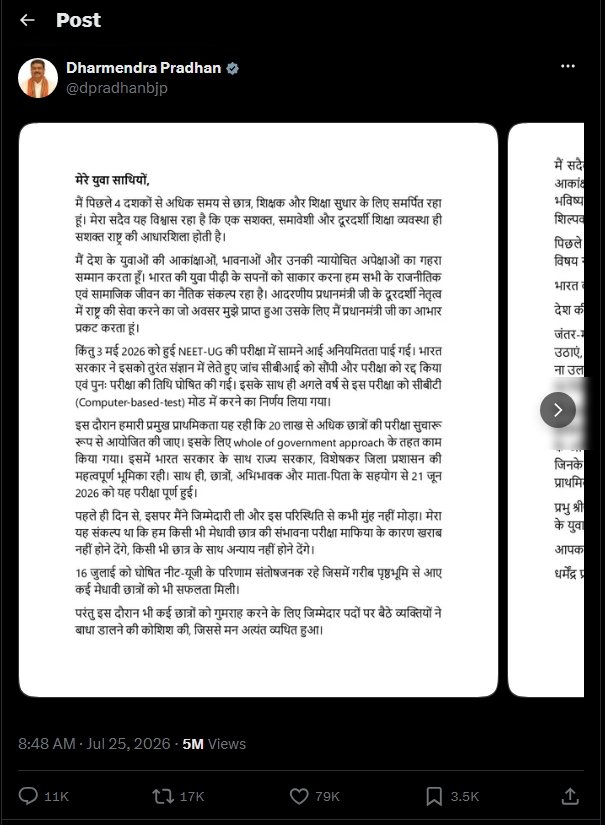
Union Education Minister Dharmendra Pradhan resigned from the Union Council of Ministers on Saturday amid mounting political pressure and nationwide protests over alleged irregularities in the NEET-UG 2026 examination. In a detailed resignation letter addressed to the country’s youth, Pradhan said his decision was driven by the larger interests of students and the nation, stressing that his resignation should not be viewed as a matter of personal prestige.
The resignation marks one of the biggest political developments since the NEET-UG controversy emerged and follows weeks of demonstrations, student protests, opposition criticism, and public demands for accountability. Major national news organizations confirmed the resignation on Saturday after Pradhan publicly shared his resignation letter on social media. Dharmendra Pradhan’s resignation has become one of the biggest political developments linked to the NEET-UG controversy.
Table of Contents
Dharmendra Pradhan Announces Resignation
In his letter, Dharmendra Pradhan reflected on his long public life and his association with education reforms, stating that he had dedicated more than four decades to serving students, teachers, and the education sector.
Dharmendra Pradhan expressed gratitude to Prime Minister Narendra Modi for giving him the opportunity to serve as Education Minister and reiterated his belief that a strong, inclusive, and future-oriented education system forms the foundation of a strong nation.
Pradhan stated that he deeply respected the aspirations of India’s youth and described fulfilling their dreams as a moral responsibility.
Dharmendra Pradhan Explains Government’s Response to NEET-UG Controversy
Addressing the NEET-UG controversy, Pradhan said irregularities came to light after the May 3, 2026 examination.
According to him, the Government of India immediately initiated corrective measures by:
- Handing the investigation over to the Central Bureau of Investigation (CBI).
- Cancelling the affected examination.
- Announcing a fresh examination date.
- Deciding to conduct future NEET examinations in Computer-Based Test (CBT) mode beginning next year.
Dharmendra Pradhan said these decisions were taken were taken promptly to protect the interests of students and restore confidence in the examination process.
Government Focused on Conducting Re-Examination
Pradhan noted that after the cancellation of the examination, the government’s highest priority was to successfully conduct the re-examination for more than 20 lakh students.
According to his statement, the examination was completed successfully on June 21, 2026 through coordinated efforts involving the Union Government, state governments, district administrations, students, and parents.
He described the exercise as a “whole-of-government” approach aimed at ensuring fairness and smooth conduct of one of India’s largest competitive examinations.
Says He Accepted Responsibility From Day One
The former Education Minister stated that he accepted responsibility from the beginning of the controversy and never attempted to distance himself from the issue.
According to Pradhan, he remained determined to ensure that deserving students did not suffer because of alleged activities of the “exam mafia.”
He added that protecting the interests of meritorious students remained his foremost concern throughout the crisis.
Mentions Successful NEET Results
Pradhan also referred to the declaration of NEET-UG 2026 results on July 16, saying that many talented students, including candidates from economically weaker and underprivileged backgrounds, achieved success.
He maintained that despite the controversy, the examination process ultimately enabled deserving candidates to secure admission opportunities.
At the same time, he expressed disappointment over what he described as attempts by certain individuals to mislead students and create unnecessary confusion during the crisis.
‘This Is Not a Matter of Personal Prestige’
One of the central themes of Pradhan’s resignation letter was his assertion that remaining in office was never a matter of personal pride.
He wrote that the youth of India represent the country’s greatest strength and that he did not want prolonged political conflict to divert students from their education and future careers.
Pradhan stated that he wanted to prevent confusion among students while ensuring that educational issues did not become entangled in prolonged legal or political disputes.
Reason for Resignation
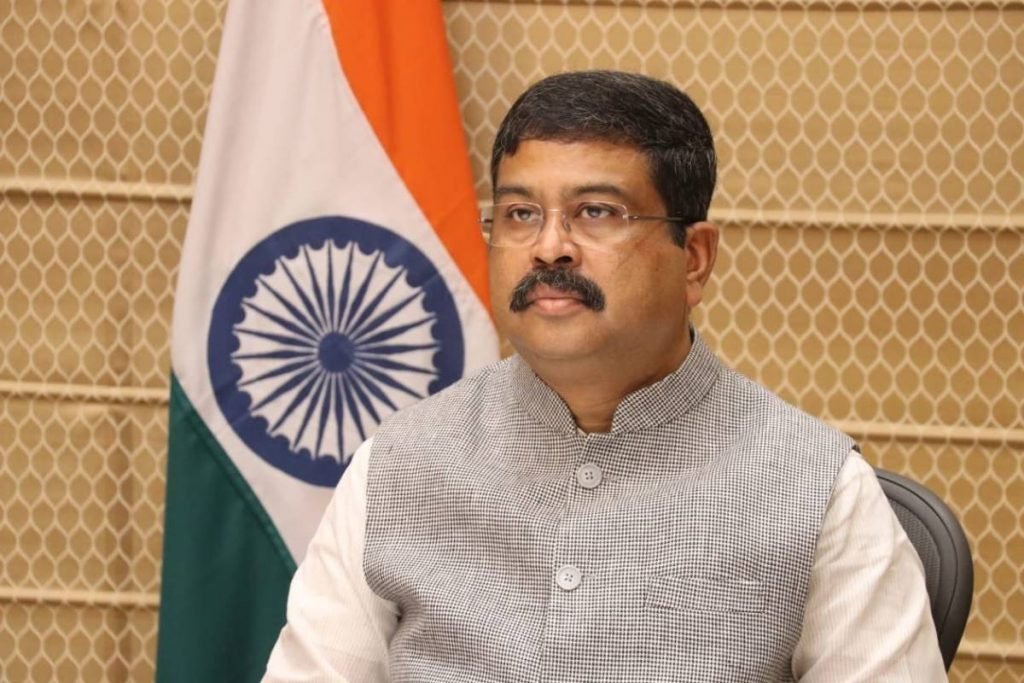
In his resignation letter, Pradhan explained that the prevailing situation at Jantar Mantar and protests taking place across the country had influenced his decision.
He stated that his resignation was intended to:
- Prevent anti-national forces from exploiting the situation.
- Preserve national unity.
- Ensure students’ futures are not affected by prolonged legal complications.
- Allow students to return their focus to education and career-building.
He therefore submitted his resignation to the Prime Minister, stating that the interests of students and the nation must come first.
Expresses Gratitude to Prime Minister and Colleagues
Pradhan concluded his letter by thanking Prime Minister Narendra Modi for his guidance, confidence, and continuous support.
He also expressed gratitude to fellow ministers, officers of the Ministry of Education, government officials, and everyone with whom he worked during his tenure.
He stated that serving the nation would remain the highest priority of his public life and pledged to continue contributing toward the development of India, Odisha, and the country’s youth.
Political Significance of the Resignation
Dharmendra Pradhan’s resignation represents a major political development in the aftermath of the NEET-UG controversy.
The resignation comes after sustained protests by students and criticism from opposition parties demanding accountability over alleged examination irregularities. It is also seen as one of the government’s most significant responses to the controversy surrounding competitive examinations.
Focus Now Shifts to Education Reforms
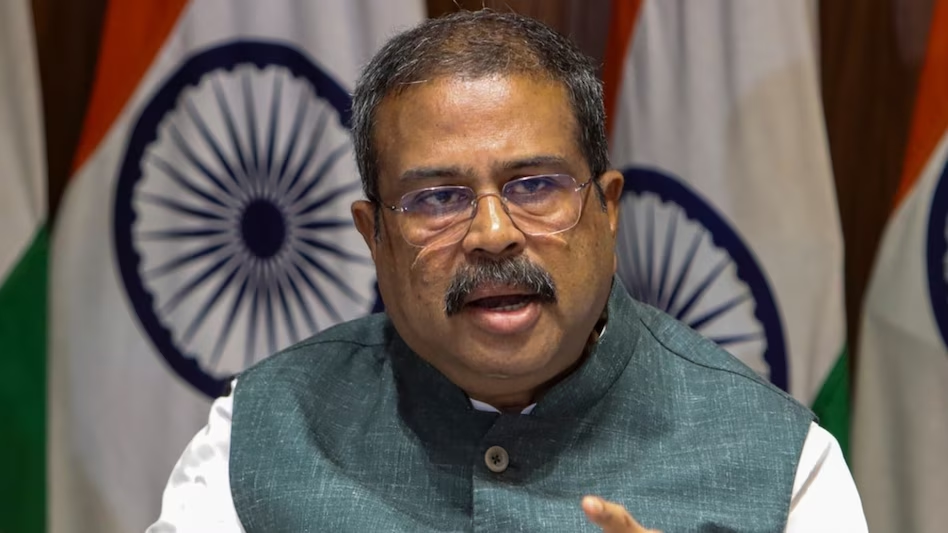
With the resignation now announced, attention is expected to shift toward the government’s next steps regarding reforms in India’s examination system.
The Centre had earlier indicated its intention to strengthen the functioning of the National Testing Agency (NTA) and introduce measures aimed at improving transparency, examination security, and institutional accountability.
Education experts and students will now closely watch the government’s decisions regarding the appointment of a new Education Minister and the implementation of promised examination reforms.
Dharmendra Pradhan’s resignation brings an important chapter of the NEET-UG controversy to a close, while opening a new phase focused on institutional reforms and restoring public confidence in India’s competitive examination system.
In his resignation letter, Pradhan defended the government’s response to the crisis, reiterated his commitment to students, and maintained that stepping down was intended to protect the interests of young people and preserve national unity rather than safeguard his own political position.
As the government moves forward with reforms and investigations continue, the focus is likely to remain on strengthening examination integrity and ensuring that future competitive examinations are conducted with greater transparency, accountability, and public trust.