
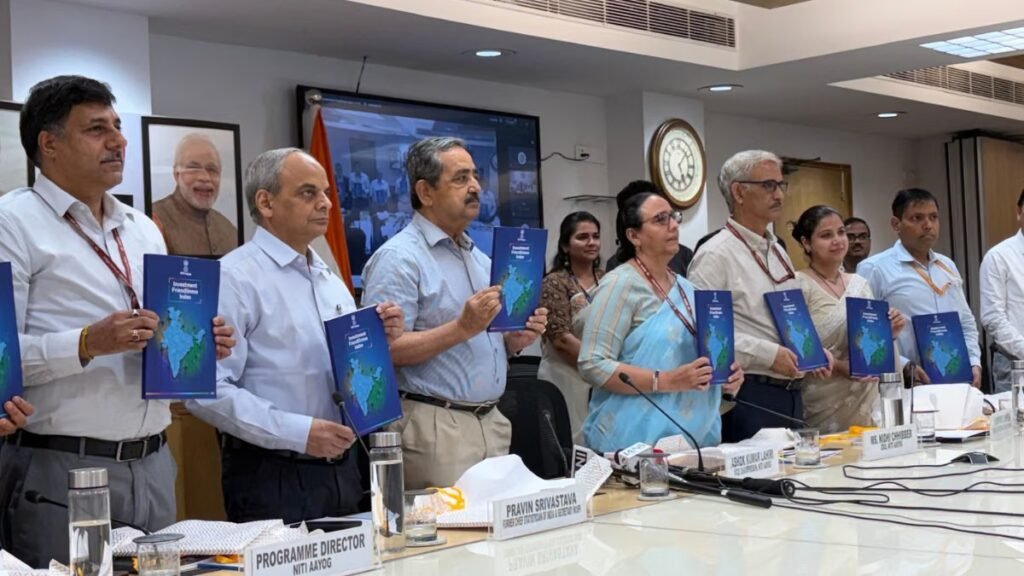
Gujarat has secured the top position in NITI Aayog’s first-ever Investment Friendliness Index 2026, emerging as the country’s most attractive destination for businesses and investors. The state scored 56.6 points, outperforming Maharashtra (53.7) and Tamil Nadu (53.3), two states that have traditionally been regarded as India’s industrial powerhouses.
The ranking reflects years of policy reforms, infrastructure development, business-friendly governance, and financial discipline that have transformed Gujarat into one of India’s leading investment destinations. The report evaluates the complete investment journey—from starting a business to expanding operations—using 84 indicators across eight major categories, including governance, infrastructure, industrial support, financial management, and investment facilitation.
The latest recognition reinforces Gujarat’s reputation as a state where businesses can establish operations quickly, access world-class infrastructure, and operate in a stable economic environment.
Table of Contents
Gujarat Tops NITI Aayog’s First Investment Friendliness Index
The Investment Friendliness Index is one of NITI Aayog’s newest initiatives designed to assess how effectively Indian states attract and support investments.
Unlike rankings that focus only on economic output, this index examines the entire business ecosystem. It measures how easily companies can obtain approvals, access industrial land, receive government support, connect to transport infrastructure, secure electricity, and operate efficiently over the long term.
Among the 17 major states evaluated, Gujarat achieved the highest overall score because of its balanced performance across almost every assessment category.
The ranking demonstrates that has successfully combined industrial growth with efficient governance, making it attractive for both domestic and international investors.
Fast Business Approvals Improve Investor Confidence
One of the strongest reasons behind Gujarat’s success is its efficient approval system for new businesses.
The state has significantly reduced administrative delays by introducing a single-window clearance mechanism through the Industrial Extension Bureau, commonly known as iNDEXTb.
Instead of approaching multiple government departments separately, investors can complete most approval-related procedures through one integrated platform.
This system helps companies obtain licenses, statutory approvals, and No Objection Certificates (NOCs) within fixed timelines, reducing uncertainty during project planning.
For businesses investing hundreds or even thousands of crores, faster approvals translate directly into lower project costs and quicker commercial operations.
Such predictable administrative processes have become one of biggest competitive advantages.
Industrial Infrastructure Supports Rapid Business Expansion
Infrastructure remains another major reason why Gujarat secured the number one position.
The state has invested heavily in developing industrial regions that already possess essential facilities before companies begin operations.
Major industrial hubs such as Dholera Special Investment Region (SIR), GIFT City, Sanand, Dahej, Jhagadia, and Saykha offer what is often called “plug-and-play” infrastructure.
These industrial zones provide ready access to roads, electricity, water supply, communication networks, and industrial utilities.
As a result, companies spend less time building basic infrastructure and can begin manufacturing much sooner.
This reduces project costs while improving investment returns, making particularly attractive for manufacturing, logistics, technology, and financial services.
Excellent Transport Connectivity Strengthens Gujarat’s Position
Efficient logistics are essential for every business, particularly industries involved in manufacturing and exports.
The report highlights Gujarat’s outstanding transport infrastructure as another important factor behind its success.
The state accounts for nearly 10% of India’s total state highway network, almost four times the national average.
It also possesses the country’s highest estimated expressway length, measuring approximately 635 kilometres.
Nearly 7% of India’s railway network passes through Gujarat, providing industries with efficient freight transportation across domestic markets.
Strong road and rail connectivity reduces transportation costs, improves supply chain efficiency, and allows businesses to move raw materials and finished products more quickly.
This logistics advantage has become particularly valuable for export-oriented industries.
Lower Electricity Costs Benefit Industries
Reliable and affordable electricity plays a major role in determining where companies choose to establish factories.
According to the NITI Aayog report, Gujarat offers industrial electricity tariffs that are approximately 29% lower than the national average.
Lower electricity costs help businesses reduce production expenses, making their products more competitive in domestic and international markets.
Equally important is the reliability of electricity supply.
Industries in Gujarat receive an average power supply of 23.8 hours every day, ensuring that manufacturing operations experience minimal disruption.
Continuous electricity allows factories to maintain production schedules without expensive backup power systems or unexpected downtime.
For energy-intensive sectors such as chemicals, engineering, pharmaceuticals, automobiles, and textiles, this represents a major operational advantage.
Gujarat’s Export Performance Reflects Industrial Strength
The state’s impressive export performance further strengthens its investment appeal.
According to the report, Gujarat contributes approximately 31% of India’s total merchandise exports, making it one of the country’s most significant export hubs.
Its ports, industrial clusters, and manufacturing ecosystem have enabled businesses to access international markets efficiently.
The state’s economic performance has also remained strong in recent years.
Between FY 2019 and FY 2024, Gujarat recorded the third-highest Gross State Domestic Product (GSDP) growth among Indian states.
Its per capita GSDP stands at approximately ₹2.64 lakh, nearly 67% higher than the average among major Indian states.
These figures indicate not only sustained economic growth but also increasing productivity across industries.
Strong MSME Network Drives Employment
While Gujarat is known for attracting large industrial investments, its success is equally supported by a vibrant network of Micro, Small and Medium Enterprises (MSMEs).
Thousands of MSMEs operate across sectors including engineering, textiles, food processing, chemicals, pharmaceuticals, ceramics, and automobile components.
These smaller enterprises generate substantial employment while supplying products and services to larger industries.
A healthy MSME ecosystem also encourages entrepreneurship by enabling local businesses to participate in national and global supply chains.
This balanced industrial structure makes Gujarat’s economy more resilient and diversified.
Financial Discipline Creates Long-Term Stability
One of the less visible but highly important reasons behind Gujarat’s ranking is its sound financial management.
According to the report, Gujarat recorded a fiscal deficit of only 2.81% of GSDP during FY 2024, the lowest among all major Indian states.
Its outstanding liabilities are around 18% of GSDP, nearly 40% lower than the average for major states.
Strong public finances allow governments to continue investing in infrastructure, education, healthcare, and industrial development without excessive borrowing.
For investors, financial stability signals lower economic risk and greater confidence in long-term policy continuity.
Innovation Ecosystem Encourages Future Growth
Innovation has become an increasingly important factor in attracting modern industries.
The report recognises Gujarat’s efforts to strengthen its innovation ecosystem through education and technology.
As of FY 2025, the state had established 614 Atal Tinkering Labs, providing students with opportunities to experiment with robotics, electronics, coding, artificial intelligence, and emerging technologies.
With approximately 1.24 Atal Tinkering Labs per one lakh population, Gujarat performs around 19% better than the average of major states.
These laboratories encourage innovation among school students while helping build a future workforce capable of supporting advanced manufacturing and technology-driven industries.
Vibrant Gujarat Summit Continues to Attract Global Investment
Another important contributor to Gujarat’s investment success is the Vibrant Gujarat Global Summit.
Over the years, the summit has evolved into one of India’s largest business and investment events, bringing together government leaders, global corporations, entrepreneurs, investors, and policymakers.
The platform enables companies to announce investment plans, sign business agreements, and explore opportunities across sectors including manufacturing, renewable energy, logistics, financial services, information technology, healthcare, and infrastructure.
The summit has significantly strengthened Gujarat’s global business profile while encouraging long-term investment partnerships.
Healthy Labour Environment Supports Business Operations
The report also points to Gujarat’s relatively stable labour environment.
Policies governing industrial relations have helped minimise disruptions caused by strikes in essential services, creating a predictable operating environment for businesses.
For industries making large capital investments, labour stability reduces operational uncertainty and improves production planning.
Combined with efficient administration, reliable infrastructure, lower electricity costs, strong exports, disciplined financial management, and continuous policy support, Gujarat has built an investment ecosystem that appeals to businesses across multiple sectors.
The NITI Aayog Investment Friendliness Index 2026 reflects how these interconnected strengths have enabled Gujarat to surpass Maharashtra and Tamil Nadu, positioning the state as India’s leading destination for manufacturing, infrastructure, technology, and industrial investment.