

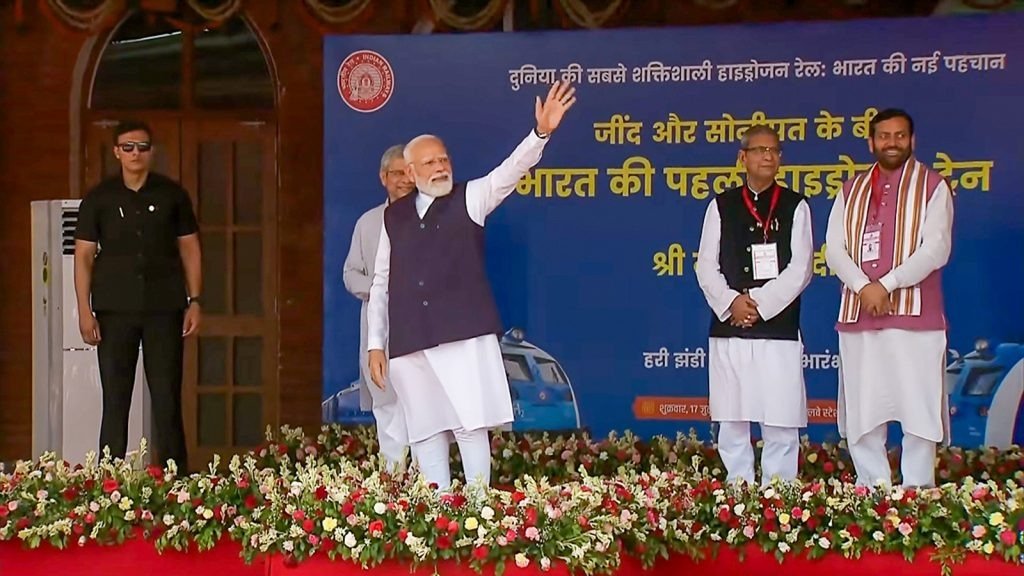
PM Modi marked a historic day for India’s infrastructure and clean energy ambitions by flagging off the country’s first hydrogen-powered passenger train and inaugurating and laying the foundation stone for development projects worth nearly ₹14,700 crore in Haryana. The wide-ranging initiatives, covering green mobility, national highways, railway infrastructure, healthcare and cultural development, reflect the government’s continued focus on sustainable growth, improved connectivity and modern public infrastructure.
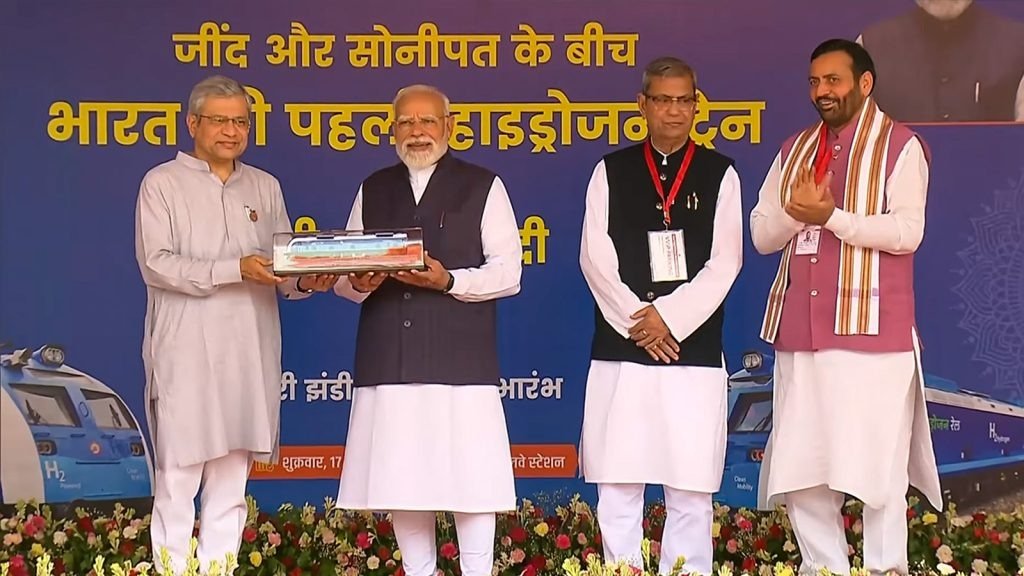
The event was held at Eklavya Stadium in Jind in the presence of Haryana Chief Minister Nayab Singh Saini and Union Railway Minister Ashwini Vaishnaw. The projects launched by PM Modi are expected to strengthen transportation networks, improve healthcare services, boost economic activity and accelerate regional development across Haryana while supporting India’s long-term environmental and infrastructure goals.
Among all the announcements, the launch of India’s first hydrogen fuel cell-powered train emerged as the biggest highlight, placing the country among a select group of nations that have adopted hydrogen technology for railway transportation.
Table of Contents
PM Modi Flags Off India’s First Hydrogen-Powered Train
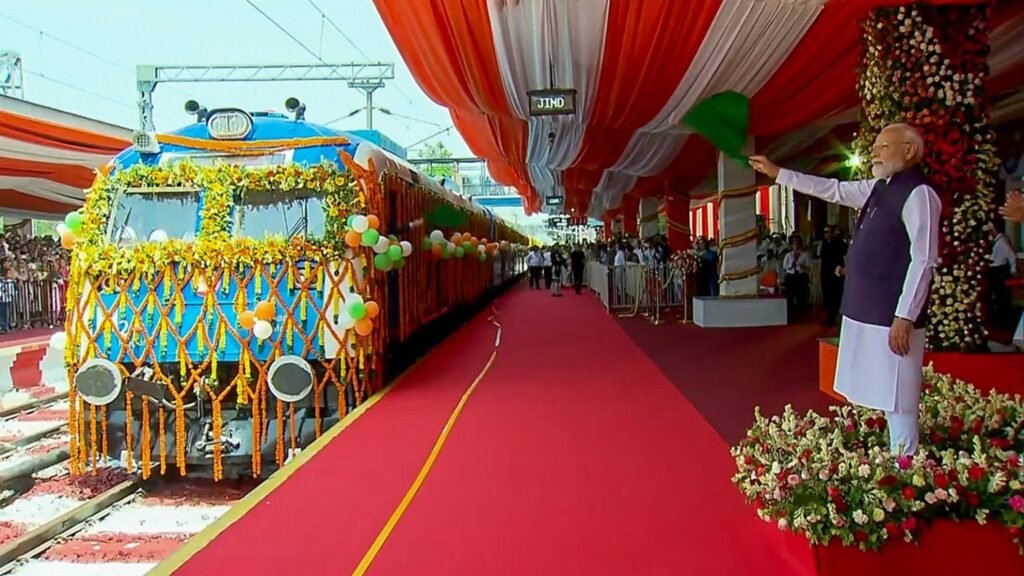
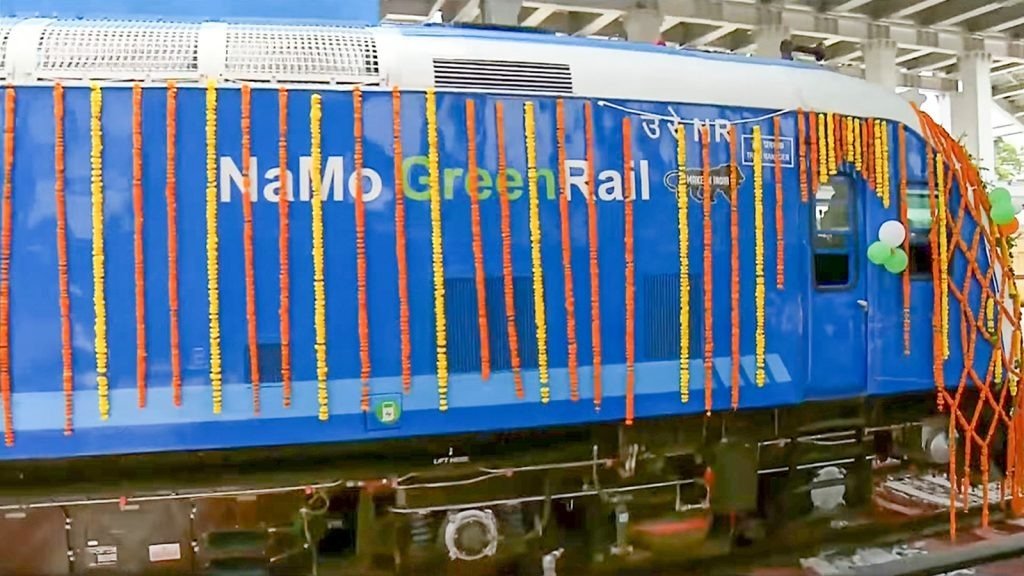
One of the most significant announcements made by PM Modi was the inauguration of India’s first hydrogen-powered passenger train operating between Jind and Sonipat under Northern Railway.
The launch represents a major milestone in the evolution of Indian Railways as it moves from conventional fossil fuel-based transportation towards cleaner and more sustainable mobility solutions.
The newly introduced 10-coach hydrogen train will cover the nearly 90-kilometre Jind-Sonipat route in approximately two hours. Unlike traditional diesel locomotives, the train generates electricity onboard using hydrogen fuel cell technology, eliminating direct carbon emissions during operation.
The only major by-product produced through this process is water vapour, making hydrogen technology one of the cleanest alternatives currently available for railway transportation.
The launch by PM Modi demonstrates India’s growing commitment to adopting advanced clean-energy technologies across public transport systems.
Indigenous Technology Powers the Hydrogen Train
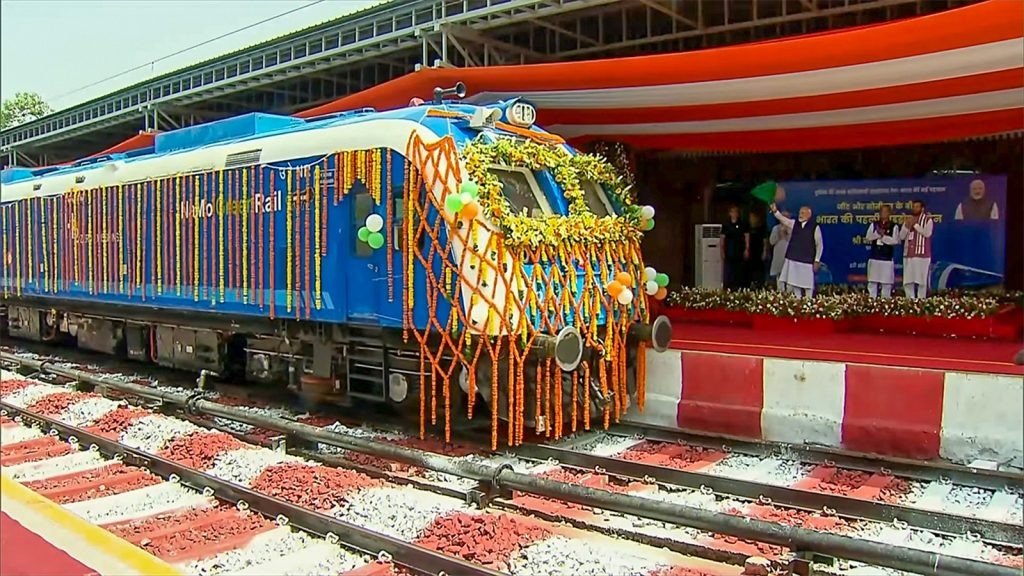
A key feature of the project is that the hydrogen-powered train has been designed, engineered and integrated entirely in India using indigenous technology.
This achievement highlights the country’s growing capabilities in advanced railway engineering and clean-energy innovation.
Equipped with a powerful 3,200-horsepower propulsion system, the train is among the most powerful hydrogen-powered passenger trains currently operating worldwide.
It is also one of the longest hydrogen-powered passenger trainsets developed globally.
The project supports the vision of technological self-reliance while reducing dependence on imported fossil fuels.
PM Modi has consistently emphasised the importance of domestic manufacturing and indigenous innovation, and this project reflects that broader national objective.
Hydrogen Technology Supports India’s Green Energy Goals
Hydrogen fuel cell technology has emerged globally as one of the most promising solutions for reducing carbon emissions from transportation.
Unlike diesel engines, hydrogen fuel cells generate electricity without combustion.
Hydrogen combines with oxygen inside specialised fuel cells to produce electrical energy while releasing only water vapour as a by-product.
This significantly reduces greenhouse gas emissions, lowers noise pollution and decreases dependence on imported diesel fuel.
Another important advantage is that hydrogen-powered trains do not require continuous overhead electrification because electricity is generated onboard.
PM Modi highlighted that the launch aligns with India’s broader clean-energy vision, supporting sustainable mobility and the country’s long-term commitment towards reducing carbon emissions.
Indian Railways Enters a New Era
The introduction of hydrogen technology marks another major chapter in the modernisation of Indian Railways.
Over the decades, India’s railway system has evolved from steam-powered locomotives to diesel engines, followed by large-scale electrification.
Now, hydrogen-powered mobility represents the next stage in this transformation.
Over the past twelve years, Indian Railways has significantly expanded railway electrification, reducing dependence on imported diesel while improving operational efficiency.
The hydrogen train launched by PM Modi builds upon these achievements by introducing another environmentally friendly transport solution.
Experts believe successful implementation on the pilot route could pave the way for similar services across other railway corridors in the future.
Massive Highway Development Projects
Beyond railway modernisation, PM Modi also dedicated and laid the foundation stone for National Highway projects worth more than ₹12,470 crore.
These infrastructure investments aim to improve connectivity, reduce travel time, lower transportation costs and support economic growth across Haryana and neighbouring states.
One of the biggest projects inaugurated was the 157.92-kilometre Delhi-Amritsar-Katra Expressway section developed at an estimated cost of around ₹9,680 crore.
The expressway forms part of the larger 667-kilometre Delhi-Amritsar-Katra corridor.
Once fully operational, it is expected to reduce travel time between Delhi and Katra from nearly fourteen hours to about six hours.
Similarly, travel between Delhi and Amritsar is expected to decline from around eight hours to nearly four hours.
Improved connectivity is likely to benefit pilgrims visiting Shri Mata Vaishno Devi while supporting tourism, logistics and industrial development along the corridor.
Better Connectivity Across Haryana
PM Modi also inaugurated several important road projects aimed at improving regional transportation.
The 33.81-kilometre Ambala-Kala Amb Highway strengthens connectivity between Haryana and Himachal Pradesh while improving access to the Kala Amb industrial region.
The upgraded highway is expected to reduce transportation costs, improve freight movement and encourage tourism towards nearby hill destinations.
Another important project is the 40.60-kilometre Jind-Gohana Greenfield Highway.
The highway will significantly reduce travel time between Jind and Gohana from nearly two hours to around forty minutes.
Improved connectivity will also strengthen transportation links with Rohtak, Panipat and the National Capital Region, benefiting commuters, farmers, businesses and logistics operators.
Additionally, PM Modi laid the foundation stone for the Hansi-Barwala Brownfield Highway project, which will upgrade existing road infrastructure to improve safety and traffic flow.
Railway Infrastructure Gets a Major Boost
The Prime Minister also dedicated the Elevated Railway Track at Kurukshetra.
For years, traffic congestion at railway crossings had posed challenges for residents and commuters.
The elevated corridor is expected to eliminate these bottlenecks, allowing smoother movement of both road traffic and railway operations.
Apart from reducing travel delays, the project is expected to improve road safety and enhance the operational efficiency of transport infrastructure within the city.
Such projects form an important part of India’s broader efforts to modernise railway infrastructure while improving urban mobility.
Strengthening Healthcare Facilities
Healthcare infrastructure also received major attention during the programme.
PM Modi dedicated two important medical institutions to the nation.
These include Pandit Neki Ram Sharma Government Medical College in Bhiwani and Maharishi Chyawan Medical College along with Rao Tula Ram Hospital at Koriawas in Narnaul.
The institutions are expected to increase access to quality healthcare services while expanding opportunities for medical education.
The additional medical colleges will increase MBBS seats, strengthen the availability of trained healthcare professionals and improve specialised treatment facilities for residents across Haryana.
Improved healthcare infrastructure also reduces the need for patients to travel long distances for advanced medical services.
Preserving Cultural Heritage
Along with transportation and healthcare, PM Modi also announced an important cultural initiative.
The foundation stone was laid for a Sikh Museum at Kurukshetra.
The museum will preserve and showcase the rich history of Sikhism, highlighting the teachings of the Sikh Gurus, their courage, sacrifices and contributions to India’s civilisation.
The project aims to promote cultural awareness while strengthening historical education for future generations.
Such institutions play an important role in preserving national heritage and promoting cultural tourism.
Infrastructure Driving Economic Growth
Infrastructure development remains one of the strongest drivers of economic progress.
Modern highways reduce logistics costs, improve supply chains and encourage industrial investment.
Efficient railway systems strengthen passenger mobility while reducing transportation expenses.
Healthcare infrastructure improves public welfare and creates employment opportunities.
Similarly, cultural institutions contribute to tourism and regional economic activity.
The projects inaugurated by PM Modi collectively represent investments in multiple sectors that are expected to generate long-term economic benefits while improving the quality of life for citizens.
From launching India’s first hydrogen-powered passenger train to expanding highways, strengthening railway infrastructure, improving healthcare facilities and preserving cultural heritage, PM Modi’s visit to Haryana marks one of the state’s largest integrated development initiatives. The combination of green mobility, modern infrastructure, medical education and enhanced connectivity reflects India’s broader vision of sustainable development, technological innovation and inclusive economic growth while laying the foundation for future-ready public infrastructure.