
Prime Minister Narendra Modi’s interaction with students at the Indian Institute of Technology (IIT) Delhi has put the spotlight on a message that extends beyond classrooms, examinations and academic scores: preparation for life cannot be limited to a fixed syllabus.
At the institute’s 57th Convocation, held on August 8, 2026, PM Modi addressed graduating students as they prepared to move from an academic environment into professional life. The occasion also highlighted India’s growing emphasis on advanced technology and research, with the Prime Minister inaugurating Param Pragya, an AI-powered supercomputing facility associated with IIT Delhi.
The central message for students was broader than conventional examination advice. Academic qualifications may open doors, but professional success, personal resilience and the ability to respond to unexpected situations require continuous learning, adaptability and confidence.
Table of Contents
Life Does Not Follow a Fixed Syllabus
The phrase “life’s exam is out of syllabus” captures a reality familiar to students and young professionals: not every challenge can be predicted in advance.
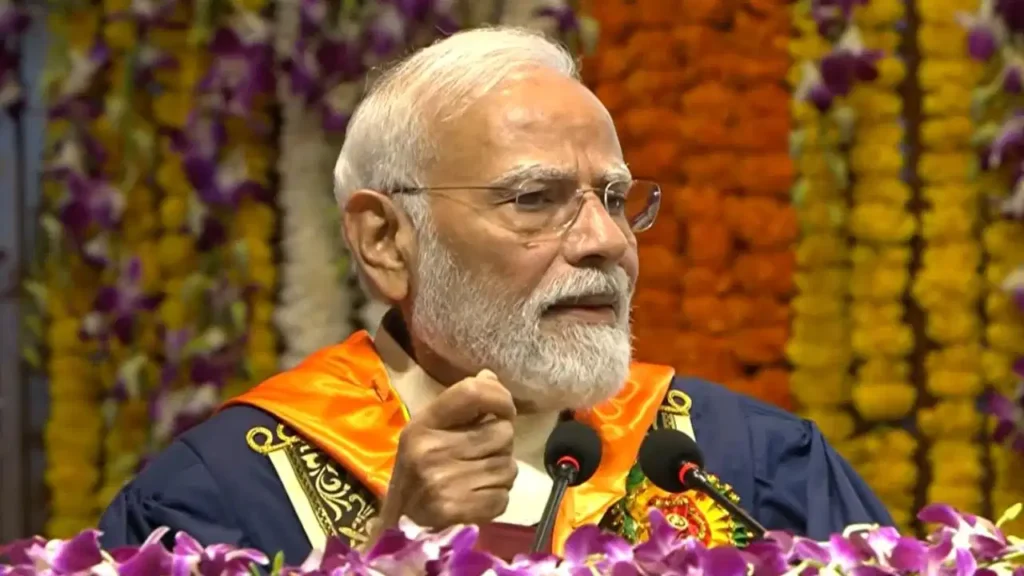
School and university examinations generally come with defined curricula, preparation material and evaluation systems. Life and professional careers are different. People may encounter unexpected opportunities, failures, changing technologies, difficult decisions and circumstances for which no textbook provides a ready-made answer.
PM Modi has repeatedly used this broader approach while speaking to students. During Pariksha Pe Charcha 2026, he stressed that education should not be viewed only as a means of passing examinations. He said education is for life, while examinations should be treated as an opportunity to assess oneself.
That message becomes particularly relevant for IIT graduates, many of whom are entering fields where technology, artificial intelligence and global competition are changing rapidly.
From Examination Success to Real-World Challenges
For students, academic success often involves solving questions within a prescribed framework. Real-world problems, however, may not provide clearly defined conditions.
A professional may have to make decisions with incomplete information, work with people from different backgrounds, learn unfamiliar technologies or change direction when an original plan does not work.
This is why skills such as critical thinking, communication, teamwork and adaptability become increasingly important after graduation.
PM Modi’s earlier interactions with students have similarly focused on developing a balanced personality rather than concentrating exclusively on marks. During Pariksha Pe Charcha 2026, he advised students to balance studies with skills, rest and hobbies, arguing that overall development is important for long-term growth.
‘Marks Are Not the Ultimate Goal’
One of the recurring themes in PM Modi’s interactions with students has been the need to look beyond examination scores.
Competitive examinations and academic results can be important milestones, but they do not completely define a student’s abilities or future.
During Pariksha Pe Charcha 2026, PM Modi said education is meant for life and examinations are meant to examine oneself. He also encouraged students to aspire not merely to “be” something but to focus on what they want to “do”.
For graduating IIT students, this distinction is significant. A degree from a prestigious institution can provide a strong foundation, but what graduates eventually create, solve or contribute to society depends on how they apply their knowledge.
Prepare Beyond Repeated Questions
PM Modi has also spoken about the limitations of preparing only through repeated examination patterns.
Responding to students during Pariksha Pe Charcha, he noted that students can struggle when a paper appears difficult because they sometimes focus too heavily on familiar questions and patterns. His advice was that students should understand the entire subject rather than limiting preparation to a narrow set of expected questions.
He compared this approach with physical training. Just as a sportsperson cannot strengthen only one part of the body and expect complete performance, students cannot depend on a small collection of repeated questions for comprehensive development.
The analogy underlines a larger principle: strong foundations create flexibility.
The Importance of Strong Foundations
A strong academic foundation allows students to approach unfamiliar problems with greater confidence.
Instead of memorising isolated answers, understanding concepts enables learners to apply those concepts in new situations. This becomes particularly important in engineering and technology, where problems often require combinations of knowledge from different disciplines.
PM Modi has advised students to strengthen their foundations and develop a habit of continuous learning. During Pariksha Pe Charcha 2026, he encouraged students to focus on understanding rather than simply chasing examination patterns.
For IIT graduates, the lesson is especially relevant because technological fields evolve quickly. Knowledge acquired during a degree may form the foundation of a career, but professionals must continue updating their skills throughout their working lives.
Curiosity Can Become a Career Advantage
Another important element of PM Modi’s student-focused messaging has been curiosity.
During Pariksha Pe Charcha 2026, he suggested that teachers can create greater curiosity by informing students in advance about what will be taught. This gives students an opportunity to read, explore and ask questions before entering the classroom.
Curiosity has significance beyond formal education.
Students who develop the habit of asking questions may be better prepared to identify new opportunities, understand unfamiliar problems and explore emerging areas of technology.
For graduates entering artificial intelligence, data science, biotechnology, robotics or other rapidly developing fields, curiosity can become a practical professional advantage.
PM Modi Highlights How Technology Is Changing Learning
The IIT Delhi event also carried a strong technology-oriented message.
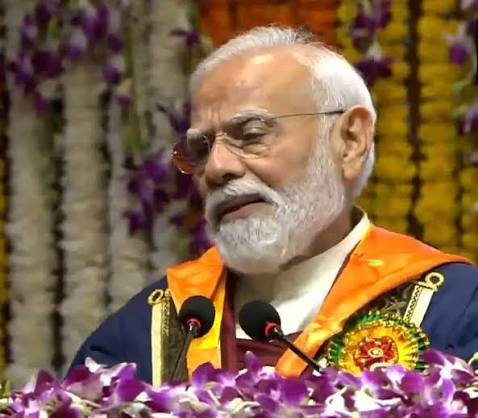
The institute’s 57th Convocation coincided with the inauguration of Param Pragya, an AI-powered supercomputing facility. The facility is intended to strengthen high-performance computing capabilities and support areas involving artificial intelligence, data analysis and scientific research.
The development reflects the increasingly important role of advanced computing in India’s research ecosystem.
The Department of Science and Technology has previously identified Param Pragya as an AI-based supercomputing facility at IIT Delhi, as part of India’s broader National Supercomputing Mission infrastructure.
For graduating students, the development offers a clear indication of how closely education, research and emerging technologies are becoming connected.
PM Modi’s AI Advice: Use Technology as a Capability Multiplier
Artificial intelligence has also featured prominently in PM Modi’s recent education-related messaging.
During Pariksha Pe Charcha 2026, he described technology as a powerful teacher and encouraged students to use AI wisely while improving their own understanding and capabilities.
The message is particularly relevant for IIT graduates because AI is increasingly influencing engineering, software development, research, healthcare, finance, manufacturing and other sectors.
However, technological tools do not eliminate the need for human judgement.
Understanding a problem, evaluating information, identifying errors and making responsible decisions remain essential skills. The most valuable professionals are likely to be those who can combine technological tools with strong conceptual knowledge and independent thinking.
Failure Is Also Part of the Learning Process
Life’s unpredictable nature also means that failure is unavoidable.
Students who perform exceptionally well academically may still encounter rejection, professional setbacks or projects that do not succeed. Such experiences can be difficult, but they can also provide valuable lessons.
PM Modi has repeatedly encouraged students not to remain trapped by past setbacks. During Pariksha Pe Charcha 2026, he advised students not to waste time dwelling on the past and instead focus on what lies ahead.
The message is not that failures are unimportant. Rather, setbacks should be treated as experiences from which students can learn and improve.
PM Modi’s Advice on Balance for Long-Term Success
Another major lesson from PM Modi’s student interactions is the importance of balance.
Academic pressure can sometimes cause students to neglect sleep, recreation, hobbies and physical well-being. However, long-term performance depends on maintaining a healthy balance.
During Pariksha Pe Charcha 2026, PM Modi highlighted the importance of balancing studies, skills, rest and hobbies.
For young professionals, this becomes even more important. Careers can involve deadlines, competition and continuous learning. Without adequate rest and personal time, sustained performance becomes difficult.
From IIT Delhi to a Larger National Mission
The IIT Delhi convocation was not only a ceremonial milestone for graduating students. It also reflected India’s wider ambition to strengthen research, innovation and technological capacity.
The inauguration of Param Pragya alongside the convocation connected the achievements of individual students with a broader national technology ecosystem.
IITs have traditionally played a significant role in India’s engineering and scientific development. Their graduates work across technology companies, research institutions, startups, public-sector organisations and global industries.
As India expands its focus on artificial intelligence and high-performance computing, institutions such as IIT Delhi are increasingly positioned at the intersection of education, research and innovation.
The Bigger Lesson for Students
The “out-of-syllabus” idea can therefore be understood as a broader lesson about preparedness.
Students cannot predict every challenge they will encounter after graduation. What they can develop is the ability to learn quickly, remain calm under pressure, understand unfamiliar situations and adapt when circumstances change.
This requires more than memorisation.
It requires conceptual understanding, curiosity, communication, resilience, teamwork and a willingness to keep learning.
The same principle applies whether a student becomes an engineer, researcher, entrepreneur, civil servant, teacher or professional in another field.
Key Mantras for Students
The guidance emerging from PM Modi’s recent interactions with students can be summarised into several practical principles:
Learn beyond the examination: Education should prepare students for life rather than only for marks.
Build strong foundations: Understanding concepts is more valuable than relying exclusively on repeated questions.
Stay curious: Asking questions and exploring unfamiliar subjects can strengthen learning.
Balance study and life: Skills, rest and hobbies are part of overall development.
Do not remain stuck in the past: Setbacks should become lessons rather than permanent obstacles.
Use technology wisely: AI and digital tools can expand capabilities, but human judgement and understanding remain essential.
Focus on doing: Career goals should ultimately be connected with meaningful work and contribution.
Prepare for uncertainty: The most important preparation is the ability to respond when circumstances do not go according to plan.
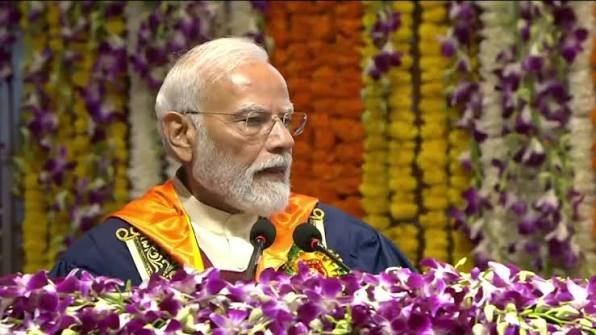
PM Modi’s message to students at a time of transition from campus to career carries significance beyond the IIT Delhi convocation.
Examinations have syllabi, fixed schedules and defined evaluation systems. Life rarely offers the same certainty. Careers can change direction, technologies can evolve and unexpected challenges can emerge without warning.
For students, the answer is not to predict every possible question. It is to build the knowledge, confidence and adaptability required to face questions that have never appeared in a textbook.
The IIT Delhi convocation, marked by the inauguration of the Param Pragya AI-powered supercomputing facility, provided a fitting setting for that message. As graduates move into a world increasingly shaped by technology and innovation, their ability to keep learning may ultimately matter as much as what they have already learned.
In that sense, the most important examination begins after the classroom ends—and its questions may not always be found in the syllabus.