
Defying an increasingly uncertain global economic environment, the Reserve Bank of India (RBI) has expressed renewed confidence in the country’s growth story by raising its GDP growth projection for FY2026-27 to 6.7% from the earlier estimate of 6.6%. The upward revision underscores the central bank’s belief that India’s domestic economy remains resilient despite mounting global headwinds, including geopolitical tensions, volatile crude oil prices, supply chain disruptions and slowing international demand.
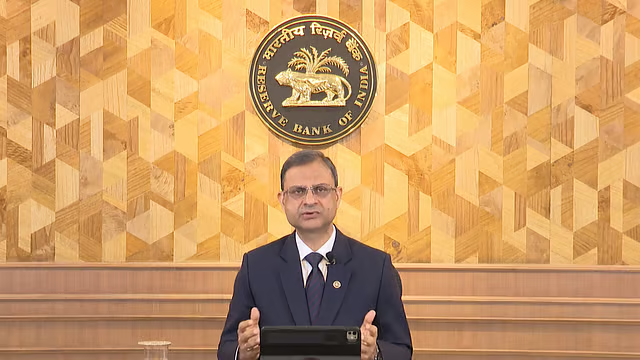
Announcing the latest decisions of the Monetary Policy Committee (MPC), RBI Governor Sanjay Malhotra said the Indian economy continues to display strong macroeconomic fundamentals supported by healthy domestic demand, infrastructure spending, improving services activity and stable financial conditions. At the same time, the central bank opted to keep the benchmark repo rate unchanged at 5.25%, maintaining a neutral policy stance while closely monitoring inflationary risks.
Table of Contents
RBI Projects Stronger Growth Despite Global Challenges
The RBI’s latest outlook comes at a time when several major economies continue to struggle with weak growth, persistent inflation, trade uncertainties and geopolitical conflicts.
Against this backdrop, India’s improved growth projection has drawn attention from economists and investors, highlighting the country’s relatively strong economic momentum.
According to the RBI, several domestic factors have contributed to the improved outlook, including:
- Robust private consumption
- Continued government capital expenditure
- Strong performance of the services sector
- Healthy banking and financial system
- Infrastructure-led investment
- Stable domestic demand
The central bank noted that these strengths are expected to support economic expansion even as external risks remain elevated.
Repo Rate Kept Unchanged at 5.25%
While improving its GDP forecast, the RBI decided not to alter the policy repo rate, keeping it at 5.25%.
The decision reflects the central bank’s balanced approach of supporting economic growth without allowing inflationary pressures to intensify.
The Monetary Policy Committee also retained its neutral policy stance, providing flexibility to respond to future economic developments depending on incoming data.
Analysts believe maintaining interest rates at current levels could provide stability to borrowers, businesses and financial markets while allowing the RBI to carefully monitor evolving global conditions.
Domestic Demand Continues to Drive Growth
One of the strongest pillars supporting India’s economy continues to be domestic consumption.
Consumer spending has remained resilient across both urban and rural markets, while government investment in roads, railways, logistics, digital infrastructure and public projects continues to create employment opportunities and stimulate economic activity.
The services sector—including banking, information technology, hospitality, telecommunications and financial services—has also maintained healthy momentum, contributing significantly to overall GDP growth.
The RBI believes these domestic strengths will continue supporting the economy over the coming quarters.
Global Headwinds Still Pose Significant Risks
Although India’s outlook remains positive, the RBI cautioned that the global environment continues to present multiple challenges.
Among the major risks identified are:
- Geopolitical tensions in West Asia
- Rising international crude oil prices
- Supply chain disruptions
- Uncertainty in global financial markets
- Slowing global trade
- Weather-related risks affecting agriculture
The central bank warned that higher energy prices and geopolitical instability could place upward pressure on inflation and affect external demand for Indian exports.
Inflation Remains a Key Focus
Despite revising the growth outlook upward, inflation management remains one of the RBI’s top priorities.
The central bank indicated that food prices, fuel costs and weather conditions will continue to influence inflation in the coming months.
Officials stressed that monetary policy decisions will remain data-driven and that future action will depend on evolving inflation trends and global developments.
This cautious approach aims to preserve price stability while ensuring that economic growth remains sustainable.
India’s Economic Fundamentals Stay Strong
Economists note that India’s macroeconomic fundamentals continue to distinguish it from many other emerging economies.
Several positive indicators include:
- Healthy foreign exchange reserves
- Stable banking sector
- Strong digital economy
- Expanding manufacturing ecosystem
- Continued infrastructure development
- Rising tax collections
- Improving formalisation of the economy
These factors have helped India maintain investor confidence even during periods of heightened global uncertainty.

Infrastructure Spending Supporting Long-Term Expansion
Government capital expenditure remains one of the biggest growth drivers.
Large-scale investments in highways, rail corridors, airports, ports, logistics infrastructure, renewable energy and urban development have strengthened economic activity while generating employment.
Infrastructure expansion has also improved connectivity, enhanced industrial competitiveness and encouraged private investment across multiple sectors.
The RBI acknowledged that sustained public investment continues to provide significant support to medium-term economic growth.
Financial Sector Remains Stable
India’s banking sector continues to show improved asset quality and healthy credit growth.
Banks have strengthened their balance sheets over recent years, enabling greater lending to households, businesses and infrastructure projects.
Steady credit expansion has supported sectors such as housing, automobiles, manufacturing and services, contributing to overall economic activity.
Financial stability remains an important factor behind the RBI’s optimistic outlook.
Investment Sentiment Continues to Improve
Both domestic and foreign investors continue to view India as one of the world’s fastest-growing major economies.
Business confidence has remained relatively stable, supported by:
- Policy reforms
- Digital transformation
- Manufacturing expansion
- Growing startup ecosystem
- Infrastructure investment
- Rising domestic consumption
Many analysts believe these structural strengths will continue attracting long-term investment despite short-term global volatility.
Global Institutions Also See India as a Growth Engine
Several international organisations have continued to identify India as one of the fastest-growing large economies.
Although global growth is expected to moderate due to persistent geopolitical tensions and economic uncertainty, India’s domestic demand, demographic advantage and ongoing reforms continue to support its long-term outlook.
Challenges That Still Require Attention
While the RBI remains optimistic, experts caution that several issues warrant close monitoring:
- Global commodity price volatility
- Crude oil imports
- Export demand
- Agricultural output
- Inflation expectations
- International financial market movements
Maintaining macroeconomic stability while sustaining high growth will require coordinated fiscal and monetary policies in the months ahead.
What the RBI’s Revised Forecast Means
The RBI’s decision to raise its GDP forecast sends an important signal to financial markets, businesses and investors.
The revision suggests that the central bank expects domestic economic activity to remain resilient despite ongoing global uncertainties.
Stable monetary policy, healthy consumption, continued infrastructure investment and financial sector strength are expected to remain the key pillars supporting India’s economic momentum.
The Reserve Bank of India’s latest monetary policy has reinforced confidence in the country’s economic resilience by raising the FY2026–27 GDP growth forecast to 6.7% while maintaining the repo rate at 5.25%. Even as geopolitical tensions, elevated oil prices and global economic uncertainty continue to pose challenges, the RBI believes India’s strong domestic demand, infrastructure push, resilient services sector and sound macroeconomic fundamentals will help sustain growth. Going forward, the central bank is expected to maintain a cautious, data-driven approach, balancing inflation management with the need to support one of the world’s fastest-growing major economies.