
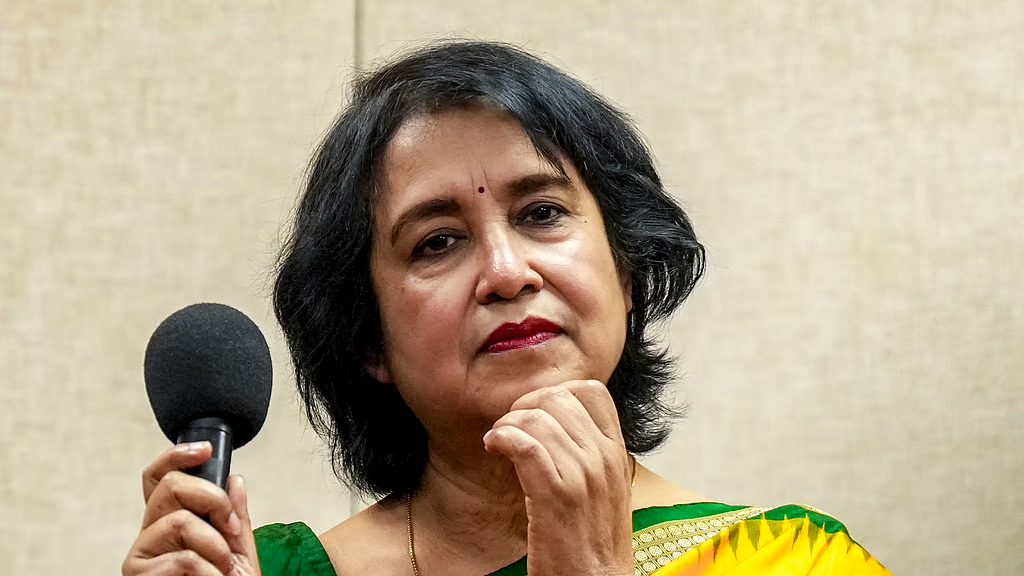
Kolkata, August 3: Exiled Bangladeshi author, physician, and human rights activist Taslima Nasrin has reignited debate over secularism, religious education, and civil rights after strongly advocating the implementation of a Uniform Civil Code (UCC) across South Asia and calling for the abolition of madrasas, which she controversially described as “jihadi factories.” Speaking at a press conference in Kolkata during her first public visit to the city in nearly two decades, Nasrin reiterated positions she says she has maintained for more than 40 years while also addressing issues relating to women’s rights, India-Bangladesh relations, and recent political developments in the region.
Nasrin’s remarks have once again placed her at the center of discussions surrounding secular governance, freedom of expression, and the role of religious institutions in society. The exiled writer, whose works have long attracted both admiration and controversy, emphasized that her advocacy stems from her belief in equal civil rights and the need for secular legal systems that treat all citizens alike regardless of religion.
Table of Contents
A Return to Kolkata After Nearly Two Decades
The press conference marked Nasrin’s first significant public appearance in Kolkata in almost 19 years. The city has held a special place in her life, as she lived there after leaving Bangladesh before being forced to leave in 2007 following widespread protests over her writings.
Reflecting on her return, Nasrin compared her experiences under successive governments in West Bengal and expressed gratitude to Suvendu Adhikari, Leader of the Opposition in the West Bengal Assembly, for facilitating her security arrangements during the visit.
She also remarked that she believes the current BJP-led central government supports freedom of speech, although she stated that she had not yet decided whether she would remain in Kolkata for an extended period.
Her return carries symbolic significance for many supporters who view Kolkata as a city historically associated with literary freedom and intellectual debate.

Four Decades of Advocacy for Uniform Civil Code
One of the central themes of Nasrin’s address was her continued support for a Uniform Civil Code, a subject she said has remained at the heart of her activism for over four decades.
“I have been fighting for the UCC for the past 40 years. This is much needed in any civilised country,” she told journalists.
The Uniform Civil Code refers to the idea of replacing religion-specific personal laws governing matters such as marriage, divorce, inheritance, and adoption with a common set of civil laws applicable to all citizens regardless of their faith.
Supporters argue that a UCC promotes equality before the law and strengthens secular governance, while critics contend that such reforms must carefully balance constitutional guarantees of religious freedom and cultural diversity.
Although discussions around the UCC have gained renewed political attention in India in recent years, Nasrin said she believes similar principles should extend across South Asia.
Women’s Rights at the Center of Her Argument
Nasrin linked her advocacy for a Uniform Civil Code directly to women’s rights, particularly in Bangladesh.
According to her, religion-based personal laws continue to deny equal rights to many women, especially in matters related to marriage and divorce.
She alleged that Hindu women in Bangladesh still lack fundamental legal protections, including equal access to divorce rights.
Throughout her career, Nasrin has consistently argued that legal systems should prioritize gender equality over religious traditions whenever the two come into conflict.
Her writings, essays, and public speeches have frequently focused on women’s empowerment, secularism, and the need for reforms aimed at protecting vulnerable communities.
Calls for Abolition of Madrasas
Among the most debated aspects of her press conference were her remarks regarding madrasas.
Nasrin called for the complete abolition of the institutions, claiming they should instead be transformed into secular schools.
During her remarks, she described madrasas as “jihadi factories,” alleging that hatred toward Hindus is taught in some religious institutions and mosques.
The comments are likely to generate significant political and public debate given the sensitive nature of discussions surrounding religious education.
Madrasas across South Asia vary considerably in curriculum, administration, and educational models. While many primarily focus on Islamic religious studies alongside general education, critics and supporters have long debated the role of religious schools within modern education systems.
Nasrin argued that educational institutions should emphasize secular values and scientific learning rather than religious instruction.
Reflections on India-Bangladesh Relations
Beyond domestic political issues, Nasrin also commented on bilateral ties between India and Bangladesh.
She expressed hope that relations between the neighboring countries would remain positive despite emerging regional challenges.
“We always acknowledge what India did for us in 1971,” she said, referring to India’s support during Bangladesh’s Liberation War.
She added that while many Bangladeshis continue to value India’s historical role, extremist elements remain opposed to closer ties between the two nations.
Her comments reflected broader concerns regarding regional security and the influence of extremist ideologies in South Asia.
Remarks on Student Movements and Regional Politics
Nasrin also drew comparisons between recent protests in India and the student movement in Bangladesh.
Referring to protests organized by the Cockroach Janata Party (CJP) in Delhi, she said a video clip reminded her of the movement that unfolded in Bangladesh.
According to Nasrin, she believes extremist groups were involved in influencing the protests in Bangladesh.
“I saw a small clip of the CJP protest. It looked like the student movement in Bangladesh through which we were fooled. We witnessed that jihadis were behind the student movement in Bangladesh,” she said.
These remarks reflect her broader concerns regarding political mobilization and ideological influence in public movements.
A Life Marked by Controversy and Exile
Taslima Nasrin remains one of South Asia’s most internationally recognized yet controversial literary figures.
Born in Bangladesh, Taslima Nasrin first gained prominence through her novels, essays, and newspaper columns focusing on women’s rights, religious extremism, and secularism.
Taslima Nasrin’s 1993 novel Lajja (Shame) attracted widespread international attention by depicting the persecution of a Hindu family following communal violence in Bangladesh.
The publication led to severe backlash from religious groups, multiple legal challenges, and threats to Taslima Nasrin’s safety.
In 1994, Taslima Nasrin left Bangladesh after facing increasing hostility and has since lived in exile in several countries.
Despite spending years outside her homeland, Taslima Nasrin has continued writing extensively on issues involving freedom of expression, minority rights, gender equality, and secular governance. According to Taslima Nasrin, protecting secular values and equal rights remains essential for building inclusive and democratic societies.
Freedom of Expression Remains a Central Theme
Throughout her public career, Taslima Nasrin has repeatedly argued that freedom of speech is fundamental to democratic societies.
Taslima Nasrin has frequently criticized censorship, political intimidation, and restrictions placed on writers, journalists, and activists.
During her Kolkata visit, Taslima Nasrin suggested that public discourse should remain open even when opinions provoke disagreement or controversy. Taslima Nasrin has consistently maintained that writers and intellectuals should be free to express their views without fear of intimidation or violence.
Supporters view Taslima Nasrin as a courageous defender of free expression, while critics argue that some of Taslima Nasrin’s statements can be deeply polarizing.
The Broader Debate Around Secularism
Nasrin’s latest comments have once again highlighted the broader debate surrounding secularism in South Asia.
Countries across the region continue to grapple with balancing religious freedom, constitutional rights, minority protections, and equal treatment under the law.
The discussion surrounding the Uniform Civil Code remains particularly significant because it touches upon questions involving legal reform, gender equality, cultural identity, and constitutional principles.
Similarly, debates over religious education continue to evoke strong opinions among policymakers, academics, religious leaders, and civil society organizations.
Nasrin’s intervention adds another prominent voice to these ongoing discussions, particularly given her decades-long advocacy for secular governance.

As Taslima Nasrin returns to Kolkata after nearly two decades, her remarks have once again sparked conversations extending far beyond literature. Her calls for a Uniform Civil Code across South Asia, criticism of religion-based personal laws, advocacy for women’s rights, and controversial comments regarding madrasas are likely to remain subjects of public and political debate in the coming weeks.
Whether one agrees or disagrees with her positions, Nasrin continues to be one of South Asia’s most influential and outspoken public intellectuals on issues of secularism, gender justice, and freedom of expression. Her latest appearance in Kolkata serves as another reminder of the enduring relevance—and controversy—of the debates she has championed throughout her career.